Bart Layton’s Los Angeles heist film is handsomely built, patiently paced and cast far better than it needed to be. It has also watched Heat a great many times, and at 141 minutes we felt each viewing.
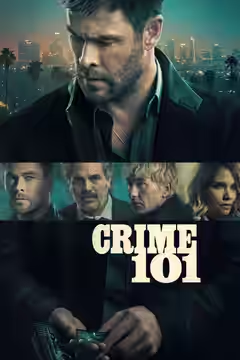
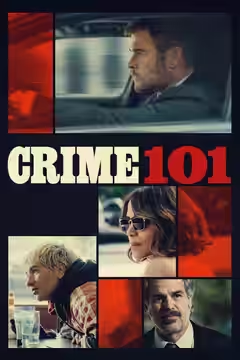
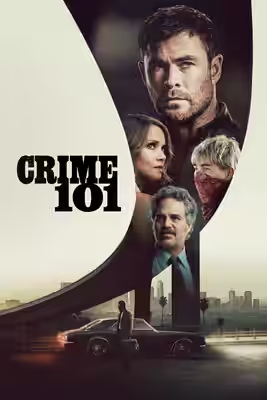
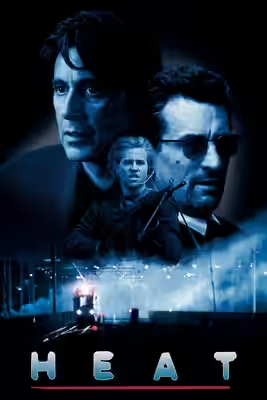
Bart Layton made his name with The Imposter (2012) and American Animals (2018), two films that kept interrupting their own stories to let the real people talk. Crime 101 has no interruptions. It is a Los Angeles heist thriller, adapted by Layton from Don Winslow’s novel, and played straight: a thief, a detective, a woman between them, a last job. It is well acted, handsomely made and a good half hour too long, and it owes so much to Heat (1995) that it sometimes forgets it is not in it.
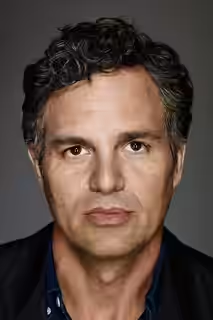
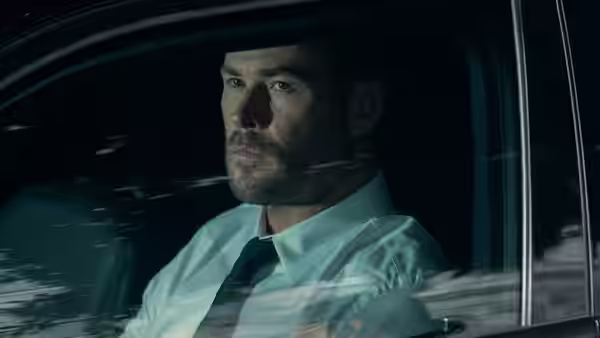
Chris Hemsworth plays Davis, who robs jewel couriers along the freeway with a discipline that borders on the monastic. Hemsworth strips out the grin and most of the voice, and what is left is a large man trying to take up as little room as possible. The coldness is the point, and also the limit, because the film gives him one want and not much else to hold. Mark Ruffalo’s Lou is the detective who has noticed the pattern nobody else wants to see, and Ruffalo plays him as a man who stopped tucking his shirt in some years ago and does not intend to start.
Halle Berry is the best thing in it. Her Sharon sells the insurance on the stones Davis keeps taking, and Berry plays her as someone who is good at her job and has just noticed how little that has bought her. Her scenes with Hemsworth are written as chess and played as something warmer, and they are the only time the film’s ideas about money and worth arrive as behaviour rather than dialogue. Barry Keoghan’s Ormon is a young crook with more appetite than sense, and Keoghan gives him a wet-lipped eagerness we could not look away from.
Erik Wilson shoots the city almost entirely after dark, so that Los Angeles becomes a grid of orange lamps and moving headlights with nobody visible in it. It is a handsome look and a familiar one. Scott Dougan gives Davis rooms with nothing on the walls and Lou rooms with too much, and Jenny Eagan dresses the thief in dark, unmarked clothes that could belong to anyone. Benjamin John Power’s score is a low electronic pulse that rarely resolves, at its best when it drops out and lets a robbery run on breath and traffic noise. Jacob Secher Schulsinger and Julian Hart cut the heists slowly, each step in order, and the chases fast; the contrast is the film’s most confident work.
The first robbery had us leaning forward. It is done almost without dialogue, and Layton lets us understand the plan a beat before it happens, so that when a thing goes right we feel we have done it ourselves. We were surprised how much we cared about a man we knew nothing about. Then, past the halfway mark, two characters sat down to explain to each other what the film was about, and we realised we knew exactly which film we were watching, and it was not this one. The pleasure came back only for the last twenty minutes, which are tense and well staged.
The trouble is the script. Layton the director trusts us; Layton the writer does not, and every idea the images have already handed us is repeated in dialogue, sometimes twice. The film’s thoughts about a city run on money, and about who gets to leave it, are real enough, but they are announced rather than shown. At 141 minutes there is room to lose a subplot or two, and several of a large cast are introduced with ceremony and then given little to do.
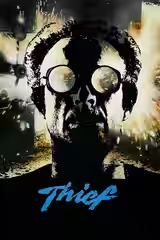
American Animals was about young men who had watched too many heist films. Crime 101 is by a man who has, and has decided to make one anyway. Against Michael Mann’s standard it is a careful copy; against the run of recent thrillers it is a grown-up, well-made one, and there are not many of those.
See it in a cinema if you can, where Wilson’s freeways fill the frame and Power’s score sits in the chest. At home it becomes a smaller, tidier film and its borrowings show more. It runs 141 minutes and carries a 15.