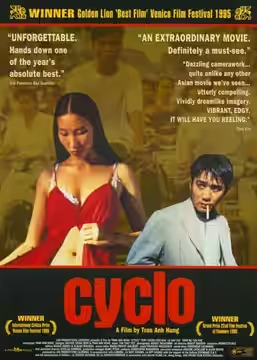
Trần Anh Hùng’s Cyclo is forcefully acted and often disturbing, but its tangled story weakens the characters. It rewards an interest in adventurous crime cinema, provided the graphic cruelty does not put you off.
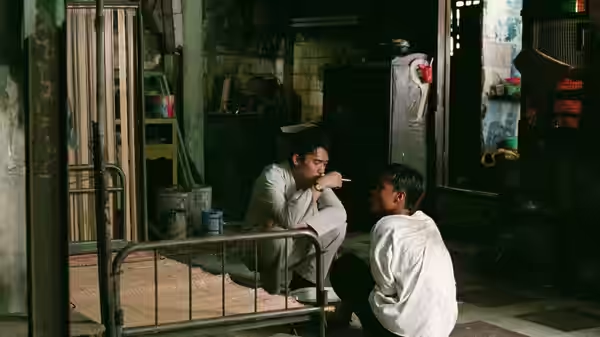
A stolen pedal cab gives Cyclo a plain, practical starting point, but Trần Anh Hùng soon wants more than a story about a man losing his work. His street drama heads towards crime, graphic violence and images that no longer obey everyday reality. The result is often frustrating, with expressive performances struggling against convoluted storytelling. We would recommend it to patient admirers of visually adventurous crime films, with a firm warning about the violence.
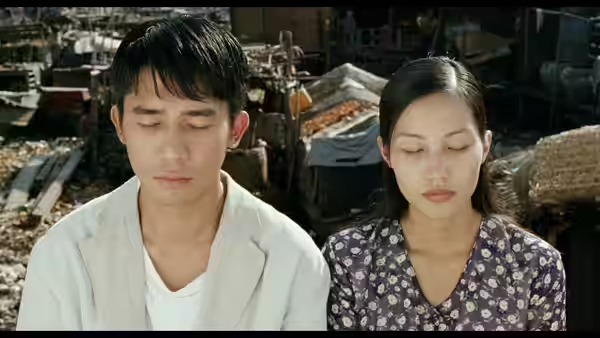
Le Van Loc is the reason the film’s early simplicity works. He makes the stolen cab matter as a piece of working equipment, and his vulnerability gives the story a person to care about before the more elaborate plotting takes over. Tony Leung brings a heavier, more troubling presence to Poet. Their performances have enough feeling to keep us watching through passages in which the script’s idea of a character is much less convincing.
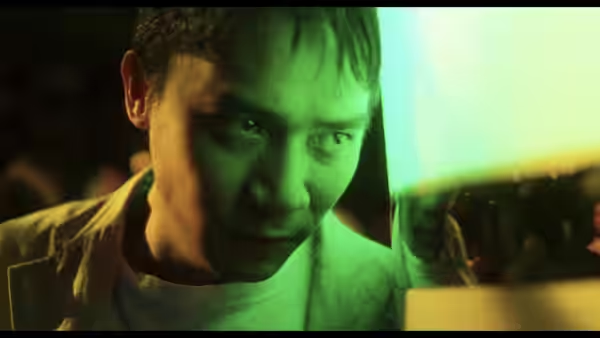
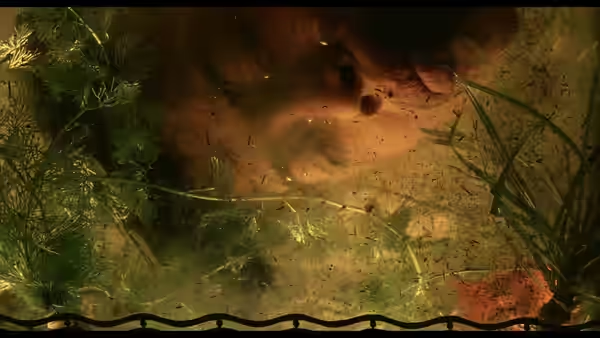
Benoît Delhomme’s cinematography makes the departure from everyday reality convincing, particularly when blood appears on the scale of a river. We were horrified by the sheer quantity of it. The exaggeration makes violence seem impossible to escape, even though the image has left realism behind. But the repeated emphasis on cruelty is harder to defend, because it gradually makes each new outrage less affecting.
The editing is credited to Benoît Delhomme, Nicole Dedieu and Claude Ronzeau, and the joins between episodes are where the film is weakest. We spend too much time working out how one passage bears on another. Tôn-Thât Tiêt’s music adds to the unease, but a score cannot supply the missing clarity about what people want or why they act. Some uncertainty is useful in a crime film; here, it repeatedly distracts from the performances.
As writer, Trần Anh Hùng also puts too much pressure on his characters to be strange. They can feel arranged for the next disturbing encounter, without enough ordinary behaviour to make that encounter matter. The actors do much to compensate, and the sense of people living under pressure remains persuasive. Yet the screenplay too often uses another shock when it needs to give someone a clearer motive or a little more time.
The move away from a straightforward street drama is still worth defending. A crime film need not explain every transaction, and a smooth account of this theft would probably lose much of what makes Cyclo unsettling. Its stranger images try to convey a life in which the next threat cannot be neatly anticipated. The difficulty is that the gaps between scenes often draw attention away from the lives the film is asking us to consider.
There is enough care in the photography and enough feeling in the acting to make the film worth considering despite those frustrations. At 123 minutes, though, its insistence becomes tiring. If graphic violence usually puts you off, the craft is not a reason to make an exception.