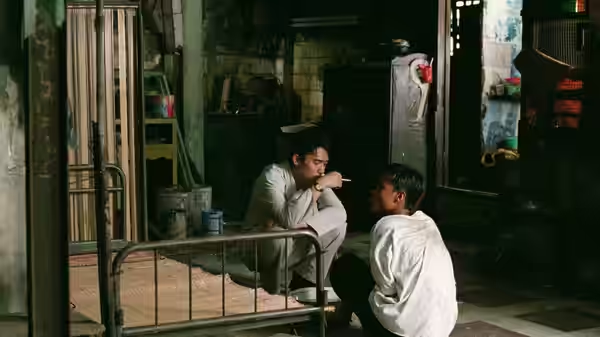
A crouching man speaks to another man seated beside a metal bed in a cramped room
Film review

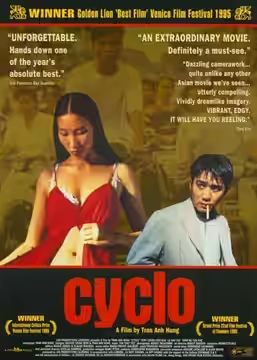
Cyclo

1995 · Directed by Trần Anh Hùng · 2h 03m

In a sentenceThe stolen pedal cab is easier to keep track of than the plot

Cyclo (Le Van Loc) has his pedal cab stolen, taking away the vehicle he relies on for work. Around him are Sister (Trần Nữ Yên Khê), Grandfather (Le Kinh Huy), Poet (Tony Leung) and Madam (Như Quỳnh). The theft makes earning a living an immediate problem, and getting back to ordinary work is no simple matter. What begins with a missing vehicle develops into a crime story, as Cyclo’s practical difficulties become caught up in the violence of street life.

Fi1m review

Trần Anh Hùng’s Cyclo is forcefully acted and often disturbing, but its tangled story weakens the characters. It rewards an interest in adventurous crime cinema, provided the graphic cruelty does not put you off.

A stolen pedal cab gives Cyclo a plain, practical starting point, but Trần Anh Hùng soon wants more than a story about a man losing his work. His street drama heads towards crime, graphic violence and images that no longer obey everyday reality. The result is often frustrating, with expressive performances struggling against convoluted storytelling. We would recommend it to patient admirers of visually adventurous crime films, with a firm warning about the violence.

Le Van Loc is the reason the film’s early simplicity works. He makes the stolen cab matter as a piece of working equipment, and his vulnerability gives the story a person to care about before the more elaborate plotting takes over. Tony Leung brings a heavier, more troubling presence to Poet. Their performances have enough feeling to keep us watching through passages in which the script’s idea of a character is much less convincing.

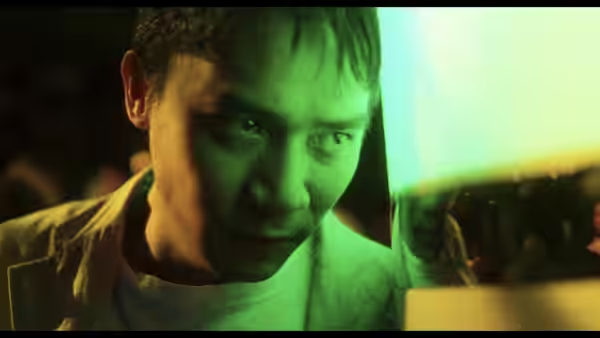
Benoît Delhomme’s cinematography makes the departure from everyday reality convincing, particularly when blood appears on the scale of a river. We were horrified by the sheer quantity of it. The exaggeration makes violence seem impossible to escape, even though the image has left realism behind. But the repeated emphasis on cruelty is harder to defend, because it gradually makes each new outrage less affecting.

The editing is credited to Benoît Delhomme, Nicole Dedieu and Claude Ronzeau, and the joins between episodes are where the film is weakest. We spend too much time working out how one passage bears on another. Tôn-Thât Tiêt’s music adds to the unease, but a score cannot supply the missing clarity about what people want or why they act. Some uncertainty is useful in a crime film; here, it repeatedly distracts from the performances.

As writer, Trần Anh Hùng also puts too much pressure on his characters to be strange. They can feel arranged for the next disturbing encounter, without enough ordinary behaviour to make that encounter matter. The actors do much to compensate, and the sense of people living under pressure remains persuasive. Yet the screenplay too often uses another shock when it needs to give someone a clearer motive or a little more time.

The move away from a straightforward street drama is still worth defending. A crime film need not explain every transaction, and a smooth account of this theft would probably lose much of what makes Cyclo unsettling. Its stranger images try to convey a life in which the next threat cannot be neatly anticipated. The difficulty is that the gaps between scenes often draw attention away from the lives the film is asking us to consider.

There is enough care in the photography and enough feeling in the acting to make the film worth considering despite those frustrations. At 123 minutes, though, its insistence becomes tiring. If graphic violence usually puts you off, the craft is not a reason to make an exception.

Critical consensus AI synthesised

63
Positive
1
Mixed
4
Negative
1

The reviews lean towards a mixed response to Cyclo, with praise clustering around its images and performances rather than its storytelling. Critics who offer an accessible assessment consistently admire the camerawork, while several single out the acting for its intensity and expressiveness. The film’s unsettling departures from realism also earn appreciation, though enthusiasm for its visual invention does not always extend to its characters. Two of the six available entries provide no accessible verdict, limiting how firmly we can describe the consensus.

The clearest divide concerns whether the craft compensates for convoluted plotting and graphic violence. Radio Times offers an unreserved endorsement, praising Le Van Loc and the uncompromising depiction of street life. Variety takes the opposing view, admiring the meticulous filmmaking but finding the disjointed story pretentious. Between those positions, reservations centre on contrived characterisation, confusing storytelling and cruelty that some critics find difficult to accept.

Radio Times
★★★★★ · David Parkinson
100

The critic calls the film a stunning achievement and an uncompromising portrait of street life. They praise Le Van Loc’s performance and the exceptional camerawork.

Read the full review →
The New York Times
12 October 1995 · festival review
64*

The accessible page shell does not reveal the critic’s verdict. It provides no details about what the review praises or criticizes.

Read the full review →
Time Out
· GA
64*

The available page does not reveal the critic’s verdict. Its description identifies the stolen pedal cab as central to the story, but provides no accessible criticism to assess.

Read the full review →
Slant Magazine
18 February 2004 · ★★½/4 · Eric Henderson
62

Henderson finds the film an imaginative, unsettling departure from its apparent neorealist setup, though its characterizations can feel contrived. He praises its striking visual flourishes, especially the surreal images of a burned-out helicopter and rivers of blood.

Read the full review →
Empire
1 January 2000 · Louise Brealy
50*

The review finds Cyclo superbly acted and brilliantly shot, but structurally convoluted and often unpleasantly violent. It particularly praises the expressive acting while criticizing the confusing storytelling and graphic cruelty.

Read the full review →
Variety
11 September 1995 · festival review · David Rooney
40*

Rooney finds the film visually accomplished but narratively compromised by convoluted, pretentious plotting. He praises its meticulous craftsmanship, intense performances, and striking imagery, while faulting the disjointed story.

Read the full review →

Straight answers AI written, from our review

Is Cyclo worth watching?
Cyclo is worth considering for patient admirers of visually adventurous crime films, and we score it 66 out of 100. We find enough feeling in the performances and care in the photography to reward that interest, but the tangled storytelling becomes tiring and the graphic cruelty is a substantial reservation.
How long is Cyclo, and what is it rated?
Cyclo runs 2h 03m. It is a drama and crime film.
Where can I watch Cyclo in Panama?
Cyclo is not on any streaming or rental service in Panama at the moment. Availability is checked daily.
How violent or frightening is Cyclo, and is it suitable for children?
Cyclo has a UK 18 certificate and contains graphic violence and repeated cruelty, making it unsuitable for children. We find its exaggerated images of blood horrifying, while the music adds to the unease; for squeamish viewers, the acting and photography are not reasons to make an exception.

How does Cyclo compare to Bicycle Thieves?
Cyclo is the more disturbing and narratively tangled of the two films; we recommend Bicycle Thieves more warmly for its moving father-son performances. Both begin with a stolen vehicle that someone needs for work, but Cyclo moves towards graphic crime and images beyond everyday reality, making it better suited to an appetite for unsettling, adventurous cinema.
What should I watch after Cyclo?
After Cyclo, try Bicycle Thieves (1948, Fi1m 93): A stolen working vehicle brings a family’s precarious finances into painful focus. Then Pixote (1980, Fi1m 88): Street survival and crime, with young performances that make the cruelty matter; and Pickpocket (1959, Fi1m 84): A quieter, more controlled study of crime through one isolated young man.

Cast

Awards

Venice Film Festival, 1995

Won
Golden Lion

If you liked this, try…

  1. Bicycle Thieves (1948, Fi1m 93)A stolen working vehicle brings a family’s precarious finances into painful focus.

  2. Pixote (1980, Fi1m 88)Street survival and crime, with young performances that make the cruelty matter.

  3. Fallen Angels (1995) · not on Fi1m yetFractured city lives, nocturnal crime and a stronger appetite for reckless humour.

  4. Pickpocket (1959, Fi1m 84)A quieter, more controlled study of crime through one isolated young man.

  5. A Touch of Sin (2013) · not on Fi1m yetEconomic desperation turns violent across several lives, with similarly forceful imagery.