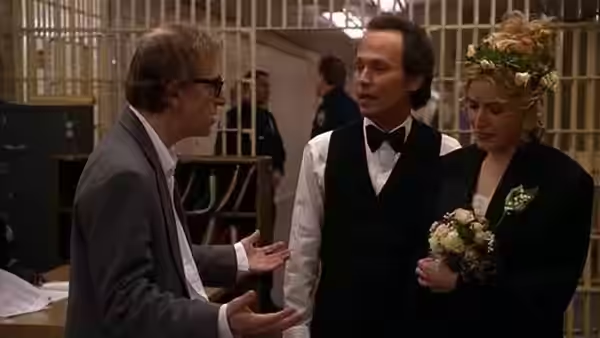
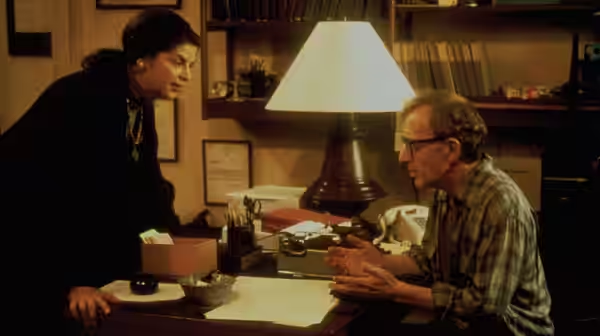
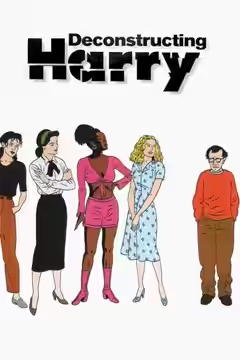
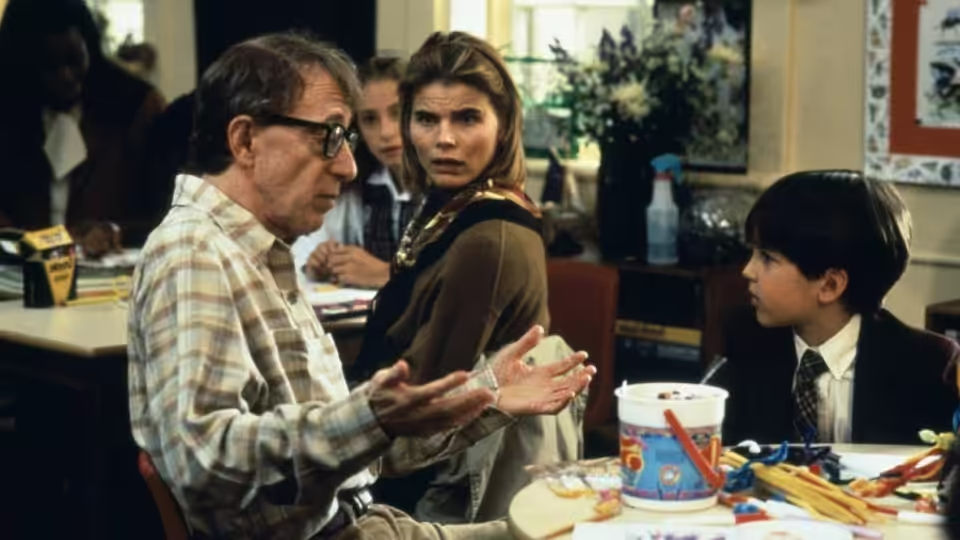
Harry (Woody Allen) gestures across a restaurant table as a woman and boy watch
Film review

Deconstructing Harry

1997 · Directed by Woody Allen · 1h 36m

In a sentenceA novelist makes enemies of his friends and somehow finds himself the most interesting victim

Harry Block (Woody Allen) has a bestseller built from the lives of his best friends, and those friendships are now at risk. What reaches the page as fiction remains personal to the people supplying the material. Lucy (Judy Davis), Joan (Kirstie Alley) and Fay Sexton (Elisabeth Shue) are among the characters in a story that moves between Harry’s life and his inventions. His writing gives him a successful book; it also gives the people around him reasons to turn against him. Harry has to face their objections to what he makes of them.

Plays from YouTube when you press play; nothing loads from them until then.

Fi1m review

Woody Allen’s sour comedy is funny enough to make its difficult company worthwhile. The shifts between a writer’s life and his fiction are sharply handled, but the women are too often left arguing with him.

Deconstructing Harry is a funny, sour comedy worth seeing if we can tolerate a film that gives its most objectionable man so much room to talk. Woody Allen, who writes, directs and plays Harry Block, makes a novelist’s use of his friends the starting point for a dispute about who gets to tell their stories. A bestseller is a considerable consolation when those friends turn against him. The script lets their complaints register. It is less generous about giving the complainants lives beyond their complaints.

Harry’s lived and invented experiences keep interrupting one another, so the film asks us to keep checking whose version we are watching. Susan E. Morse’s editing makes those changes brisk and readable without removing their capacity to unsettle. The interruptions often improve a joke by denying Harry the comfortable pause in which an excuse might start to sound reasonable. At 96 minutes, the film has enough pace to stop this fractured storytelling becoming a lecture about the difficulty of being a writer.

We laughed, then felt slightly ashamed of ourselves, because Harry’s conversion of friendship into saleable material is funny even when the people he uses object. The ensemble scenes allow irritation to build instead of merely providing him with appreciative listeners. Judy Davis as Lucy and Kirstie Alley as Joan give the comedy a useful resistance to Harry’s self-importance. Harry is most interesting when the exchanges allow us to hear how inadequate his excuses are.

Carlo Di Palma’s cinematography and Santo Loquasto’s production design help the shifts between experience and invention remain easy to follow. Neither contribution turns the fictional passages into a separate attraction that delays the comedy. The images leave us free to attend to the performers and to the collision between what Harry writes and what his friends resent. That restraint works, although the cutting supplies more of the film’s character than the individual settings do.

The weakness is the writing of women. The film is willing to expose Harry’s selfishness, but too often a woman’s anger matters chiefly because it supplies another problem for him. The performances make that anger audible; the script does less to make the women interesting when they are not reacting to Harry. We do not need him to become decent. The repeated emphasis on his difficulties simply makes several of the arguments feel alike.

As a comedy about a writer, it is stronger whenever Harry’s predicament produces a scene instead of another excuse. The chaotic car journey gives the film welcome movement and lets the jokes develop through disorder. We would happily have had more of that and less repetition in the personal disputes. Woody Allen remains good at finding comic possibilities in Harry’s confusion, even when we have heard enough of Harry himself.

Those reservations need not make the evening a punishment. There is enough comic invention, and enough pleasure in the abrupt turns between life and fiction, to justify spending time with this difficult company. The cast’s timing keeps the arguments funny after their substance has begun to repeat. Choose it for the sour jokes and the brisk editing; leave it alone if another self-absorbed writer is more than the evening can bear.

Critical consensus AI synthesised

62
Positive
4
Mixed
4
Negative
2

The reviews lean cautiously favourable, though agreement is stronger on the film’s dark humour and formal invention than on its merits as a whole. Praise centres on the shifts between Harry’s real and fictional lives, the clarity of the complicated storytelling and the willingness to leave its protagonist unredeemed. The Independent particularly admires the brisk storytelling, inventive editing and sharp ensemble scenes. Supporters find the comedy painfully self-critical, with several praising its ability to make uncomfortable material funny.

The spread is wide, and the treatment of women is a dividing point. Empire finds laughs but is disturbed by Allen’s scathing treatment of women and his own neuroses. The AV Club goes much further, finding sexist characterisation, self-indulgence and too few laughs to compensate. Elsewhere, reservations concern familiarity and abrasiveness: qualities that admirers accept as part of the film’s risk-taking, rather than reasons to dismiss it.

The Independent
4 April 1998 · David Thomson
90*

Thomson praises the film as an assured, richly constructed achievement and argues that Allen is a major director. He singles out the film’s brisk, lucid storytelling, inventive editing, and sharp ensemble scenes for praise.

Read the full review →
IndieWire
11 January 2007 · robbiefreeling
75*

The critic finds the film endlessly funny, unusually dark, and refreshingly unwilling to redeem its protagonist. They single out its painful, self-lacerating humor and disorienting shifts between reality and fiction.

Read the full review →
Variety
7 September 1997 · festival review · David Stratton
75*

Stratton finds the film provocative, funny and challenging, though its abrasive comedy may divide audiences. He especially praises how clearly Allen handles the film’s complex, shifting structure.

Read the full review →
RogerEbert.com
64*

The URL identifies a review of the specified film, but the page content is unavailable. The browser-check page provides no critic verdict or praise to summarize.

Read the full review →
The New York Times
12 December 1997 · Janet Maslin
64*

The page appears to be a review, but its text is inaccessible. I cannot verify the critic’s verdict or what the review singles out.

Read the full review →
Time Out
· GA
64*

The page identifies this as a review, but its text is unavailable, so the critic’s verdict cannot be determined. No specific praise or complaint is accessible.

Read the full review →

Straight answers AI written, from our review

Is Deconstructing Harry worth watching?
Deconstructing Harry is worth watching for its sour jokes and brisk shifts between a novelist’s life and fiction; we score it 72 out of 100. The cast keeps the arguments funny, but the women are too often reduced to complaints about Harry, and his self-absorption can become tiring.
How long is Deconstructing Harry, and what is it rated?
Deconstructing Harry runs 1h 36m. It is a comedy and drama film.
Where can I watch Deconstructing Harry in Ukraine?
Deconstructing Harry is not on any streaming or rental service in Ukraine at the moment. It is available in 9 other countries; change your country at the top of the page to see where. Availability is checked daily.
How violent or frightening is Deconstructing Harry, and is it suitable for children?
Deconstructing Harry carries a US R certificate, so we would not recommend it for children. That rating signals adult viewing, but we cannot give a specific warning about violence or frightening material here; our review describes sour comedy and personal disputes rather than assessing those elements.
How does Deconstructing Harry compare to Barton Fink?
Deconstructing Harry is the better fit for sour personal arguments, while we recommend Barton Fink for a more unnerving comedy about an unhappy writer. Both find professional success little help with personal confusion, and both grow repetitive; Harry’s brisk shifts between life and fiction provide a particular comic pleasure.
What should I watch after Deconstructing Harry?
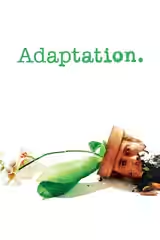
After Deconstructing Harry, try Barton Fink (1991, Fi1m 83): Another writer discovers that professional success offers little protection from personal confusion. Then 8½ (1963, Fi1m 86): A filmmaker’s stalled work spills into fantasies, memories and troublesome personal relationships; and Adaptation. (2002, Fi1m 83): A blocked writer’s anxieties become the machinery of an increasingly unruly comedy.

Cast

Awards

Academy Awards, 1998

Nominated
Best Writing, Original Screenplay

European Film Award for Best Non-European Film, 1998

Nominated
European Film Award for Best Non-European Film

If you liked this, try…

  1. Barton Fink (1991, Fi1m 83)Another writer discovers that professional success offers little protection from personal confusion.

  2. 8½ (1963, Fi1m 86)A filmmaker’s stalled work spills into fantasies, memories and troublesome personal relationships.

  3. Adaptation. (2002, Fi1m 83)A blocked writer’s anxieties become the machinery of an increasingly unruly comedy.

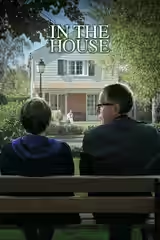
  4. In the House (2012) · not on Fi1m yetWriting about other people becomes a dangerous pleasure in this sly French comedy.

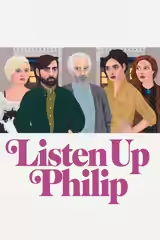
  5. Listen Up Philip (2014) · not on Fi1m yetAnother successful writer makes poor company, with more attention paid to those around him.