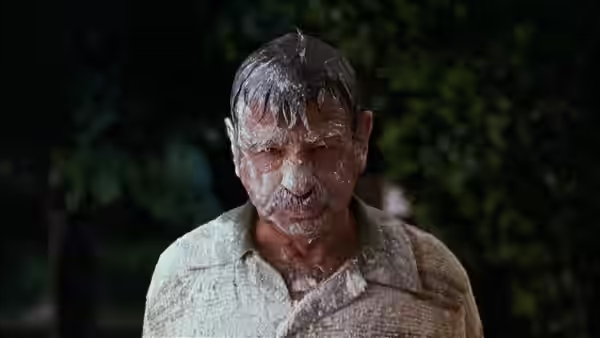
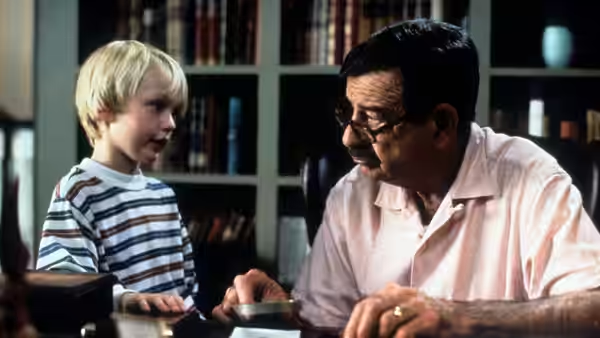
Dennis Mitchell (Mason Gamble) runs between shrubs in a garden
Film review

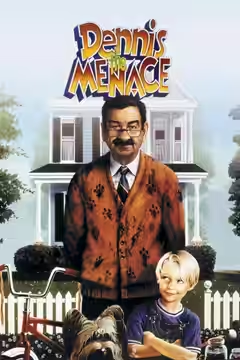
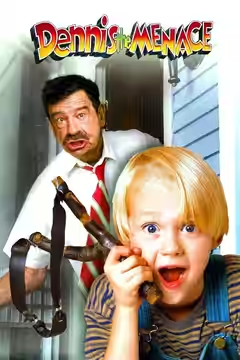
Dennis the Menace

1993 · Directed by Nick Castle · 1h 36m

In a sentenceWalter Matthau being slowly destroyed by a five-year-old, and that is the whole film and nearly enough

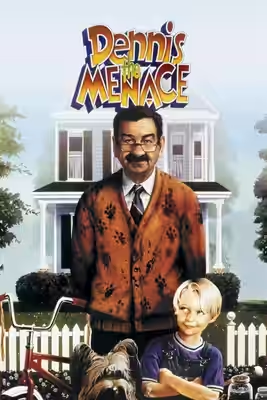
Summer in a leafy American suburb. Dennis Mitchell (Mason Gamble) is five, blond, devoted to his slingshot and even more devoted to the elderly neighbour he keeps nearly killing. Mr Wilson (Walter Matthau) wants his garden and his quiet. His wife Martha (Joan Plowright) adores the boy. When Dennis’s parents Alice (Lea Thompson) and Henry (Robert Stanton) both have to work and every babysitter in town turns him down, the Wilsons are talked into having him for the day. Dennis sets about the house. Along the railway line, meanwhile, a tramp called Switchblade Sam (Christopher Lloyd) walks into town, pocketing whatever he passes.

Plays from YouTube when you press play; nothing loads from them until then.

Fi1m review

John Hughes’s version of Hank Ketcham’s comic strip is gentle, sunlit and thin, and it has one real asset: Walter Matthau, who turns a cartoon grouch into an actual man. Christopher Lloyd’s tramp belongs in a different and nastier film.

Hank Ketcham drew Dennis the Menace as a newspaper strip for decades: a small boy, a slingshot, a neighbour who wanted to be left alone. John Hughes, who wrote and produced this, has made the obvious film from it and then bolted on a villain, because three years earlier Home Alone taught him that a small boy and a burglar sell tickets. The result is gentle, sunny and thin, and it has one real asset. Walter Matthau is on screen for most of its 96 minutes, and whenever he is, the film is fine.

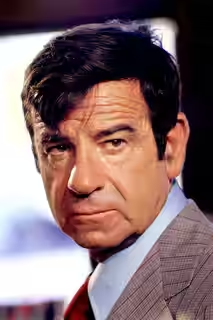
Matthau plays Mr Wilson not as the strip’s cartoon but as a man. He has his garden and his wife, and he regards the boy next door as weather: something that arrives, does damage and cannot be reasoned with. His face is the film. Whenever one of Dennis’s pranks lands, Matthau takes a full three seconds to work out what has happened, and that delay is where the laughs are; we laughed out loud, properly, in a way the rest of the film rarely manages. He is also allowed to be unkind to the child, and the film is braver for it.

Joan Plowright gives Martha the warmth that makes Wilson’s grumbling bearable, and the two of them have the timing of people who have been married for decades and know which arguments are worth having. Mason Gamble, as Dennis, is a sweet, round-faced five-year-old who says his lines clearly and looks where he is told. At that age that is not a small achievement, and it is also not quite a performance; the strip’s Dennis was a force of nature and this one is mostly a nice boy. Lea Thompson and Robert Stanton, as his parents, have little to do except need a babysitter.

Nick Castle directs it like a Saturday afternoon. Thomas E. Ackerman shoots the neighbourhood in soft, even sunshine, with lawns the green of a seed packet and not a cloud anywhere. James D. Bissell fills Wilson’s house with china, doilies and polished wood, so that every surface is something Dennis can break, and makes the garden a small fussy kingdom with the greenhouse at its heart. Ann Roth and Bridget Kelly put Dennis in the strip’s striped shirt and dungarees and Wilson in cardigans buttoned to the neck. Jerry Goldsmith’s score is light and chattering, woodwind and pizzicato, and it does the job of telling us a prank is coming; it is pleasant and a little busy. Alan Heim keeps the gags short, which is a mercy.

Then there is Christopher Lloyd. Switchblade Sam walks into town along the railway line in a long black coat, with a face the colour of old newspaper and teeth to match, lifting things from washing lines and children’s pockets. Lloyd plays him with no wink at all. We found him properly unpleasant, and we were some minutes in before we realised the film thought he was funny. He is a figure from a grimmer picture dropped into this one. The second half takes his story where you would expect, into Home Alone territory, and we will leave it there, except to say that the slapstick is heavier than anything the film has earned, and the mildness that made the first hour pleasant starts to look like a shortage of ideas.

Hughes’s script has a handful of good jokes, most of them given to Matthau, and a great many scenes that are simply a boy doing something and an adult reacting. Margaret Wade (Amy Sakasitz), the bossy girl who wants Dennis to play husband, is the one child in it with any edge, and the film uses her twice and forgets her. Compared with the strip, which had one panel and a last line that landed, the film sprawls; compared with Home Alone, it is kinder and far less funny.

It runs 96 minutes and carries a PG, and for a child under eight it will do nicely; the pranks are harmless and the garden is a lovely place to spend an afternoon. Adults will spend the time watching Matthau and wishing the film had trusted him to be enough. He nearly was.

Critical consensus AI synthesised

57
Positive
1
Mixed
5
Negative
1

Most critics land on mixed, and the agreement is almost entirely about one man. Walter Matthau’s Mr Wilson is the performance the reviews return to: the crotchety neighbour makes Dennis’s scenes work and is, for some, the only real pleasure for an adult in the audience. Beyond him, the praise is faint. The film is called agreeably low-key, a change from the more frenetic children’s comedies of its day, and Mason Gamble’s Dennis is found endearing by some and only just adequate by others.

The reservations gather around the plot, which is called thin, and the jokes, which several find scarce. Empire is the most forgiving, finding it entertaining regardless; Variety is the outlier at the bottom, judging it safe, largely unfunny and suited mainly to the youngest children. The spread is otherwise narrow, with the reviews clustering in the middle, and one or two of the older notices say too little to place with any confidence.

Empire
1 January 2000 · Jenny Cooney
70*

The review finds the film entertaining despite its thin plot. It praises Walter Matthau and Jill Plowright’s comic performances and Mason Gamble’s endearing turn as Dennis.

Read the full review →
Los Angeles Times
25 June 1993 · Peter Rainer
65*

Rainer finds the film tepid but agreeably low-key, with its lack of crassness a welcome change from more frenetic children’s films. He especially praises Walter Matthau’s performance as the crotchety Mr. Wilson, which makes many of Dennis’ scenes work.

Read the full review →
Time Out
· NF
65*

The available metadata presents this as a family comedy adapted from Hank Ketcham’s comic strip, but does not reveal the critic’s overall verdict. It notes John Hughes’s skill with family comedies, while the specific praise or complaint is unavailable.

Read the full review →
The New York Times
25 June 1993
64*

The accessible page does not reveal the critic’s verdict. Its blocked text also prevents identifying anything specifically praised or criticized.

Read the full review →
Radio Times
★★★ · David Parkinson
60

The review finds the film often funny but also painfully poor. It singles out Walter Matthau’s performance as brilliant, while Mason Gamble only just gets by.

Read the full review →
RogerEbert.com
★★/4 · Roger Ebert
50

The review’s verdict and specific praise or complaint cannot be verified from the blocked page. The accessible page contains only a browser check, not the review text.

Read the full review →

Straight answers AI written, from our review

Is Dennis the Menace worth watching?
Dennis the Menace is worth watching for children under eight and for anyone who wants to see Walter Matthau being slowly worn down by a five-year-old; we scored it 56. The pranks are harmless and the suburb is sunny and pleasant, but the film is thin, and adults will spend the time wishing it had trusted Matthau to carry it alone.
How long is Dennis the Menace, and what is it rated?
Dennis the Menace runs 1h 36m. It is a family and comedy film.
Where can I watch Dennis the Menace in Hong Kong?
Dennis the Menace is available to rent from Apple TV from HK$28.00. Availability is checked daily; the links above go straight to each service.
How does Dennis the Menace compare to Home Alone?
Dennis the Menace is the kinder and considerably less funny of John Hughes's two boy-versus-intruder comedies, and Home Alone is the better film. The earlier picture is crueller, its slapstick is timed with more care, and its laughs are earned; here the burglar plot feels bolted on, and Christopher Lloyd's tramp belongs in a grimmer film than the one around him.
Is Dennis the Menace based on a true story or a book?
Dennis the Menace is based on Hank Ketcham's long-running newspaper comic strip, not on a true story. The film keeps the strip's essentials, a small boy, a slingshot and a neighbour who wants his quiet, then adds a villain the strip never needed. You do not need to know the source; where the strip had one panel and a last line, the film sprawls.
What should I watch after Dennis the Menace?
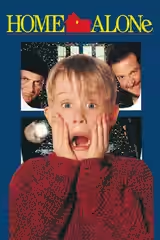
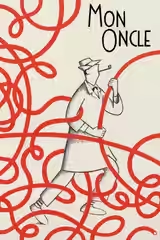
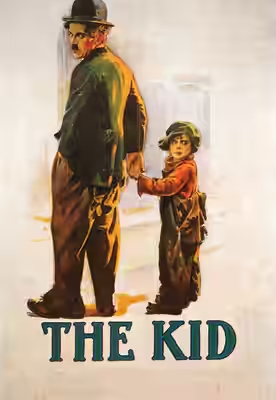
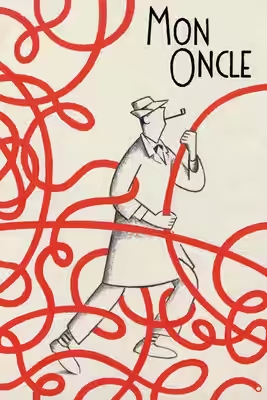
After Dennis the Menace, try Home Alone (1990, Fi1m 80): Hughes’s earlier boy-versus-burglar film, crueller and considerably funnier than this one. Then The Kid (1921, Fi1m 84): Chaplin’s tramp and a small boy; the original and still the tenderest version; and Mon Oncle (1958, Fi1m 82): Tati’s suburban comedy of a boy, an uncle and a house that fights back.

Cast

If you liked this, try…

  1. Home Alone (1990, Fi1m 80)Hughes’s earlier boy-versus-burglar film, crueller and considerably funnier than this one.

  2. The Kid (1921, Fi1m 84)Chaplin’s tramp and a small boy; the original and still the tenderest version.

  3. Mon Oncle (1958, Fi1m 82)Tati’s suburban comedy of a boy, an uncle and a house that fights back.

  4. Up (2009, Fi1m 88)A grouchy widower, an unwanted boy, a garden of sorts; done with real feeling.

  5. Paddington (2014, Fi1m 84)Household chaos caused by a polite small creature, with a neighbour who disapproves.

Free account

Know what to watch tonight

Two lists that know where things are streaming, collections you can share, your own score beside ours, and Discover that remembers what you have seen.

  • Want to see, sorted by what is streaming now
  • Seen, with your score out of ten
  • No adverts, ever