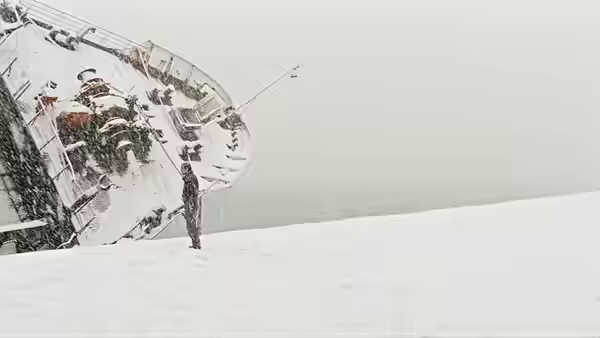
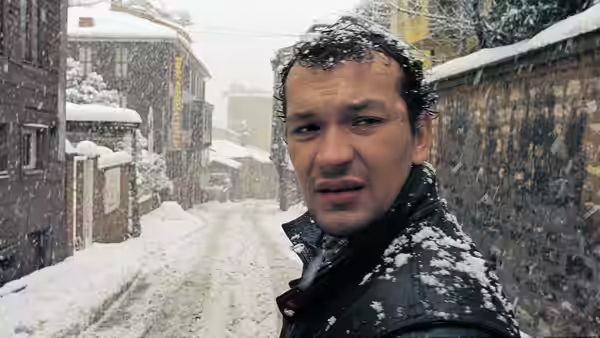
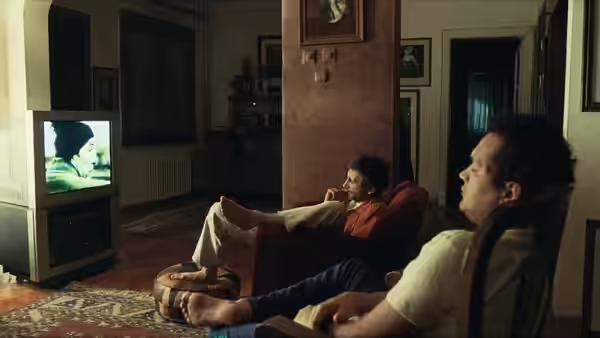
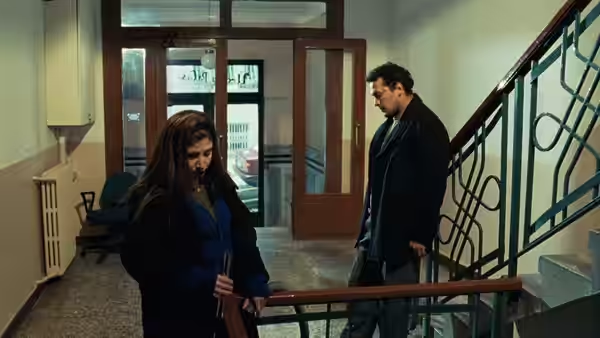
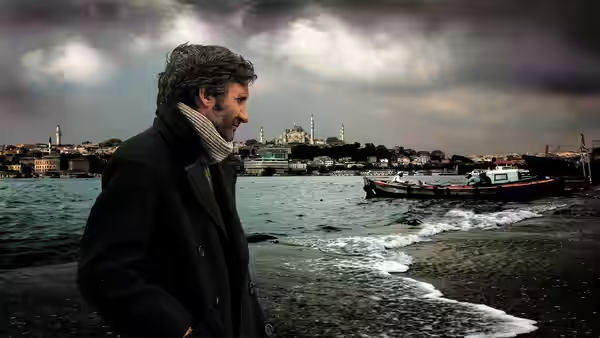
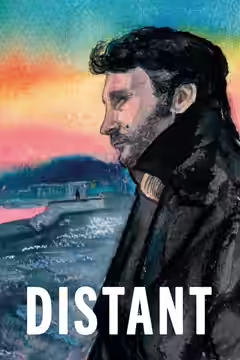
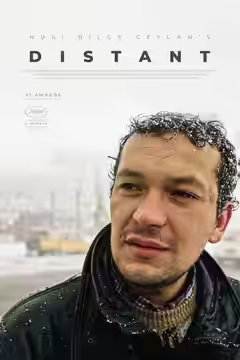
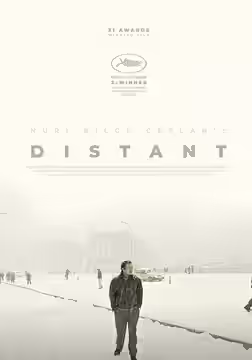
A man stands beside a stranded ship on a snow-covered shore
Film review

Distant

2002 · Directed by Nuri Bilge Ceylan · 1h 46m

In a sentenceWe came to watch two lonely men and found ourselves worrying about a rusting ship

Mahmut (Muzaffer Özdemir) and Yusuf (Mehmet Emin Toprak) are two lonely men whose relationship unfolds through small details and moments of comedy. Nazan (Zuhal Gencer) is also part of the story, alongside a lover (Nazan Kesal) and a janitor (Feridun Koç). The drama moves slowly, leaving time to observe the men and the spaces around them. A rusted, half-sunken ship appears among the expansive views. Attention settles on the characters’ behaviour and on the difficulty of making contact with another person.

Plays from YouTube when you press play; nothing loads from them until then.

Fi1m review

Nuri Bilge Ceylan’s Distant makes two lonely men absorbing company through subtle acting, dry humour and carefully composed images. Its patience occasionally becomes a drag, and some symbolism is blunt, but the feeling holds.

Distant is a quietly moving drama with a stubbornly slow pace, and we recommend it with that qualification. Nuri Bilge Ceylan wants us to pay attention to two lonely men without expecting them to become eloquent about their condition. The interest lies in their relationship, the small details around it and the flashes of comedy that stop their unhappiness becoming oppressive. That is enough to sustain the film, though not every pause earns its length.

Muzaffer Özdemir’s Mahmut and Mehmet Emin Toprak’s Yusuf are compelling because the performances leave us some work to do. Neither actor presses a feeling upon us, and their restraint makes a small alteration in behaviour worth noticing. This is acting that benefits from being watched patiently: we have time to reconsider an impression rather than accept the first expression as the whole person. The humour helps, allowing the men to be recognisably fallible without inviting us to feel superior to them.

Working as his own cinematographer, the director uses expansive framing to make us examine the space around the characters as well as their faces. The compositions are exact, but they rarely feel like an excuse to stop attending to the people inside them. Our eye can wander to a detail and back again, and that freedom matters in a film whose pace could otherwise become coercive. The images ask for concentration without continually advertising what we should think.

The rusted, half-sunken ship is harder to defend as a subtle choice. We felt unexpectedly sad looking at it, because something so large and plainly useless makes its decay difficult to dismiss. Yet it also shows the risk in this approach: an image can suggest so much that it begins to do the characters’ thinking for them. The film is more persuasive when an ordinary detail needs us to notice it than when a metaphor all but announces its meaning.

The editing, shared by Nuri Bilge Ceylan and Ayhan Ergürsel, makes room for this kind of looking, sometimes more room than the scene needs. At 106 minutes, the film is not an ordeal of duration, but there are pauses in which observation gives way to waiting. We do not need a dramatic confrontation every few minutes; we do need the stillness to keep changing what we understand. Some stretches repeat a feeling that the performances have already made clear.

Viewers accustomed to drama that moves from one decisive conversation to the next may find this frustrating. Among films that give priority to observation, it earns its place through the actors’ ability to hold our attention without appearing to ask for it. The humour matters too, keeping the solemnity from becoming a duty and making the men company worth having. Watch it when there is no need to hurry.


Critical consensus AI synthesised

68
Positive
2
Mixed
3
Negative
0
The Guardian
28 May 2004 · Peter Bradshaw
90*

Bradshaw calls the film beautiful, humane and among the year’s best. He especially praises Ceylan’s crystalline compositions and the subtle performances that make the lonely men’s relationship so involving.

Read the full review →
The New Yorker
7 March 2004 · Anthony Lane
70*

Lane finds Distant stately and slow, but ultimately compelling and emotionally resonant. He praises its flashes of comedy and the striking image of a rusted, half-sunken ship.

Read the full review →
Screen Daily
30 April 2003 · Dan Fainaru
64*

The page identifies this as a review, but the critic’s verdict is not visible. The accessible text does not reveal what the critic praises or criticizes.

Read the full review →
The New York Times
12 March 2004
64*

The page is inaccessible, so the critic’s verdict cannot be verified. No praise or complaint can be reliably attributed from the available text.

Read the full review →
Slant Magazine
25 February 2005 · ★★½ · Ed Gonzalez
50

Gonzalez finds the film’s deliberately restrained approach largely effective, though some of its metaphors are too obvious. He praises how the expansive framing and small details draw viewers into the characters’ lives.

Read the full review →

Straight answers AI written, from our review

Is Distant worth watching?
Distant is worth watching if patient, observational drama appeals to you; we score it 73 for its restrained performances, dry humour and quietly moving portrait of two lonely men. The carefully composed images reward attention, but some pauses drag and the symbolism can be blunt, so we recommend it when there is no need to hurry.

How long is Distant, and what is it rated?
Distant runs 1h 46m. It is a drama film.
Where can I watch Distant in South Africa?
Distant is not on any streaming or rental service in South Africa at the moment. It is available in 1 other country; change your country at the top of the page to see where. Availability is checked daily.
How does Distant compare to Late Spring?
Distant and Late Spring both make ordinary relationships absorbing through restrained performances, but we recommend Late Spring more strongly for its emotional force. Its father-and-daughter story makes family pressures painful to watch, while Distant observes two lonely men with dry humour and careful attention to their surroundings; both require patience.
What should I watch after Distant?
After Distant, try Late Spring (1949, Fi1m 92): Another patient drama in which restrained performances make ordinary relationships painfully absorbing. Then Stranger Than Paradise (1984, Fi1m 82): Deadpan company for anyone who finds comedy in people barely managing conversation.

Cast

Awards

International Submission to the Academy Awards, 2004

Nominated
International Submission to the Academy Awards

Cannes Film Festival, 2003

Won
Cannes Film Festival Grand Prix

European Film Award for Best Director, 2003

Nominated
European Film Award for Best Director

European Film Award - People's Choice Award for Best Director, 2003

Nominated
European Film Award - People's Choice Award for Best Director

If you liked this, try…

  1. Late Spring (1949, Fi1m 92)Another patient drama in which restrained performances make ordinary relationships painfully absorbing.

  2. The Green Ray (1986) · not on Fi1m yetLoneliness, awkward company and humour that never quite lets discomfort off the hook.

  3. The Lunchbox (2013) · not on Fi1m yetA warmer route through urban loneliness, with small exchanges carrying considerable feeling.

  4. Stranger Than Paradise (1984, Fi1m 82)Deadpan company for anyone who finds comedy in people barely managing conversation.

  5. Still Life (2006) · not on Fi1m yetHuman lives observed against landscapes that make private disappointments feel harder to escape.