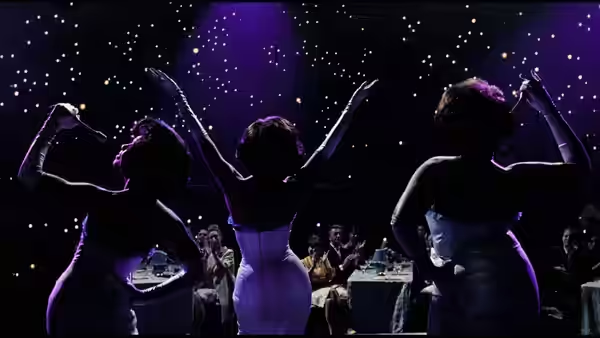
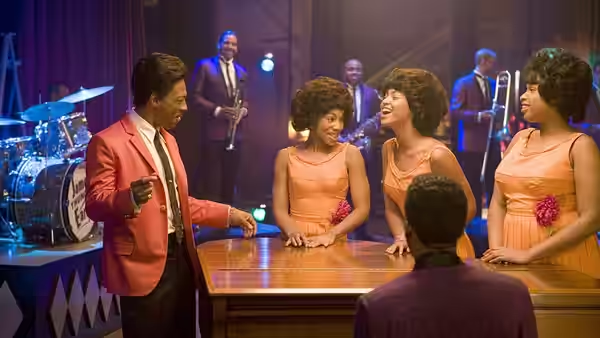
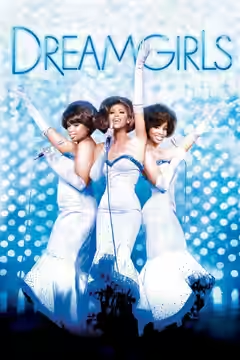
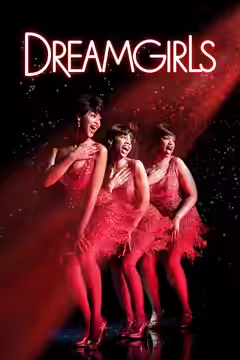
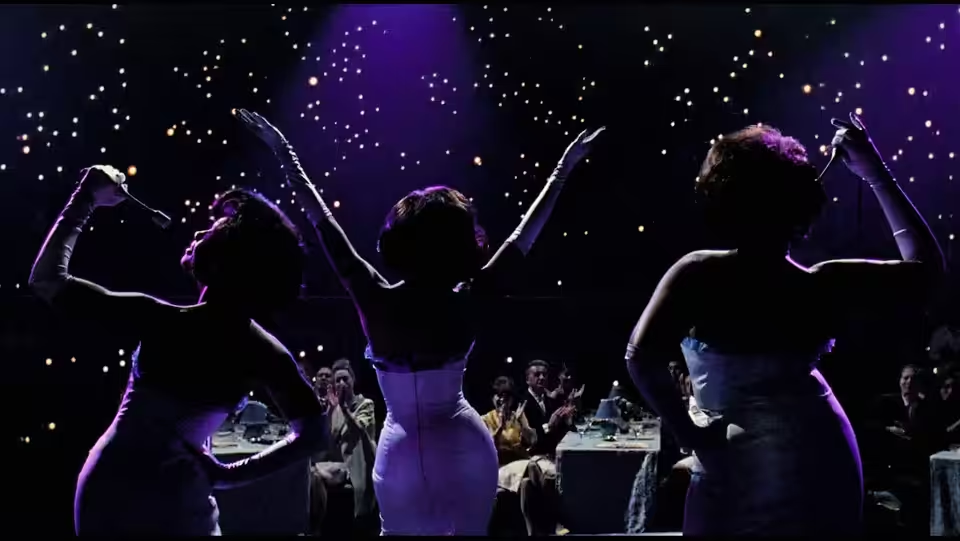
The Dreamettes raise their arms onstage before a seated audience
Film review

Dreamgirls

2006 · Directed by Bill Condon · 2h 10m

In a sentenceJennifer Hudson stops the film dead for five minutes, and it never entirely recovers

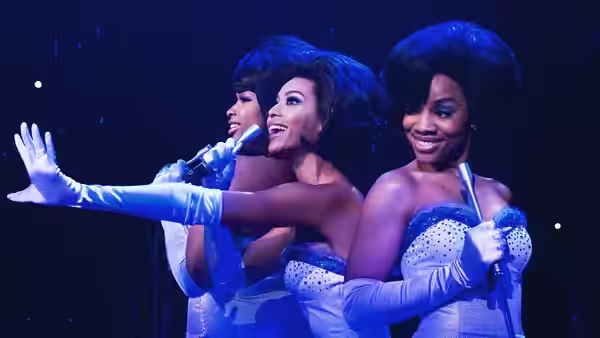
Detroit, 1962. Three young women who call themselves the Dreamettes, Effie White (Jennifer Hudson), Deena Jones (Beyoncé) and Lorrell Robinson (Anika Noni Rose), enter a talent contest at a Detroit theatre with songs written by Effie’s brother C.C. White (Keith Robinson). They do not win. A car salesman in the audience, Curtis Taylor Jr. (Jamie Foxx), talks his way into being their manager and gets them a job singing backup for the headliner James ‘Thunder’ Early (Eddie Murphy), over the objections of Early’s long-serving manager Marty Madison (Danny Glover). Curtis wants more than the circuit of black clubs and theatres: he wants records that white radio will play, and he starts paying disc jockeys to play them. Effie has the voice. Curtis has begun to notice that Deena has the face.

Plays from YouTube when you press play; nothing loads from them until then.

Fi1m review

Bill Condon’s film of the Broadway musical is handsome, well cast and about half as good as its best five minutes. Jennifer Hudson and Eddie Murphy are the reasons to see it; the songs around them are the reason it is not better.

Bill Condon, who wrote the screenplay for Chicago (2002), writes and directs this film of the 1981 Broadway musical by Tom Eyen and Henry Krieger, about a Detroit girl group and the car salesman who turns them into stars. The story is officially not about the Supremes and Berry Gordy, and anyone who has heard of either will spend the first half hour ticking off the resemblances. What Condon has made is a handsome, well-cast, 130-minute musical that is decent for most of its length and, for about five minutes, something far better than decent. Those five minutes belong to Jennifer Hudson.

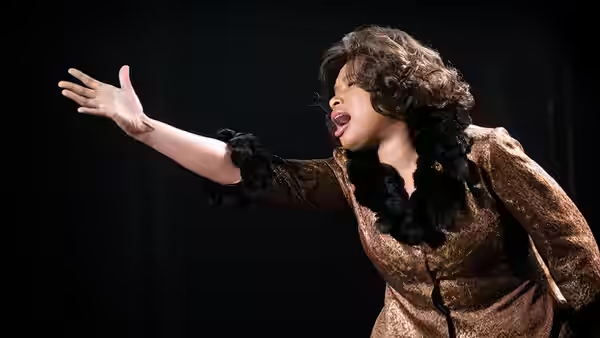
Her number comes a little after the hour, and we will not say what brings it on. What we can say is what it did to us. We had been enjoying the film in a mild, well-disposed way, and then Hudson planted herself in the middle of a half-lit room and sang Effie’s great refusal, the number everyone has heard of, as a quarrel rather than a showpiece, going hoarse at the top, refusing to leave after everyone else had, and we sat forward and stayed there until she had finished. Condon shoots it close, lets Tobias A. Schliessler’s light go hot and amber on her face, and keeps the cutting to a minimum, which is the right call. It is the only time the film and its music are the same size.

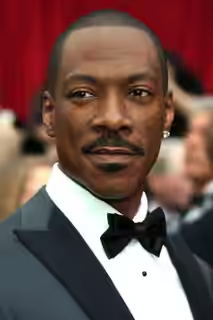
Eddie Murphy is the other reason to go. His James ‘Thunder’ Early is a soul shouter in the James Brown line, all splits and sweat and processed hair, and Murphy plays the comedy of him and then, as the years pass and the style goes out of fashion, the sadness: a man told to stand still and sing ballads when standing still is the one thing he cannot do. It is the best acting he has done in a long while, and he sings it himself. Anika Noni Rose, as Lorrell, the Dreamette who falls for him, is warm and sharp and given too little. Danny Glover’s Marty Madison, the old-school manager who loses his client to a younger man in a better suit, is quietly the film’s conscience.

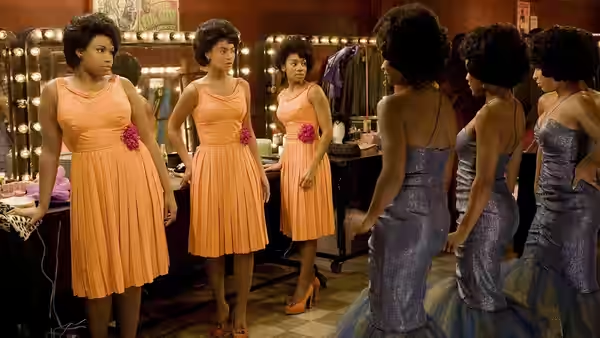
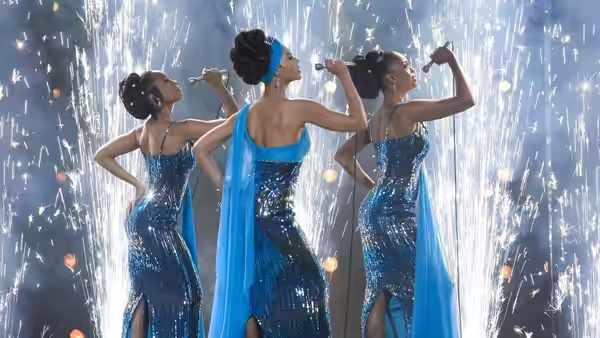
John Myhre’s sets move the group from a shabby Detroit theatre with a bare bulb in the dressing room to Curtis’s record company offices, a Miami hotel ballroom and the chrome and glass of Las Vegas, and they chart the rise more clearly than the script does. Sharen Davis’s costumes do the same job in cloth: matching home-made cotton at the talent contest, then wigs, then sequins, then white. Schliessler shoots the stage numbers in footlight glare and backlit haze, which flatters everyone and suits the material. Virginia Katz, though, is asked to carry too much. Years go by in montage, a calendar page and a costume change, and more than one relationship we are meant to mind about is settled in a cutaway between songs.

The larger trouble is the songs. Krieger’s score is what Broadway in 1981 thought Motown sounded like, and it is not what Motown sounded like; the hooks are approximate, the lyrics announce the theme, and when the plot needs a record to be a hit we are told it is one rather than hearing why. Jamie Foxx plays Curtis Taylor Jr. buttoned tight, a man who is already the mogul he means to become, so we never see the charm that would have got three teenagers into his car outside a theatre. Beyoncé’s Deena is written as a face for most of the running time, which is the point of her, and when the film finally hands her a song of her own, ‘Listen’, it has left the request until the last possible minute.

Chicago solved the oldest problem of the screen musical, why anyone is singing, by putting the numbers in Roxie’s head. Dreamgirls mostly solves it by keeping the songs on stage, where they belong, and it stiffens whenever it lets them off. The sung quarrels, of which there are several, are delivered at full volume by people standing a yard apart in offices and dressing rooms, and at least once we laughed where we were not meant to.

See it, then, for Hudson and Murphy, and go in knowing that the film around them is a well-upholstered 12A that runs 130 minutes and could have lost twenty. It loses little at home; most of it is a stage show anyway, and the one scene that matters works at any size. Most critics have been split down the middle on this one, and we understand both halves.

Critical consensus AI synthesised

57
Positive
3
Mixed
4
Negative
4

The reviews split almost evenly, with as many critics dismissing Dreamgirls as recommending it, but on one point they are nearly unanimous: Jennifer Hudson. Her performance, especially her singing of “And I Am Telling You I’m Not Going”, is singled out in review after review, including by critics who like little else. Several also credit the film’s energy, its glamour and its casting, and Eddie Murphy’s turn earns a mention from Total Film.

Beyond Hudson the spread is wide. Empire and The New Yorker find an exhilarating, emotionally powerful musical that also has something to say about the price of success. The Guardian and Slant Magazine argue the songs are the weak link, undistinguished and unable to lift the production, and IndieWire goes further, calling it boring and poorly written. The measured reservations concern structure: a divided focus, formulaic numbers, and too much attention on its two lead singers at the expense of the rest.

Empire
23 January 2007 · Angie Errigo
90*

The critic finds the film an accomplished, emotionally powerful musical with a compelling story. Jennifer Hudson’s performance and the film’s cinematic staging are particular standouts.

Read the full review →
The New Yorker
17 December 2006 · David Denby
90*

Denby praises Dreamgirls as an exhilarating, successful movie musical that also examines the costs of commercial success. He singles out Jennifer Hudson’s intense performance of “And I Am Telling You I’m Not Going.”

Read the full review →
Total Film
2 February 2007 · ★★★★ · Total Film
80

The review calls Dreamgirls an old-school crowd-pleaser, though its divided focus and piecemeal structure keep it from reaching the heights of the best screen musicals. It praises Eddie Murphy’s performance and singles out Jennifer Hudson’s singing, especially “And I’m Telling You I’m Not Going,” as the film’s most memorable moment.

Read the full review →
Screen Daily
1 December 2006 · Mike Goodridge
64*

The page identifies this as a review, but the review text is unavailable. Its verdict and any specific praise or complaint cannot be determined from the accessible text.

Read the full review →
Time Out
30 January 2007
64*

The available page identifies this as a film review, but its verdict is not accessible. No specific praise or complaint can be reliably extracted from the supplied page text.

Read the full review →
Radio Times
★★★ · Sue Robinson
60

The review says the film delivers the expected glamour and glitz. It singles out Jennifer Hudson’s performance as especially strong.

Read the full review →

Straight answers AI written, from our review

Is Dreamgirls worth watching?
Dreamgirls is worth watching for Jennifer Hudson and Eddie Murphy, and we scored it 68. Hudson's big number a little after the hour is far better than anything around it, and Murphy finds real sadness in his soul shouter as fashion passes him by. The songs in between are approximate Motown and the film runs twenty minutes long.
How long is Dreamgirls, and what is it rated?
Dreamgirls runs 2h 10m. It is a drama and music film.
Where can I watch Dreamgirls in Hong Kong?
Dreamgirls is available to rent from Apple TV from HK$28.00. Availability is checked daily; the links above go straight to each service.
How violent or frightening is Dreamgirls, and is it suitable for children?
Dreamgirls is a 12A and contains nothing violent or frightening. The adult content is a story of ambition, payola and love affairs going wrong, told largely through songs and several shouted quarrels, so it suits teenagers and older children who can sit through 130 minutes of musical. Younger children will find it long rather than upsetting.
How does Dreamgirls compare to The Commitments?
Dreamgirls is the more lavish film and The Commitments is the better one. Alan Parker's Dublin band borrows real soul standards and is funnier and warmer for it, while Condon's Detroit story uses Broadway songs written to sound like Motown and often falls short. Choose Dreamgirls for Hudson and Murphy, The Commitments for the music and the company.
What should I watch after Dreamgirls?
After Dreamgirls, try The Commitments (1991, Fi1m 82): Dublin kids form a soul band; the songs are borrowed and all the better for it. Then Chicago (2002, Fi1m 73): Condon’s screenplay, Rob Marshall’s direction, and a cleverer answer to why anyone is singing; and Twenty Feet from Stardom (2013, Fi1m 74): A documentary about backing singers who never got moved to the front.

Cast

Awards

Academy Awards, 2007

Nominated
Best Costume Design
Nominated
Best Production Design
Nominated
Best Supporting Actor
Won
Best Sound
Won
Best Supporting Actress

If you liked this, try…

  1. Sparkle (1976) · not on Fi1m yetThe Harlem girl-group story this one is often compared to, rougher and sadder.

  2. The Commitments (1991, Fi1m 82)Dublin kids form a soul band; the songs are borrowed and all the better for it.

  3. Chicago (2002, Fi1m 73)Condon’s screenplay, Rob Marshall’s direction, and a cleverer answer to why anyone is singing.

  4. Cadillac Records (2008) · not on Fi1m yetChess Records, Chicago blues and Beyoncé as Etta James, with the history left in.

  5. Twenty Feet from Stardom (2013, Fi1m 74)A documentary about backing singers who never got moved to the front.