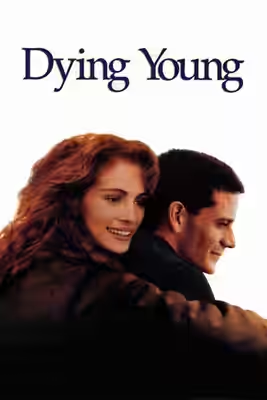
Dying Young has two appealing leads and too little believable writing to support them. Campbell Scott’s restraint helps, but Joel Schumacher’s romance keeps asking for tears it has not done enough to earn.
Joel Schumacher’s Dying Young wants us to care deeply about a romance whose participants are drawn too thinly. It is a poor melodrama with two actors worth watching, which makes its failures particularly frustrating. Richard Friedenberg’s screenplay, adapted from the novel by Marti Leimbach, never gives the relationship enough convincing detail. Too much depends on accepting the couple’s importance because the film has already decided how moved we ought to be, and has the music ready.
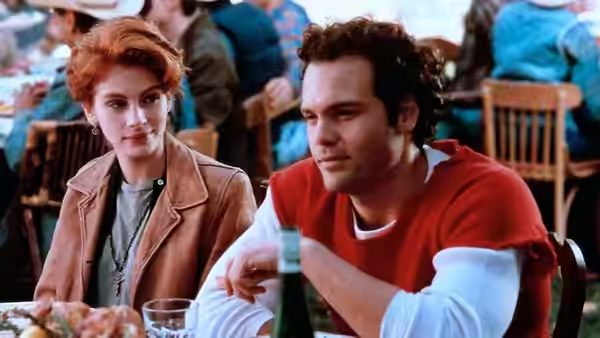
Julia Roberts plays Hilary O’Neil with the direct appeal that the writing leans on far too heavily. Her presence gives us a reason to take an interest, but it cannot supply all the missing details of a person. The character remains familiar when she needs to become particular, and the performance has too little opportunity to surprise us. Over 111 minutes, the expectation that an actor’s charm will compensate for thin characterisation becomes a substantial demand.
Campbell Scott, as Victor Gaddes, gives the film its strongest reason to persist. His restraint allows feeling to develop without insisting that we acknowledge it immediately, and suggests a more complicated man than the screenplay provides. We were moved by the effort he makes to keep Victor’s distress contained. That understatement matters because so much around him pushes for an immediate emotional response. He makes room for us to feel something without being hurried towards it.
The class-clash plotting supplies obstacles without making the couple more interesting. Contrivances matter particularly in a romance, because each unlikely development invites us to question the relationship we are meant to accept. Here the writing gives us too many opportunities to do that, then expects the tearful scenes to overcome our doubts. Some become difficult to take seriously, despite the actors’ commitment, because the characters have not been established firmly enough to make their unhappiness persuasive.
Editors Robert Brown and Jim Prior cannot keep the middle from sagging. The thin characterisation makes stretches of emotional uncertainty feel repetitive, as the relationship keeps receiving attention without becoming much more convincing. We spend too long waiting to understand these people better, rather than simply watching them suffer through the demands of the plot. A shorter cut might have made the film easier to sit through, but it would still need a screenplay that gave its central pair more individuality.
Juan Ruiz Anchía’s cinematography and James Newton Howard’s music serve a film whose feelings are much more emphatic than its character writing. The sweeping score establishes a warm, sorrowful mood, and there is nothing wrong with a romance allowing itself that much feeling. The problem is how persistently the music seems to be doing work the relationship should do. It leaves little space for the actors’ less insistent efforts, particularly when Campbell Scott is already finding something worth attending to.
A romantic melodrama is entitled to ask for tears, and believable people can make even a familiar story hurt. This one has enough warmth to explain why some viewers will forgive the contrivances, especially if either lead is the main attraction. We cannot recommend it on those terms: the performances offer moments of feeling that the surrounding film cannot sustain. Campbell Scott’s admirers have the clearest reason to stay.