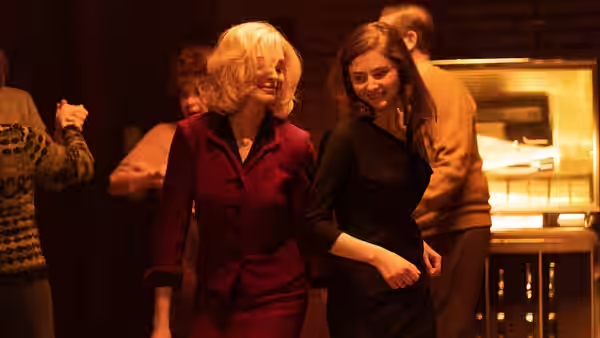
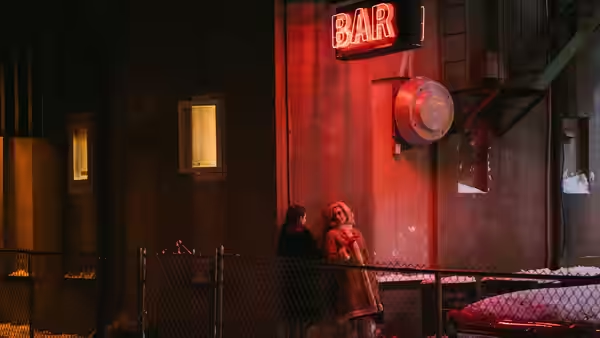
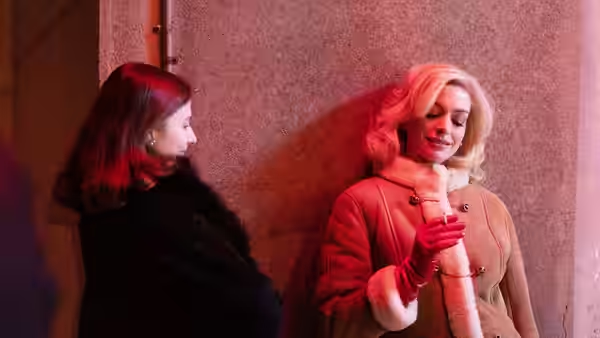
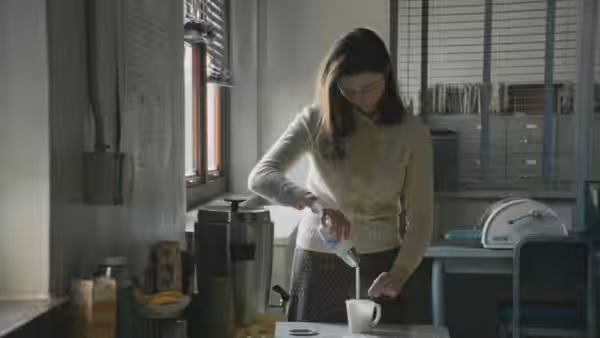
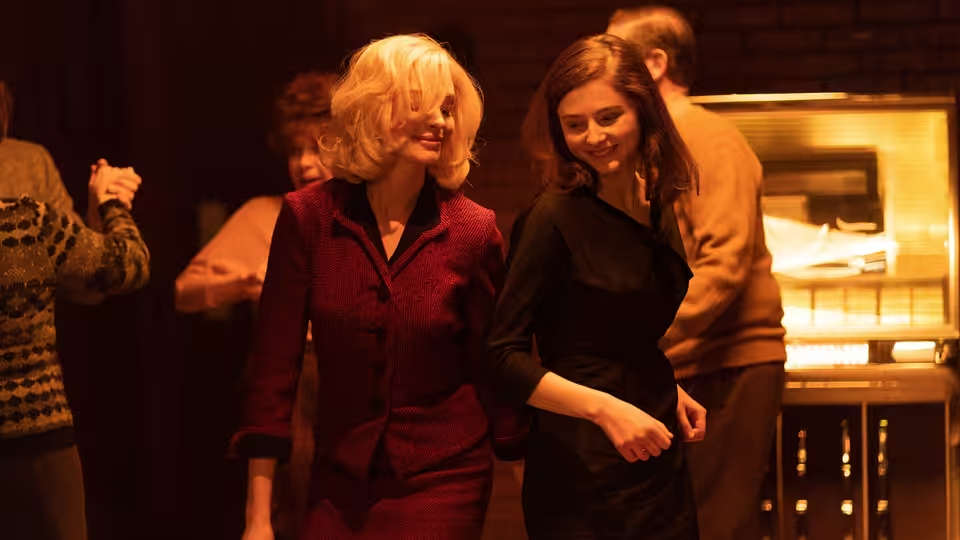
Rebecca (Anne Hathaway) and Eileen (Thomasin McKenzie) walking together through a bar
Film review

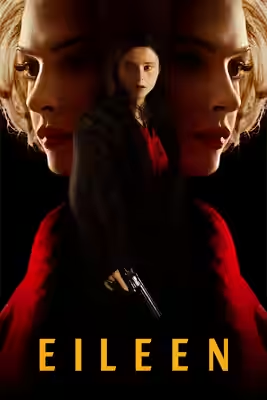
Eileen

2023 · Directed by William Oldroyd · 1h 38m · ICAA 16

In a sentenceAn hour of longing in a borrowed cardigan, then the film remembers it promised a thriller

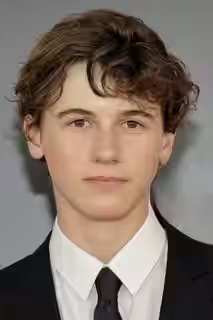
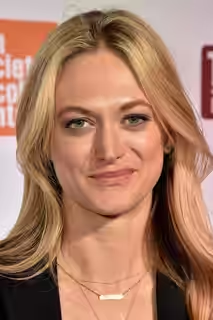
New England, the 1960s, the week before Christmas. Eileen Dunlop (Thomasin McKenzie) types and files at a boys’ prison and goes home each night to her father Jim (Shea Whigham), a retired policeman who drinks and keeps his gun within reach. She has nowhere else to go and nothing much to want until Rebecca (Anne Hathaway) arrives as the prison’s new psychologist: blonde, educated, smoking where nobody else dares, and inclined to notice Eileen. A friendship starts over drinks. Rebecca takes an interest in one of the boys, Lee Polk (Sam Nivola), and in his mother (Marin Ireland). Eileen takes an interest in Rebecca. Adapted by Ottessa Moshfegh and Luke Goebel from Moshfegh’s novel and directed by William Oldroyd.

Plays from YouTube when you press play; nothing loads from them until then.

Fi1m review

William Oldroyd’s adaptation of Ottessa Moshfegh’s novel is a handsome, slow, funny study of a young woman’s longing, with Anne Hathaway as the object and Thomasin McKenzie doing the longing. The last third changes genre, and then the film stops rather than ends.

William Oldroyd’s second film, after Lady Macbeth, is another study of a young woman kept in a house she did not choose. Eileen Dunlop (Thomasin McKenzie) types and files at a boys’ prison in New England in the 1960s, drives home through the snow to a father (Shea Whigham) who has stopped washing up and started waving a gun about, and spends her lunch breaks imagining sex and violence in roughly equal measure. Then Rebecca arrives. For an hour the film is patient, sly and often funny about wanting. In its last third it turns into something else, and we do not think it earns the change.

McKenzie plays Eileen as someone who has decided to be invisible and is starting to resent how well it is working. She hunches, she watches, she eats sweets out of a desk drawer, and now and then a look crosses her face that suggests the mouse has plans. Hathaway’s Rebecca is the opposite proposition: a blonde in a good coat who smokes where she likes, says “Eileen” as if it were a compliment and treats the prison’s grey men as a private joke she is prepared to share. The film is careful never to tell us whether Rebecca is remarkable or simply the first person to look at Eileen twice. There is a scene in a bar where the two of them dance, and it is the happiest the film gets.

Ari Wegner shoots all this through what looks like a lifetime of cigarette smoke. The snow is grey, the walls are the colour of weak tea, and the only bright thing in any room is Hathaway’s hair. Craig Lathrop’s Dunlop house is a place where nobody has moved anything in years, and his prison is green paint and radiators. Olga Mill dresses Eileen in wool that fits like it belonged to someone else and Rebecca in clothes cut for a different city. Richard Reed Parry’s score is the surprise: big, swooning strings that belong to a grander romance than the one on screen, so that every time Eileen looks at Rebecca the music takes her side. It is the film’s best joke and also the reason we believed her.

Nick Emerson’s cutting does the other clever thing. Eileen’s daydreams, a hand on a guard’s belt, a gun going off in the kitchen, arrive without warning in the middle of ordinary shots and are snatched away before the scene has noticed. The first time it happened we laughed out loud. By the third we had stopped trusting anything on screen. For that first hour we were with her completely, and when Rebecca walks into the office and McKenzie’s face does something it has not done all film, we felt the lift ourselves.

Then the film takes a turn we will not describe, except to say that it moves to a different house, a different kind of picture and a much smaller cast. Marin Ireland, as the mother of one of the boys, is given one long scene and plays it with a flatness that is the most frightening thing in the film. We sat up for it. But the film has spent an hour teaching us to read Eileen’s face and now asks us to watch her react to other people’s business; the longing that carried the first hour is gone and nothing replaces it. Then it ends, sharply, at a point where we had assumed there were twenty minutes to go.

Lady Macbeth had the same problem the other way round: it knew exactly where it was going and got there a little too neatly. Eileen knows where it is going and, having arrived, does not know what to do. Ottessa Moshfegh and Luke Goebel’s script, from Moshfegh’s own novel, is good on the small humiliations of a shared office and a shared house, and much less good at the mechanics of a thriller. The first hour is a fine piece of work. We only wish someone had made the second.

See it for McKenzie, for Hathaway’s cigarettes and for Parry’s strings, and see it with someone, because you will want to argue about the last twenty minutes on the way home. It runs 98 minutes and carries a 15, and it feels shorter, which for once is not a compliment.

Critical consensus AI synthesised

73
Positive
13
Mixed
0
Negative
2

Most critics like Eileen, and the praise clusters in the same two places: the lead performances and the atmosphere. Anne Hathaway and Thomasin McKenzie are singled out throughout, several reviews calling the pairing the film’s engine and a few naming it their best work to date. The 1960s New England setting, the sickly festive colour and the score are credited with a mood of glamour rubbing against grime, and the novel’s dark humour is judged to have survived the adaptation intact. Many enjoy the film’s willingness to swerve from a story of repression into something much nastier.

The reservations gather around that swerve and what follows it. Even admirers find the script thin and the ending abrupt, with the central relationship left underdeveloped. The dissent is sharp rather than widespread: Empire calls it a workaday genre exercise, The Times finds the late plot ridiculous, and The Guardian judges it a solemn, anticlimactic misfire. The gap between the warmest and coldest reviews is unusually wide.

Variety
22 January 2023 · Critics Pick · Jessica Kiang
85*

The critic hails the deliciously deranged, genre-devouring portrait of perversity with career-high performances from Hathaway and McKenzie. It singles out the formal precision and blackly comedic power shifts that make the twisted psychodrama exhilarating.

Read the full review →
The AV Club
29 November 2023 · B+ · Murtada Elfadl
83

The critic finds it a stylish wild ride and enthralling adaptation that keeps tension lively with committed performances, though not entirely satisfying. It is imaginatively conceived and beguiling with subtle beats.

Read the full review →
Evening Standard
30 November 2023 · Nick Howells
80*

The critic finds the film an erotic neo-noir about desire and liberation in which the protagonist's repressed urges are unleashed by a glamorous newcomer. McKenzie's performance is singled out as the standout for its depth and intoxication.

Read the full review →
Little White Lies
30 November 2023 · 4/4/4 · Katherine McLaughlin
80

The review commends the dark humour from the novel being well translated and the strong chemistry between the leads. It singles out the atmospheric 1960s setting with its disorientating festive colours and the film's exploration of repression and yearning.

Read the full review →
Los Angeles Times
30 November 2023 · Justin Chang
80*

The critic praises the sleek, unnerving adaptation and especially Anne Hathaway's mesmerizing turn as the glamorous catalyst. It singles out the film's willingness to leave the protagonist's inner life partly ambiguous while delivering shocking reveals.

Read the full review →
Radio Times
★★★★ · Patrick Cremona
80

The critic calls it a bleak but alluring noir thriller whose script translates the novel's feel impeccably. They single out the richly atmospheric mood created through period stylings and score, plus the ingenious third-act twist.

Read the full review →

Straight answers AI written, from our review

Is Eileen worth watching?
Eileen is worth watching for its first hour, a patient and often funny study of a young woman's longing, and we scored it 68. Thomasin McKenzie and Anne Hathaway are both good, and Richard Reed Parry's swooning score takes Eileen's side in a way we believed. The last third changes genre and then stops rather than ends, so go in for the performances, not the thriller.
How long is Eileen, and what is it rated?
Eileen runs 1h 38m and is rated 16 by the ICAA in Spain. It is a thriller and crime film.
Where can I watch Eileen in Spain?
Eileen is not on any streaming or rental service in Spain at the moment. It is available in 26 other countries; change your country at the top of the page to see where. Availability is checked daily.
How violent or frightening is Eileen, and is it suitable for children?
Eileen carries a 15 in the UK and an R in the US, and it is not for children. Eileen's daydreams of sex and violence cut into ordinary scenes without warning, a father waves a gun about at home, and the last third turns into a much darker kind of picture. Teenagers of fifteen and up who can take slow-burning unease should be fine.
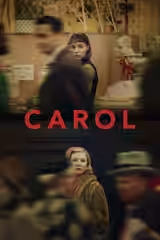
How does Eileen compare to Carol?
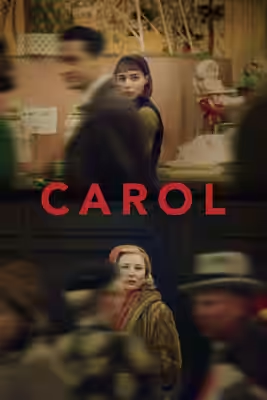
Eileen and Carol both follow a plain young woman drawn to an older, better-dressed one in mid-century America, but Carol stays a romance and Eileen changes into a thriller in its last third. Carol is the more complete film, sustained from first shot to last; Eileen has the sharper wit and the stranger, darker mind, but does not know what to do once it arrives. Choose Carol for feeling, Eileen for oddness.
Is Eileen based on a true story or a book?
Eileen is based on a novel, not a true story: Ottessa Moshfegh's book of the same name, which Moshfegh adapted for the screen with Luke Goebel. The script is good on the small humiliations of a shared office and a shared house, and weaker at the mechanics of a thriller. You do not need to have read the novel; the film's first hour works entirely on its own.
What should I watch after Eileen?
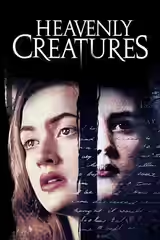
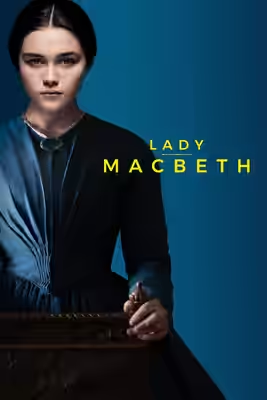
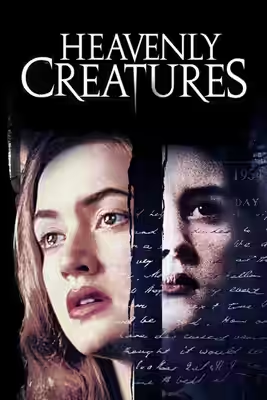
After Eileen, try Lady Macbeth (2016, Fi1m 80): Oldroyd’s first: Florence Pugh in a cold house, deciding what she is owed. Then Carol (2015, Fi1m 88): A woman in a good coat walks into a shop and the 1950s tilt; and Heavenly Creatures (1994, Fi1m 84): Two girls, one friendship, and a plan the adults never see coming.

Cast

If you liked this, try…

  1. Lady Macbeth (2016, Fi1m 80)Oldroyd’s first: Florence Pugh in a cold house, deciding what she is owed.

  2. Carol (2015, Fi1m 88)A woman in a good coat walks into a shop and the 1950s tilt.

  3. Heavenly Creatures (1994, Fi1m 84)Two girls, one friendship, and a plan the adults never see coming.

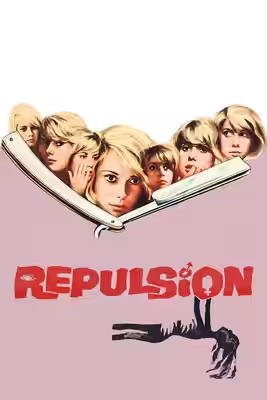
  4. Repulsion (1965, Fi1m 88)A young woman alone in a flat, her daydreams leaking into the furniture.

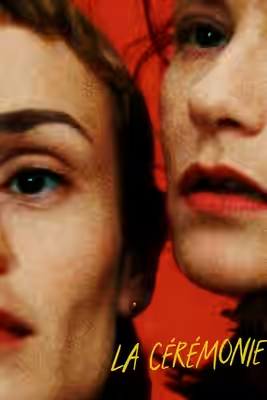
  5. La Cérémonie (1995) · not reviewed yetChabrol’s two provincial women, a big house, and a friendship going somewhere bad.

Free account

Know what to watch tonight

Two lists that know where things are streaming, collections you can share, your own score beside ours, and Discover that remembers what you have seen.

  • Want to see, sorted by what is streaming now
  • Seen, with your score out of ten
  • No adverts, ever