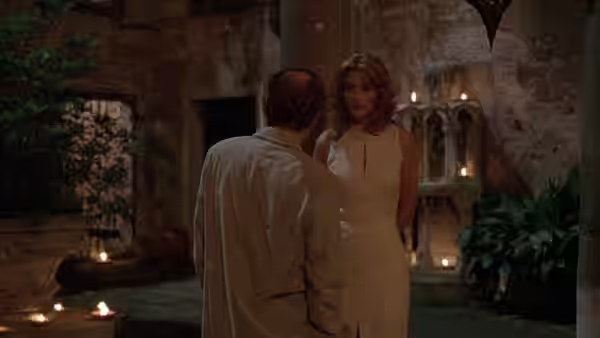
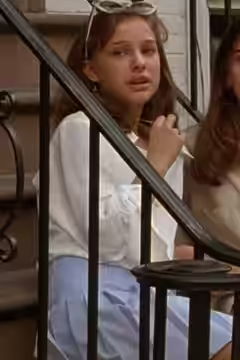
Skylar Dandridge (Drew Barrymore) and Holden Spence (Edward Norton) walk beside a fountain
Film review

Everyone Says I Love You

1996 · Directed by Woody Allen · 1h 41m

In a sentenceNobody in this family can hold a tune, which turns out to be the nicest thing about them

New York, over a year. D.J. Berlin (Natasha Lyonne), a teenager on the Upper East Side, narrates her large, comfortably off family’s affairs. Her mother Steffi Dandridge (Goldie Hawn) is married to Bob Dandridge (Alan Alda), a lawyer whose money funds Steffi’s causes. Their eldest, Skylar Dandridge (Drew Barrymore), has been proposed to by Holden Spence (Edward Norton), who sings the question on Fifth Avenue; Scott Dandridge (Lukas Haas) has alarmed the household by turning Republican; Lane and Laura Dandridge (Gaby Hoffmann, Natalie Portman) love the same boy. D.J.’s father Joe Berlin (Woody Allen), a writer in Paris, has been left by his girlfriend again. Through a vent in a friend’s flat, D.J. overhears a stranger’s therapy sessions, Von Sidell (Julia Roberts), and files the details away.

Fi1m review

Woody Allen’s musical asks a cast hired for other reasons to sing old standards in their own thin voices, and the gamble mostly pays off. It is slight, one subplot is uncomfortable, and Goldie Hawn is the best thing in it.

Woody Allen has made a musical in which almost nobody was cast for their singing. The songs are old standards, the settings are New York, Venice and Paris, and the voices belong to actors doing their best. That is the whole idea, and it is a good one. Everyone Says I Love You is slight, and it is charming, and the two things are connected: it asks for nothing but a little goodwill and it repays that in full. It is worth an evening if you can bear people singing badly for the right reasons.

The numbers work because Allen does not pretend they are anything other than ordinary people bursting into song. Edward Norton opens the film with Just You, Just Me on Fifth Avenue in a voice that is eager, small and slightly behind the beat, and the jewellers’ assistants join in. A hospital sequence turns Makin’ Whoopee over to patients on gurneys and doctors with their charts. In a funeral parlour the dead sit up in their coffins and sing Enjoy Yourself, and we laughed out loud, partly at the audacity and partly because it is the one idea in the film that could not exist anywhere else. Susan E. Morse cuts the numbers with patience, letting a whole verse play out in a single frame so we can see the actors’ nerve.

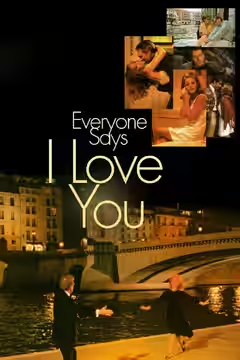
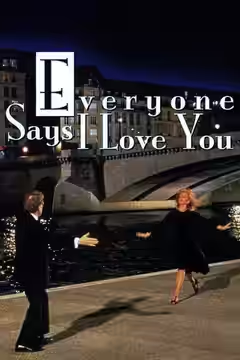
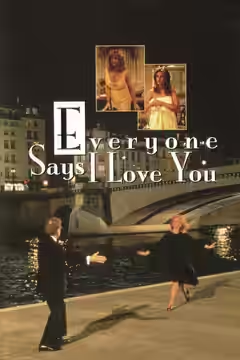
Carlo Di Palma shoots the New York interiors in warm, low, book-lined light, and Santo Loquasto designs the Dandridge flat as the kind of liberal money that has never had to count anything. Jeffrey Kurland puts the family in soft autumn wools and Allen in the same corduroy he has worn for thirty years. Paris is shot at night, on wet stone, and it is here that the film has its best-known scene: Allen and Hawn dancing on the bank of the Seine to I’m Thru with Love, Hawn lifted off the ground and floating as if the song had picked her up. It moved us more than we had any right to expect. Two middle-aged people who used to be married, one of whom cannot dance and one of whom plainly can, and the film lets it run without a joke to cover the feeling.

Hawn is the reason to see it. She sings properly, she moves properly, and she plays Steffi as a woman whose kindness is a kind of appetite, adopting causes the way other people adopt cats. Alan Alda gives Bob a mild, put-upon decency and the film’s funniest political rows with Lukas Haas. Natasha Lyonne narrates with the flat authority of a girl who thinks she has everyone worked out, and is usually wrong. Tim Roth, as the paroled Charles Ferry, arrives late and is menacing in a film that otherwise has no idea what menace is, which is the point of him.

The trouble is Allen’s own storyline. Joe woos Von Sidell, a married woman he has never met, using the secrets D.J. has overheard in therapy, and the film treats this as whimsy. We did not. Julia Roberts is game and lovely and has almost nothing to play, since her character exists to be manipulated and then to be philosophical about it, and the sixty-year-old Allen opposite her is a piece of casting the film never quite justifies. Every time it cuts back to Venice we found ourselves waiting to return to the family.

There is also too much of everything. At 101 minutes, with a dozen speaking parts and half as many plots, several of the Dandridges are sketches rather than people; Gaby Hoffmann and Natalie Portman share one joke between them. Drew Barrymore, alone in the cast, was dubbed, and the film would have been more honest if it had let her sing as badly as everyone else.

Allen has made this family portrait before, most fully in Hannah and Her Sisters (1986), where the household had weight and the year meant something. This is the same shape with songs and half the ballast. Take it for what it is: a small, sunny film about people who love each other and cannot sing, watched at home on a grey evening, where a wobbling voice and a floating woman by a river are exactly enough.


Critical consensus AI synthesised

71
Positive
4
Mixed
2
Negative
1

Most critics like it. The reviews lean warm, four positive out of seven, and the praise clusters on the musical numbers rather than the plot: the choreographed sequences, above all Goldie Hawn’s dance with Allen beside the Seine, which several critics single out as the high point. The decision to let untrained actors sing is taken as a charm by most, and the film is more than once called one of Allen’s stronger outings of the decade.

The reservations are about familiarity and control. Total Film finds it enjoyable but less original than Allen’s earlier work, and Radio Times notes that the cast’s limited singing can distract even while admiring the boldness of the departure. The spread is wide: Empire and Variety are close to raves, while The Independent stands alone in dismissing it, finding the many plotlines and performances out of step with one another and the songs unable to hide a film with nothing at its centre.

Empire
1 January 2000 · Adam Smith
90*

The critic calls it arguably Woody Allen’s finest film of the 1990s and warmly recommends its blend of comedy and sentiment. The songs, especially the untrained singers’ performances and the choreographed musical sequences, are singled out for praise.

Read the full review →
Variety
1 December 1996 · Leonard Klady
90*

Klady presents the film as a bold, delightful musical and one of Allen’s strongest outings. He especially praises Goldie Hawn’s performance and her climactic dance with Allen along the Seine.

Read the full review →
Radio Times
★★★★ · Tom Hutchinson
80

Hutchinson finds the film strangely endearing despite its familiar Allen themes. He praises its bold musical departure and the dance sequence by the Seine, while noting that the cast’s limited singing ability can distract.

Read the full review →
The New York Times
6 December 1996 · Janet Maslin
80*

Maslin finds the film a delightful, witty, sunny musical comedy, though one romantic subplot feels weary. She especially praises the dance beside the Seine, which captures the film’s wistful, hopeful view of romance.

Read the full review →
Time Out
· TCh
65*

The available text does not reveal the critic’s overall verdict. It singles out a deliciously sloppy rendition of ‘Just You, Just Me’ as a highlight.

Read the full review →
Total Film
18 April 1997 · ★★★ · Total Film
60

The review calls the film a funny, enjoyable winner, though less original than Allen’s earlier classics. It praises the tightly working cast and neatly staged dance scenes, especially the hospital sequence.

Read the full review →

Straight answers AI written, from our review

Is Everyone Says I Love You worth watching?
Everyone Says I Love You is worth an evening for anyone who can enjoy actors singing old standards badly on purpose, and we scored it 72. It is slight and overcrowded, and Woody Allen's own subplot, in which he woos a stranger using her overheard therapy sessions, sits uneasily. Goldie Hawn, dancing on the bank of the Seine, is the reason to see it.
How long is Everyone Says I Love You, and what is it rated?
Everyone Says I Love You runs 1h 41m. It is a comedy and romance film.
Where can I watch Everyone Says I Love You in Lithuania?
Everyone Says I Love You is not on any streaming or rental service in Lithuania at the moment. It is available in 11 other countries; change your country at the top of the page to see where. Availability is checked daily.
How violent or frightening is Everyone Says I Love You, and is it suitable for children?
Everyone Says I Love You is a 12 in the UK and contains almost nothing violent or frightening. Tim Roth's paroled convict brings a brief flicker of menace to a film that otherwise has none, and the plot turns on adult affairs, a divorce and a man exploiting a woman's private therapy. Older children will be fine; younger ones may simply be bored by the standards.
How does Everyone Says I Love You compare to The Umbrellas of Cherbourg?
Everyone Says I Love You is the looser and lighter of the two, and The Umbrellas of Cherbourg is the better film. Demy sings every line and lets ordinary grief sit under the colour; Allen has a cast of non-singers burst into standards for charm and laughs, and a hospital or funeral-parlour number is the best it gets. Choose Demy for a romance that stays with you, Allen for a sunny evening that asks for nothing.
What should I watch after Everyone Says I Love You?
After Everyone Says I Love You, try The Umbrellas of Cherbourg (1964, Fi1m 88): Every line sung, and the ordinary grief underneath the colour is what stays. Then Hannah and Her Sisters (1986, Fi1m 88): The same New York family, a year in its life, and the weight this one lacks.

Cast

Awards

European Film Award for Best Non-European Film, 1997

Nominated
European Film Award for Best Non-European Film

If you liked this, try…

  1. The Umbrellas of Cherbourg (1964, Fi1m 88)Every line sung, and the ordinary grief underneath the colour is what stays.

  2. Same Old Song (1997) · not on Fi1m yetResnais has his cast lip-sync French pop mid-sentence; it is stranger and sadder than it sounds.

  3. Hannah and Her Sisters (1986, Fi1m 88)The same New York family, a year in its life, and the weight this one lacks.

  4. Pennies from Heaven (1981) · not on Fi1m yetSteve Martin mouths Depression-era standards in a musical that hates its own dreams.

  5. Golden Eighties (1986) · not on Fi1m yetAkerman’s shopping-centre musical: hairdressers and shopkeepers in love, sung with a straight face.