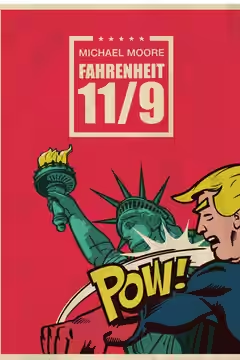
Michael Moore’s angriest film since Fahrenheit 9/11 is a sprawl of stunts, montages and arguments he starts and does not finish. In the middle of it is forty minutes on the poisoning of Flint that is as good as anything he has made.
Michael Moore has never been a tidy filmmaker, and Fahrenheit 11/9 is his untidiest. It opens in the early hours of 9 November 2016, with the cable anchors who had waited all evening to call it for Hillary Clinton staring at their screens, and asks how that night came about. The answer takes 128 minutes and goes by way of Flint, a school in Florida and a teachers’ strike in West Virginia. Some of it is the best work Moore has done since Fahrenheit 9/11 (2004). A good deal of it is a man changing the subject.
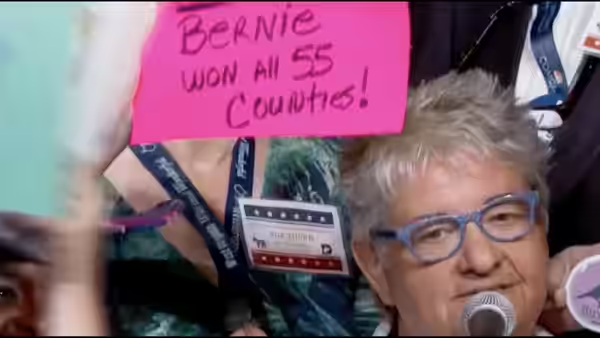
The opening stretch is the weakest and the most Moore. He blames the networks for the free airtime, then admits he sat beside Trump on Roseanne Barr’s sofa and found him pleasant. He blames the Democrats for choosing a candidate people did not want, and shows Bernie Sanders winning the West Virginia primary and the state’s delegates going to Clinton anyway. Each is a fair point and none is pursued. Pablo Proenza and Doug Abel cut the first half hour as a run of accusations, each landing before the last has been explained, like a man emptying a drawer onto a table.
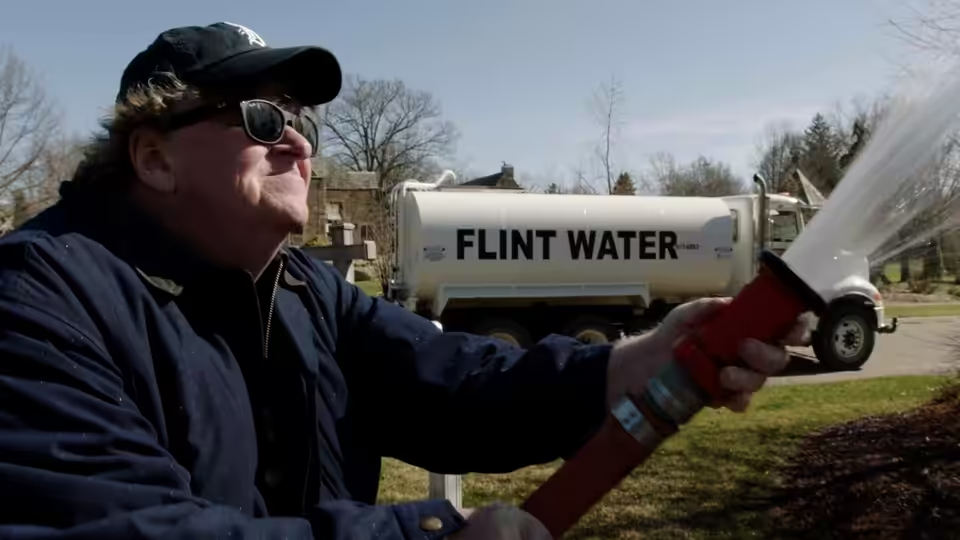
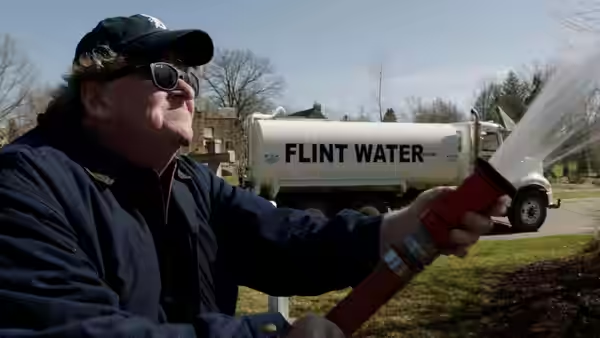
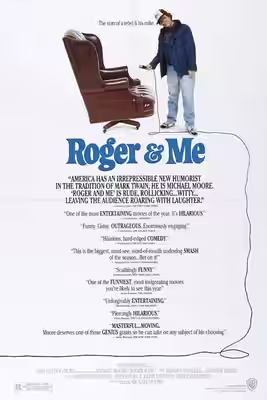
Then Moore goes home. Flint, Michigan, is where he grew up and where he made Roger & Me (1989), and in 2014 the state switched the city’s water supply to the Flint river to save money and put lead into its children. Jayme Roy and Luke Geissbühler shoot the city in flat winter light: brown water in a glass, a clinic waiting room, empty streets. Moore drives a tanker of Flint water to the governor’s residence and turns a hose on the lawn, and for once the stunt is not the point. We were angry watching this, in a way none of the Trump material managed, because Moore stops talking and lets the doctors and the mothers say what lead does to a five-year-old. When Barack Obama arrives, asks for a glass of Flint water and takes a sip for the cameras, the film simply watches the faces around him fall, and it is the most damning minute in it.
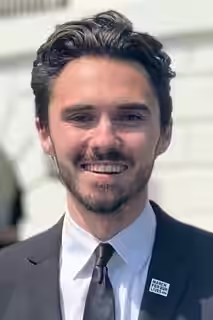
The second half finds its hope in people who did not wait to be asked. West Virginia teachers walk out over pay and health cover and stay out until they win. The Parkland students, David Hogg among them, organise a national march within weeks of the shooting at their school. Alexandria Ocasio-Cortez knocks on doors in the Bronx before anyone outside it knows her name. These stretches moved us in the ordinary way, because the people in them are doing something rather than describing it, and Moore, wisely, gets out of their way.
Then he reaches for history. Late on, the film draws the parallel between Trump and Hitler that others have drawn before it, at length and with a straight face, and the stretch is the film’s most discussed and its least useful. The people he is speaking to have already made the comparison; the people he wants to reach will switch off the moment the name comes up. The showman gets the better of the reporter here, and we found ourselves checking the time.
Moore’s case against the news channels, with Brooke Baldwin, Ashleigh Banfield and Joy Behar cut together as one long open mouth, is the film’s other good idea. It is dropped after ten minutes. Moore is heard throughout and seen less than he used to be, which is an improvement. He sounds tired, and he says so.
Roger & Me had one town and one man. Bowling for Columbine (2002) had one question and followed it to the end. This has one country and every grievance in it, and finishes a third of them. Most critics have been kinder to the whole than we are, and we can see why; Flint carries a lot of goodwill forward. Not all of it.
See it for Flint, a documentary of its own and a fine one, and treat the rest as the price of admission. At home you can pause when Moore starts on Hitler and pick it up again with the teachers.