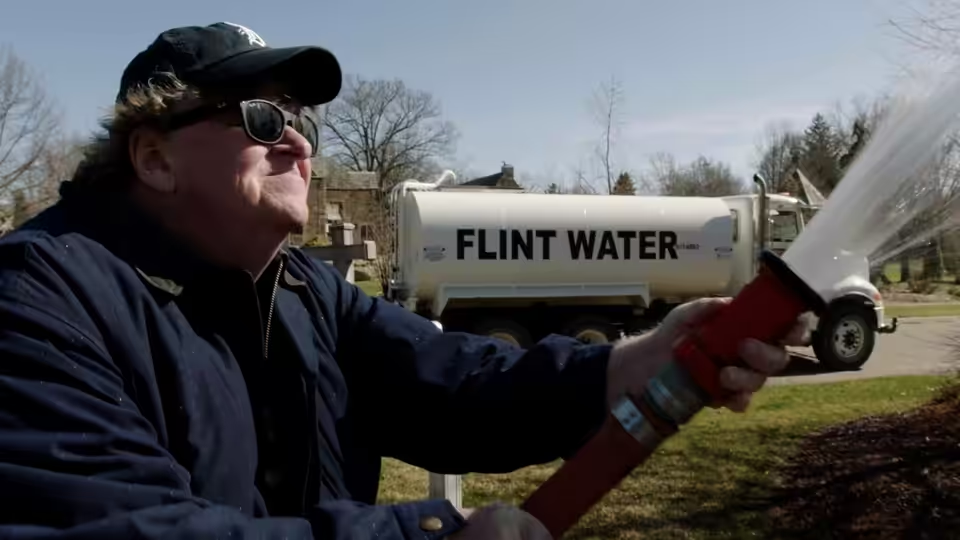
A scene from Fahrenheit 11/9
Film review

Fahrenheit 11/9

2018 · Directed by Michael Moore · 2h 08m

In a sentenceA film about Trump that is best when it forgets him and goes home to Flint

It is the early hours of 9 November 2016 and the television anchors who have spent the evening waiting to call it for Hillary Clinton have gone quiet. Donald Trump (in archive footage) walks out to accept. Michael Moore asks how it happened and starts with himself, with a clip of Moore and Trump sharing a sofa on Roseanne Barr’s chat show. He goes after the networks for the free airtime, and after the Democrats for the candidate they chose over Bernie Sanders. Then he drives home to Flint, Michigan, where the state has switched the city’s water supply and poisoned it.

Plays from YouTube when you press play; nothing loads from them until then.

Fi1m review

Michael Moore’s angriest film since Fahrenheit 9/11 is a sprawl of stunts, montages and arguments he starts and does not finish. In the middle of it is forty minutes on the poisoning of Flint that is as good as anything he has made.

Michael Moore has never been a tidy filmmaker, and Fahrenheit 11/9 is his untidiest. It opens in the early hours of 9 November 2016, with the cable anchors who had waited all evening to call it for Hillary Clinton staring at their screens, and asks how that night came about. The answer takes 128 minutes and goes by way of Flint, a school in Florida and a teachers’ strike in West Virginia. Some of it is the best work Moore has done since Fahrenheit 9/11 (2004). A good deal of it is a man changing the subject.

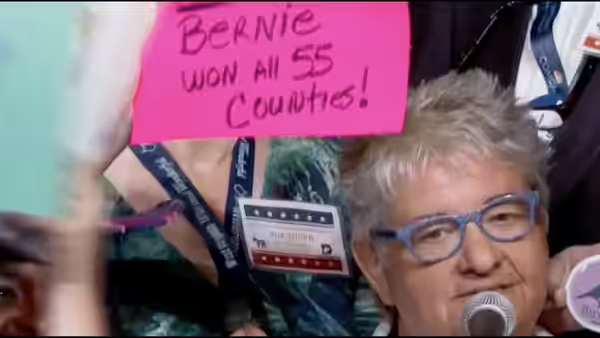
The opening stretch is the weakest and the most Moore. He blames the networks for the free airtime, then admits he sat beside Trump on Roseanne Barr’s sofa and found him pleasant. He blames the Democrats for choosing a candidate people did not want, and shows Bernie Sanders winning the West Virginia primary and the state’s delegates going to Clinton anyway. Each is a fair point and none is pursued. Pablo Proenza and Doug Abel cut the first half hour as a run of accusations, each landing before the last has been explained, like a man emptying a drawer onto a table.

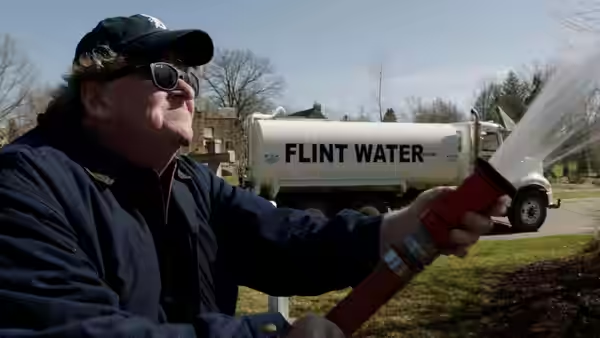
Then Moore goes home. Flint, Michigan, is where he grew up and where he made Roger & Me (1989), and in 2014 the state switched the city’s water supply to the Flint river to save money and put lead into its children. Jayme Roy and Luke Geissbühler shoot the city in flat winter light: brown water in a glass, a clinic waiting room, empty streets. Moore drives a tanker of Flint water to the governor’s residence and turns a hose on the lawn, and for once the stunt is not the point. We were angry watching this, in a way none of the Trump material managed, because Moore stops talking and lets the doctors and the mothers say what lead does to a five-year-old. When Barack Obama arrives, asks for a glass of Flint water and takes a sip for the cameras, the film simply watches the faces around him fall, and it is the most damning minute in it.

The second half finds its hope in people who did not wait to be asked. West Virginia teachers walk out over pay and health cover and stay out until they win. The Parkland students, David Hogg among them, organise a national march within weeks of the shooting at their school. Alexandria Ocasio-Cortez knocks on doors in the Bronx before anyone outside it knows her name. These stretches moved us in the ordinary way, because the people in them are doing something rather than describing it, and Moore, wisely, gets out of their way.

Then he reaches for history. Late on, the film draws the parallel between Trump and Hitler that others have drawn before it, at length and with a straight face, and the stretch is the film’s most discussed and its least useful. The people he is speaking to have already made the comparison; the people he wants to reach will switch off the moment the name comes up. The showman gets the better of the reporter here, and we found ourselves checking the time.

Moore’s case against the news channels, with Brooke Baldwin, Ashleigh Banfield and Joy Behar cut together as one long open mouth, is the film’s other good idea. It is dropped after ten minutes. Moore is heard throughout and seen less than he used to be, which is an improvement. He sounds tired, and he says so.

Roger & Me had one town and one man. Bowling for Columbine (2002) had one question and followed it to the end. This has one country and every grievance in it, and finishes a third of them. Most critics have been kinder to the whole than we are, and we can see why; Flint carries a lot of goodwill forward. Not all of it.

See it for Flint, a documentary of its own and a fine one, and treat the rest as the price of admission. At home you can pause when Moore starts on Hitler and pick it up again with the teachers.

Critical consensus AI synthesised

64
Positive
15
Mixed
8
Negative
2

Most critics come out in favour, though few of them without reservation. The praise clusters on the Flint water section, singled out again and again as the strongest and most upsetting stretch, and on the passages with young activists and the Parkland students, which many find give the film its hope. A good number credit Moore for turning his anger on the Democrats and on American society at large rather than solely on Trump, and several call it his most effective work in years.

The reservations are nearly unanimous in kind: scattershot, rambling, too many targets, too little focus. The spread is wide. The Times and Vulture rate it among his best; The Telegraph finds a sloppy rant with an overdone Hitler analogy; Slant goes further and calls Moore’s showmanship as self-promoting as Trump’s own. Several say it preaches to the converted, and Collider complains that it offers no concrete ideas for change.

The Times
19 October 2018 · ★★★★☆ · Kevin Maher
90*

Moore is reinvigorated and potent in this analysis of Trump's rise, demolishing targets including Democrats and using effective stunts and montages, with a strong section on parallels to Hitler.

Read the full review →
Vulture
9 September 2018 · festival review
90*

Moore has about the right number of irons in the fire and strikes the living hell out of every one in this fullest, most original and urgent film, one of the most urgent ever made.

Read the full review →
IndieWire
7 September 2018 · festival review · Eric Kohn
70*

Moore strikes an alarming tone rooted in grim realities but this angry movie spotlights the potential for a new chapter of activism and resistance.

Read the full review →
Los Angeles Times
20 September 2018 · Robert Abele
70*

Moore channels outrage in a messy but powerful way that shames the left as often as it demonizes the right. The film is a dire warning and impassioned call to action that leaves one feeling the best course is to get out and fight rather than wish or hope.

Read the full review →
RogerEbert.com
7 September 2018 · festival review · Brian Tallerico
70*

Moore is angrier than ever but directs much of his outrage at American society as a whole for enabling Trump rather than solely at the president. The film is scattershot but ultimately Moore’s best in years for its simple, nonpartisan call to get mad and take action, with strong sections on the Flint water crisis.

Read the full review →
Sight and Sound
9 September 2018 · festival review · Tom Charity
70*

Moore places the blame for Trump's election, prospects the consequences and exhorts the resistance. The film is most compelling on the Flint water scandal and the betrayal of Moore's hometown.

Read the full review →

Straight answers AI written, from our review

Is Fahrenheit 11/9 worth watching?
Fahrenheit 11/9 is worth watching for its reporting on Flint’s poisoned water, though the wider political documentary is scattered; we score it 60 out of 100. We recommend it to viewers interested in Moore’s reporting, with the caveat that his stunts and unfinished accusations make the 128 minutes feel longer than they need to.
How long is Fahrenheit 11/9, and what is it rated?
Fahrenheit 11/9 runs 2h 08m. It is a documentary film.
Where can I watch Fahrenheit 11/9 in Serbia?
Fahrenheit 11/9 is not on any streaming or rental service in Serbia at the moment. It is available in 17 other countries; change your country at the top of the page to see where. Availability is checked daily.
How violent or frightening is Fahrenheit 11/9, and is it suitable for children?
Fahrenheit 11/9 has a UK 15 certificate and is unsuitable for children under 15; its account of lead poisoning in Flint makes for distressing viewing. Doctors and mothers describe the harm to children, which we find more upsetting than the political material. The certificate also warrants caution for sensitive older teenagers.
How does Fahrenheit 11/9 compare to Roger & Me?
Fahrenheit 11/9 is less disciplined than Roger & Me, which we recommend as the stronger, more focused introduction to Moore’s work. Both find powerful material in Flint, but the earlier film stays with one town and one man, while Fahrenheit 11/9 moves between national grievances without pursuing enough of them properly.
What should I watch after Fahrenheit 11/9?
After Fahrenheit 11/9, try Roger & Me (1989, Fi1m 78): Moore’s first film, one town and one man, and still his most disciplined. Then Weiner (2016, Fi1m 75): A politician destroys himself on camera and keeps letting the crew film; and The Act of Killing (2012, Fi1m 88): Indonesian death squad veterans restage their crimes; horrifying and impossible to stop watching.

Cast

If you liked this, try…

  1. Roger & Me (1989, Fi1m 78)Moore’s first film, one town and one man, and still his most disciplined.

  2. The War Room (1993) · not reviewed yetA campaign from the inside, without a narrator telling you what to think.

  3. Weiner (2016, Fi1m 75)A politician destroys himself on camera and keeps letting the crew film.

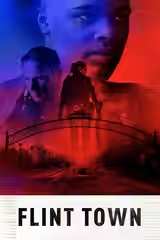
  4. Flint Town (2018) · not reviewed yetThe same poisoned city, seen through its police department over two years.

  5. The Act of Killing (2012, Fi1m 88)Indonesian death squad veterans restage their crimes; horrifying and impossible to stop watching.

Free account

Know what to watch tonight

Two lists that know where things are streaming, collections you can share, your own score beside ours, and Discover that remembers what you have seen.

  • Want to see, sorted by what is streaming now
  • Seen, with your score out of ten
  • No adverts, ever