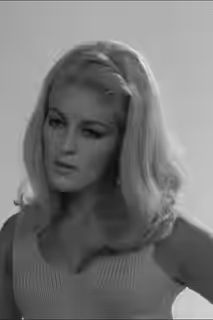
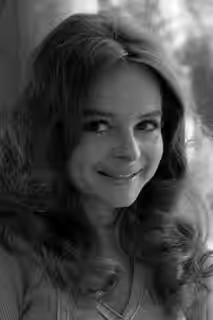
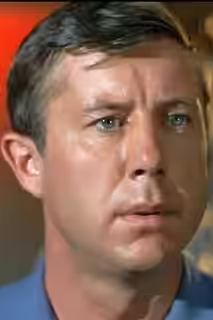
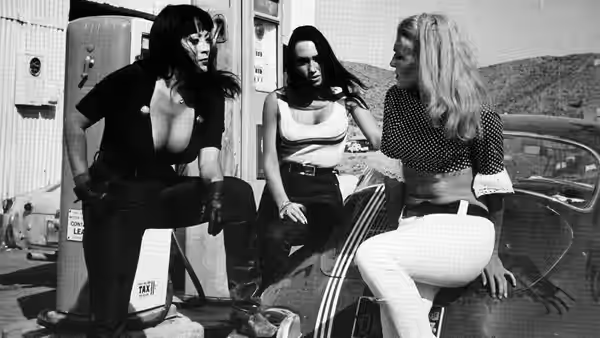
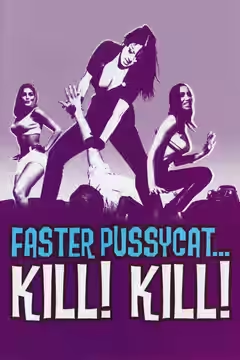
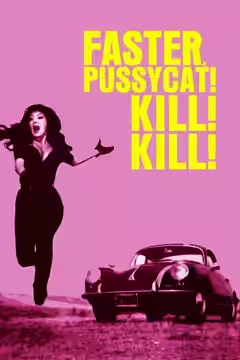
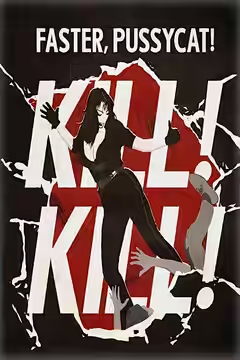
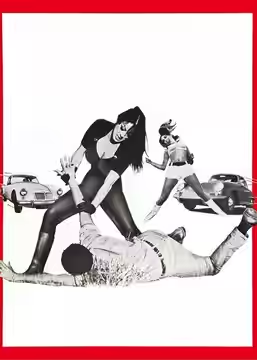
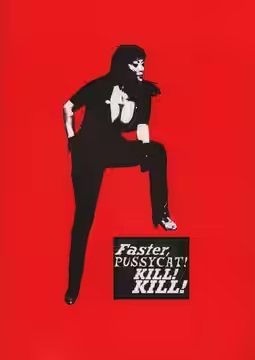
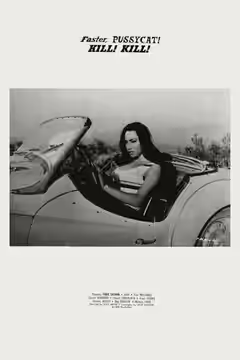
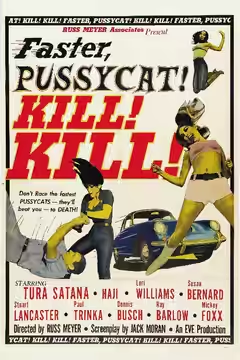
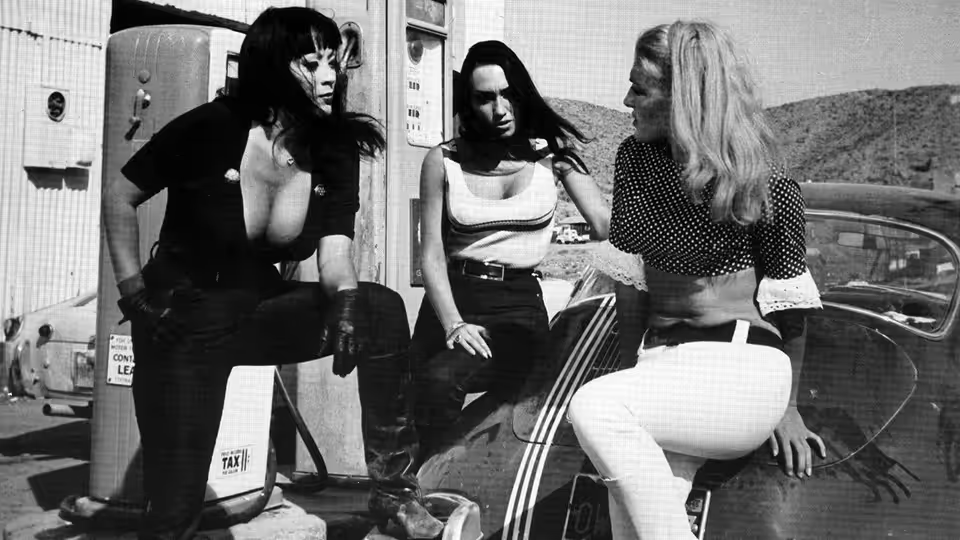
Three women gather beside a car at a gas station
Film review

Faster, Pussycat! Kill! Kill!

1965 · Directed by Russ Meyer · 1h 23m

In a sentenceThree go-go dancers drive into the desert and the men there have clearly not read the title

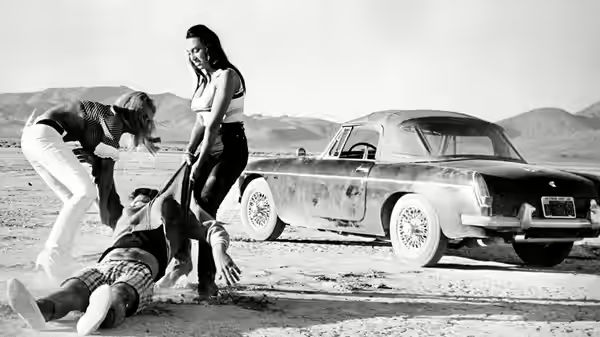
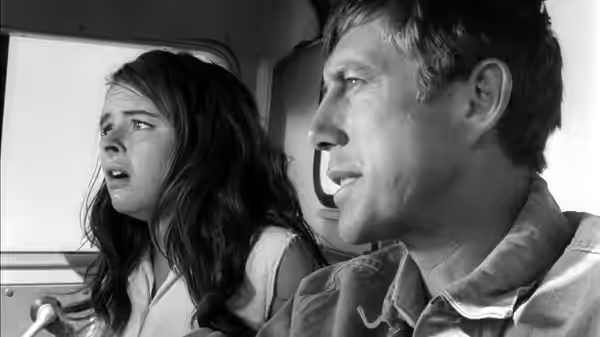
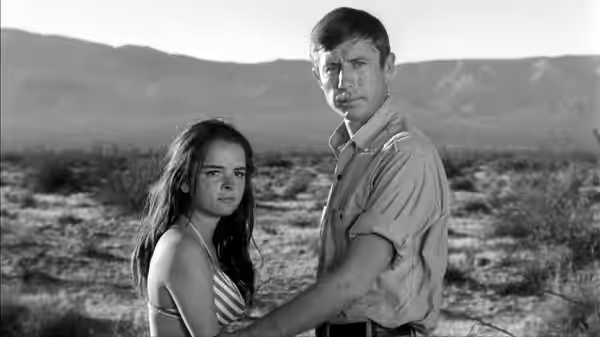
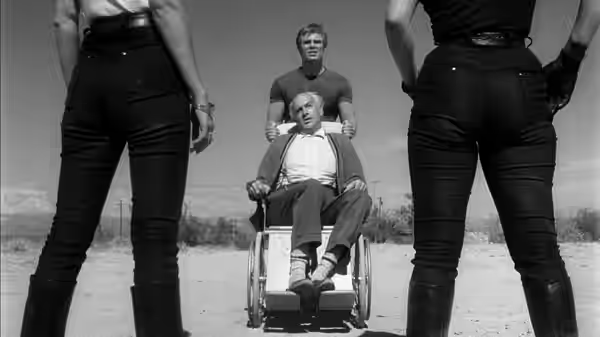
Three go-go dancers, Varla (Tura Satana), Rosie (Haji) and Billie (Lori Williams), drive their sports cars out into the California desert. On a salt flat they find Tommy (Ray Barlow) timing laps in his car while his girlfriend Linda (Susan Bernard) holds the stopwatch. Varla challenges him to a race, the race turns into a fight, and Tommy does not get up. The women drug Linda and take her with them. At a petrol station the attendant (Michael Finn) mentions an old man (Stuart Lancaster) on a nearby ranch, in a wheelchair, with two sons, Kirk (Paul Trinka) and a slow, musclebound giant credited as The Vegetable (Dennis Busch), and a fortune hidden somewhere on the land. Varla decides they will pay him a visit.

Fi1m review

Russ Meyer’s black-and-white desert pulp is 83 minutes of leather, karate and dialogue nobody has ever spoken aloud. Tura Satana holds it together by force; the film sags whenever she is sitting down and the men are talking.

Faster, Pussycat Kill Kill opens with John Furlong’s narrator welcoming us to violence in the tone of a man reading a public information notice, then cuts to three women dancing on a tiny stage while men off screen bark at them. Ten minutes later the women are in the desert in sports cars. Twenty minutes in, one of them has killed a man with her bare hands. Russ Meyer directed, produced and co-edited it, in black and white, in 1965, and at 83 minutes it does not have a slow reel until it reaches the ranch where most of it is set. It is a cheap, fast, odd little film that has outlived nearly everything made alongside it, and it is good, with one long soft stretch and a cast in which only half the people can act.

Jack Moran’s script is the kind of thing that gets called quotable, which is a way of saying nobody has ever spoken like this. Varla (Tura Satana) does not talk so much as issue statements. Rosie (Haji) answers in an accent from nowhere. Billie (Lori Williams) wants a drink and a swim and says so, repeatedly. The plot, once it gets to Stuart Lancaster’s Old Man and his hidden money, is a heist film with the heist removed: three women arrive at a ranch and everyone waits to see who moves first.

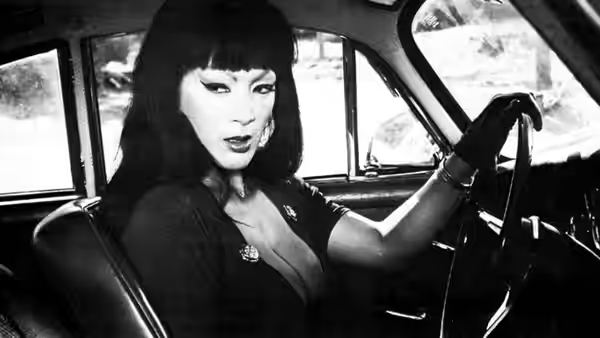
We laughed through the race on the salt flat, at the insults and the dust and the cars that plainly cannot go as fast as the editing says they do. Then Satana got out of hers, and we stopped. The fight with Ray Barlow’s Tommy is filmed from low down so that she fills the frame, it lasts under a minute, and it ends more quickly and more brutally than a film sold on the word superwomen had led us to expect. That fight is the film’s real subject. Satana does not play Varla as a tease or a joke; she plays her as a woman who enjoys hurting people and has found a place with nobody to stop her.

Walter Schenk shoots the desert in hard, flat light so the salt glares white and the women’s black leather goes glossy against it, and almost every shot of Satana is from below, which is how she comes to look eight feet tall. Meyer and Charles G. Schelling cut fast, ending scenes on a line rather than after it, and the race is built from short shots of wheels and faces so that two ordinary cars look like a duel. Paul Sawtell and Bert Shefter supply brass and drums that keep going under scenes that would otherwise sit still, which is most of them once the ranch appears.

The ranch is the problem. Lancaster’s Old Man is given long speeches about women, trains and the state of the country, and he leers through all of them; Meyer finds him funnier than we did. Paul Trinka’s Kirk is the decent son and about as interesting as decent sons usually are in films like this. Dennis Busch, as The Vegetable, is asked to lift heavy things and look sad, and does both. Susan Bernard’s Linda is drugged early and screams often, and the script treats her as luggage that occasionally speaks. For a long stretch in the middle the film puts its best character in a chair and lets the men talk.

Haji and Williams are better than the film needs, Haji sulking and hovering at Varla’s elbow, Williams bored to the point of mutiny, and the three of them together give the picture its shape: nobody trusts anyone, and nobody has to say it. Set against the drive-in pictures it was made to sit alongside, it is sharper, faster and considerably stranger. It has since been claimed as a feminist film, and it is not one, and we doubt Meyer would have wanted it to be. The women win every argument and start every fight, and the camera looks at them the way his camera always looked at women. The film is not troubled by holding both of those at once.

Most critics land roughly where we do. Watch it late, with company, and do not try to keep track of the money. You will not remember where it was hidden. You will remember the gloves.

Critical consensus AI synthesised

74
Positive
2
Mixed
2
Negative
0
Empire
1 January 2000 · Kim Newman
95*

Newman regards the film as a standout Russ Meyer classic and an exuberant expression of American cinema’s obsessions. He particularly praises Tura Satana’s menacing performance, alongside the film’s driving jazz score and comic melodrama.

Read the full review →
Time Out
· RM
70*

The review is positive, presenting Meyer as more than a purveyor of exploitative spectacle. It singles out his skill as an action director, while noting the film’s trio of starlets.

Read the full review →
Variety
31 December 1965 · Variety Staff
65*

The review finds the film energetic and technically accomplished, but held back by weak writing and performances. It particularly praises Meyer’s direction and crisp, well-paced editing.

Read the full review →
The New York Times
13 January 1995
64*

The page is identified as a film review, but its text is unavailable. The critic’s verdict and specific praise or complaint cannot be determined.

Read the full review →

Straight answers AI written, from our review

Is Faster, Pussycat! Kill! Kill! worth watching?
Faster, Pussycat Kill Kill is worth watching for anyone with a taste for cheap, fast, strange 1960s pulp, and we scored it 75. Tura Satana holds the whole thing together by force, and the race and fight on the salt flat are reason enough on their own. It sags in the middle, once the film reaches the ranch and lets the men do the talking.
How long is Faster, Pussycat! Kill! Kill!, and what is it rated?
Faster, Pussycat! Kill! Kill! runs 1h 23m. It is an action and crime film.
Where can I watch Faster, Pussycat! Kill! Kill! in Austria?
Faster, Pussycat! Kill! Kill! is not on any streaming or rental service in Austria at the moment. Availability is checked daily.
How violent or frightening is Faster, Pussycat! Kill! Kill!, and is it suitable for children?
Faster, Pussycat Kill Kill carries no UK certificate and was never rated in the US, and it is not a film for children. A man is killed with bare hands within the first twenty minutes, a young woman is drugged and carried off, and the camera looks at the women in leather in the way Russ Meyer's camera always did. Older teenagers who can take some leering and one brutal fight will manage; the squeamish will not enjoy it.
How does Faster, Pussycat! Kill! Kill! compare to Kill Bill: Vol. 1?
Faster, Pussycat Kill Kill is the rougher, shorter and stranger of the two, and Kill Bill: Vol. 1 is the more accomplished piece of filmmaking. Tarantino borrows the women, the fights and the attitude from Meyer and admits it; his fights are extraordinary, but his is half a film and knows it. Choose Tarantino for craft and Meyer for Tura Satana, whom nobody has managed to copy.
What should I watch after Faster, Pussycat! Kill! Kill!?
After Faster, Pussycat! Kill! Kill!, try Kill Bill: Vol. 1 (2003, Fi1m 72): Tarantino borrows the women, the fights and the attitude, and admits it. Then Thelma & Louise (1991, Fi1m 85): Two women, one car, the same desert, and rather more conscience.

Cast

If you liked this, try…

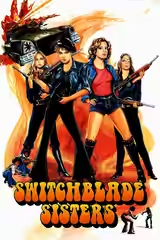
  1. Switchblade Sisters (1975) · not on Fi1m yetJack Hill’s girl-gang picture, made with the same energy and slightly more plot.

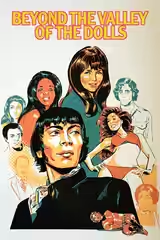
  2. Beyond the Valley of the Dolls (1970) · not on Fi1m yetMeyer with a studio’s money and Roger Ebert’s script; louder, sillier, in colour.

  3. Kill Bill: Vol. 1 (2003, Fi1m 72)Tarantino borrows the women, the fights and the attitude, and admits it.

  4. Female Prisoner #701: Scorpion (1972) · not on Fi1m yetJapanese exploitation with a heroine who barely speaks and needs no help.

  5. Thelma & Louise (1991, Fi1m 85)Two women, one car, the same desert, and rather more conscience.