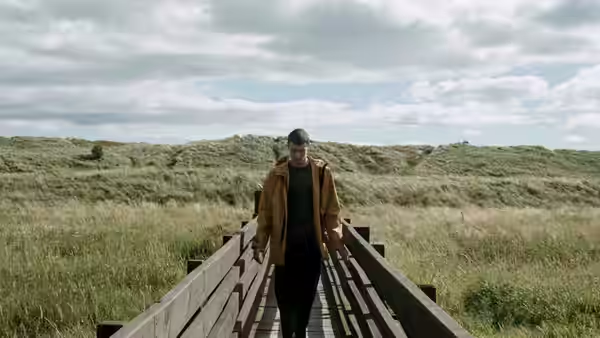
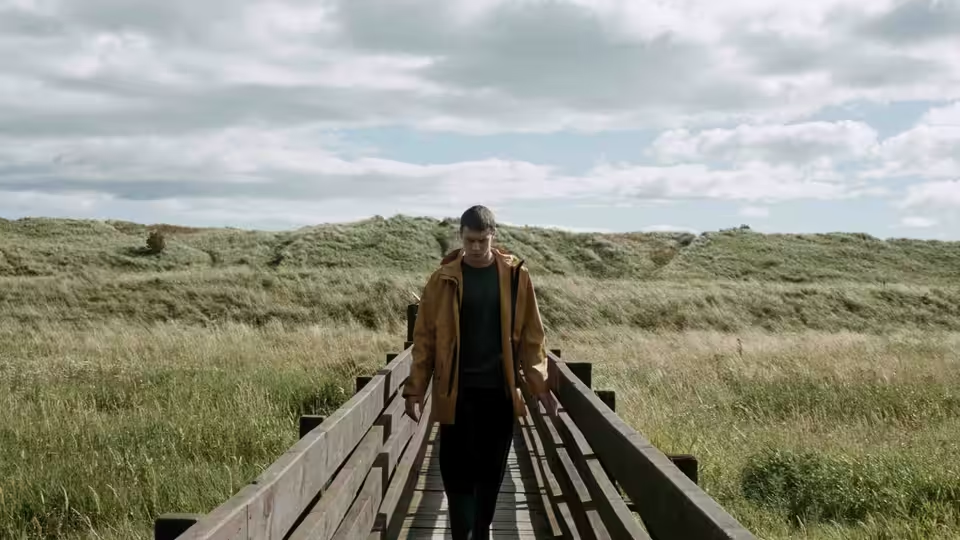
A young man walks along a wooden boardwalk through grassy dunes
Film review

For Those in Peril

2013 · Directed by Paul Wright · 1h 33m

In a sentenceGeorge MacKay is troubled enough without the entire coastline joining in

Young lives have been lost in a coastal community in Aberdeenshire, and Aaron (George MacKay) struggles to live with what has happened. Cathy (Kate Dickie) and Jane (Nichola Burley) are among those around him, but companionship does not make his distress easy to explain. His closeness to his brother’s girlfriend offers some comfort, while a tense encounter in a pub makes contact with others more difficult. Between the coast, the pub and glimpses of lost lives, everyday reality mingles with myth as Aaron tries to make sense of the tragedy.

Plays from YouTube when you press play; nothing loads from them until then.

Fi1m review

George MacKay gives Paul Wright’s coastal drama a painful immediacy that survives its stylistic excesses. The imagery sometimes overstates the grief, but the performances make it worth the discomfort.

For Those in Peril is a moving, uneven drama whose actors make its more elaborate passages worth tolerating. Writer-director Paul Wright tries to show grief changing how a person experiences the world, with coastal Aberdeenshire providing the setting and myth entering everyday life. That is a sensible ambition for a story about a man whose mind is unsettled by loss. The difficulty is that the director sometimes gives us several ways of understanding a feeling we have already understood.

George MacKay, as Aaron, supplies the reason to keep watching when that happens. His restraint allows the character’s distress to remain difficult to read, without making him remote or merely a case to be explained. We felt painfully on edge during the pub scene, because George MacKay makes Aaron’s discomfort seem so hard to conceal. It is the sort of scene in which another expressive image would only get in the way, and the performance needs no such assistance.

The connection between Aaron and his brother’s girlfriend is another point where the film becomes easier to care about. Shared grief can make such relationships feel like a screenwriting exercise, but there is an awkward emotional closeness here that resists neat explanations. Kate Dickie, as Cathy, also gives the suffering a force that does not depend on our accepting every stylistic choice. The direction is most convincing when it lets these performances establish how difficult it is for people to reach each other.

Benjamin Kračun’s cinematography gives the Aberdeenshire coast an unsettling presence. The landscape feels bound up with Aaron’s distress, and the mixture of realism and myth can make familiar surroundings seem uncertain. The documentary-style footage is especially effective at making the lost young lives feel immediate, giving the grief something specific to attach to. Elsewhere, the visual invention becomes too noticeable: we start considering what an image means when we ought to be watching Aaron.

Michael Aaglund’s editing has to bring the documentary-style material and the more poetic imagery into the same film, and the joins do not always feel necessary. There are passages where the changes of approach seem to be doing work the actors have already done. Across 93 minutes, that insistence becomes wearing, though the film never loses our interest entirely. Paul Wright could have trusted the performances to carry more of these passages without so much help.

Erik Enocksson’s music contributes to the unease, although this is hardly a film in need of extra emotional prompting. Simon Rogers’s production design is most persuasive in the everyday settings, particularly the pub, where ordinary surroundings give the tension somewhere credible to develop. Neither department is responsible for the tendency to press too hard. That comes from Paul Wright’s writing and direction, which sometimes treat another layer of meaning as an improvement in itself.

Grief dramas can settle into a routine of pain followed by reassurance, and the willingness to let realism become strange is welcome here. George MacKay and Kate Dickie keep us interested in people we might otherwise start treating as clues to be decoded. That is enough to make the unevenness worth accepting, though viewers who prefer a straightforward story may find the interruptions wearing. Save it for an evening when being unsettled is an acceptable outcome.

Critical consensus AI synthesised

70
Positive
6
Mixed
5
Negative
0

Most critics respond positively to For Those in Peril, with praise clustering around its performances and its attempts to give grief a visible form. George MacKay receives repeated approval for an understated, emotionally forceful performance, while the coastal setting and inventive imagery help establish the film’s unsettling atmosphere. The more enthusiastic reviews find that its blend of myth and realism deepens the emotion, rather than merely decorating an account of trauma.

Reservations concern how consistently those choices work. Several critics find the film uneven or not entirely convincing, with complaints about cliché, competing ideas and uncertain dramatic momentum. Empire praises MacKay but finds the results only occasionally powerful; The Skinny admires the boldness while questioning the stylistic excesses and muddy metaphors. The spread runs from strong enthusiasm to qualified appreciation, with no outright negative verdicts, though agreement on the acting is firmer than agreement on the storytelling.

Los Angeles Times
2 October 2014 · Gary Goldstein
90*

Goldstein praises the film as a haunting, powerful psychodrama and a must-see for serious filmgoers. He especially singles out its spiritual depth, inventive visuals, and George MacKay’s revelatory performance.

Read the full review →
The Hollywood Reporter
18 May 2013 · festival review · Stephen Dalton
80*

Dalton finds the film haunting, atmospheric, and a very strong debut. He praises its inventive visual textures as an effective expression of the protagonist’s disrupted psyche.

Read the full review →
The Guardian
18 May 2013 · festival review · Peter Bradshaw
70*

Bradshaw finds the film striking and emotionally powerful, though sometimes strained by cliché and too many ideas. He singles out George Mackay’s performance and the tense pub scene as especially effective.

Read the full review →
Variety
18 May 2013 · festival review · Charles Gant
70*

Gant finds the film a visually arresting poetic reverie, though its sustained pull is uncertain. He particularly praises Wright’s evocative depiction of coastal Aberdeenshire and its formally ambitious imagery.

Read the full review →
Evening Standard
4 October 2013 · The Standard
65*

The review finds Wright’s debut poetic but not entirely convincing. It praises George MacKay’s performance and the emotional chemistry between Aaron and his brother’s girlfriend.

Read the full review →
Screen Daily
18 May 2013 · festival review · Mark Adams
64*

The paywall prevents access to the critic’s verdict. The visible text does not reveal what the critic singles out for praise or complaint.

Read the full review →

Straight answers AI written, from our review

Is For Those in Peril worth watching?
For Those in Peril is worth watching for George MacKay’s restrained performance in an unsettling drama about grief, and we score it 73. We find the performances moving enough to outweigh the overworked imagery, though its shifts between everyday reality and myth can be wearing if you prefer a straightforward story.
How long is For Those in Peril, and what is it rated?
For Those in Peril runs 1h 33m. It is a drama film.
Where can I watch For Those in Peril in Germany?
For Those in Peril is not on any streaming or rental service in Germany at the moment. It is available in 14 other countries; change your country at the top of the page to see where. Availability is checked daily.
How does For Those in Peril compare to Ratcatcher?
For Those in Peril shares Ratcatcher’s Scottish setting and unsettling treatment of loss, but its mixture of realism and myth sometimes overstates feelings the actors already convey. We favour Ratcatcher for its unsentimental approach and attention to physical detail, despite some thinly drawn relationships; For Those in Peril suits viewers willing to accept stylistic excess for the force of its performances.
What should I watch after For Those in Peril?
After For Those in Peril, try Ratcatcher (1999, Fi1m 88): Another Scottish childhood shaped by loss, with images that remain stubbornly unsettling. Then The Spirit of the Beehive (1973, Fi1m 87): Childhood, isolation and imagined terrors, observed with patience rather than explanation; and Leave No Trace (2018, Fi1m 88): A more restrained study of distress, carried by two closely attentive performances.

Cast

If you liked this, try…

  1. Ratcatcher (1999, Fi1m 88)Another Scottish childhood shaped by loss, with images that remain stubbornly unsettling.

  2. Maborosi (1995) · not on Fi1m yetA quieter coastal grief drama that gives everyday routines room to matter.

  3. The Headless Woman (2008) · not on Fi1m yetFor another disturbed perspective, where familiar places become difficult to trust.

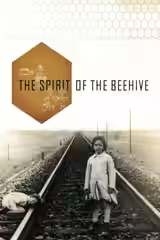
  4. The Spirit of the Beehive (1973, Fi1m 87)Childhood, isolation and imagined terrors, observed with patience rather than explanation.

  5. Leave No Trace (2018, Fi1m 88)A more restrained study of distress, carried by two closely attentive performances.