Michael Almereyda’s corporate-Manhattan Hamlet is a proper idea rather than a change of costume, and the cameras, the hotel and Bill Murray’s Polonius make it worth an evening. Ethan Hawke’s murmuring prince is the soft centre of a sharp film.
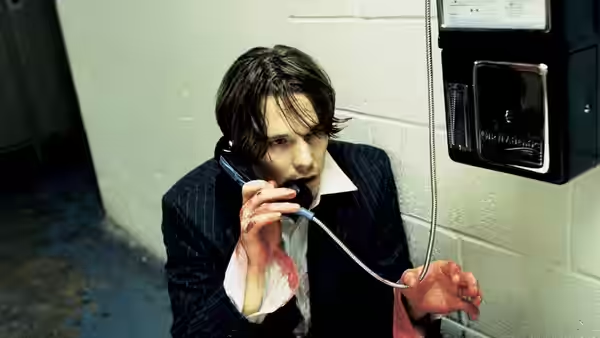
Michael Almereyda moves Hamlet to Manhattan in the year 2000 and cuts it to 112 minutes. Denmark is a corporation, Elsinore is a hotel, and the prince is a film-school dropout who carries a toy camera everywhere and talks to it more readily than to people. It is a real idea, not a change of costume, and for long stretches it works. Where it falls short is at the centre. Ethan Hawke gives us a Hamlet so withdrawn that the play’s engine, a mind that cannot stop, seems to be running in another room.
Start with what is good. The ghost comes in over the closed-circuit cameras, and surveillance runs through the whole film: Polonius wires Ophelia for sound, Claudius watches his nephew on monitors, everyone is recorded by somebody. Almereyda has noticed that the play was already about being watched and has given the watchers the equipment. The play within the play becomes a short film Hamlet edits from old tapes and screens for the family, the cleverest thing in the picture and, oddly, one of the most faithful.
Gideon Ponte builds the Denmark Corporation out of glass and grey carpet and the Hotel Elsinore out of beige rooms with expensive lamps, and gives Hamlet a flat piled with screens and cassettes. John de Borman shoots the city at night through windows, so faces are laid over traffic and neon and the reflections do some of the work the speeches used to. Carter Burwell’s score is low and sparse, strings and a piano that never quite settles, the right choice for a film this quiet. Kristina Boden cuts fast, and the speed costs something: the text is trimmed hard, sometimes mid-thought, and a couple of the famous speeches arrive already half over.
“To be or not to be” is delivered in the Action aisle of a Blockbuster, the prince pacing past shelves of shrink-wrapped explosions. It is a good joke and it means something too, since the speech is about doing nothing and he is surrounded by the opposite. But Hawke murmurs it, as he murmurs most of the part. He has the face for a sad prince and none of the danger. We never believed this Hamlet could hurt anyone, and the play needs us to believe he might.
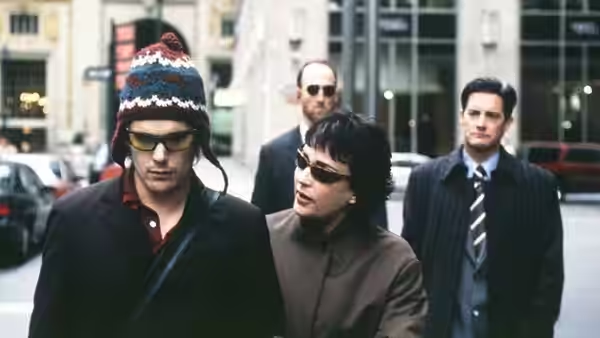
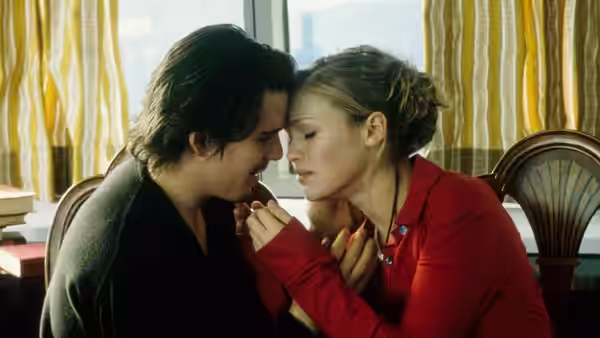
The supporting cast carries him. Bill Murray plays Polonius as a middle manager who has given the same advice at a great many dinners and half believes it, and his farewell to Laertes, delivered while helping him into his coat, is the warmest scene in the film. We laughed at the old fool and then felt for him, which is the order Shakespeare intended. Julia Stiles makes Ophelia a sullen, watchful teenager who photographs everything and says little. Kyle MacLachlan’s Claudius is a smooth chief executive back from a good lunch, and Liev Schreiber speaks the verse as though he has done it before. Diane Venora is given too little to do as Gertrude. Jeffrey Wright turns up late as the Gravedigger for a couple of minutes and makes them count.
The moment that got at us was small. Hamlet alone in his flat, playing back home video of his parents on a little screen, rewinding, playing it again, saying nothing. Hawke is better silent than speaking, and in that scene the whole business of a son who cannot move on is on his face without a line. We were moved, and slightly annoyed that the film had not found more scenes like it. In the long middle stretch, men in suits talking across tables, we drifted and watched the city behind them.
Baz Luhrmann did modern-dress Shakespeare at full volume four years earlier with Romeo + Juliet. Almereyda does it at a mutter, and there is something honest in that. Against Olivier’s or Branagh’s films it is a sketch, but a sketch with a dozen images you will remember.
Watch it with the play half remembered rather than fully. It is short enough that its thin patches pass quickly. Bring patience for the prince; everyone around him is doing better work than he is, which is the family’s complaint too.