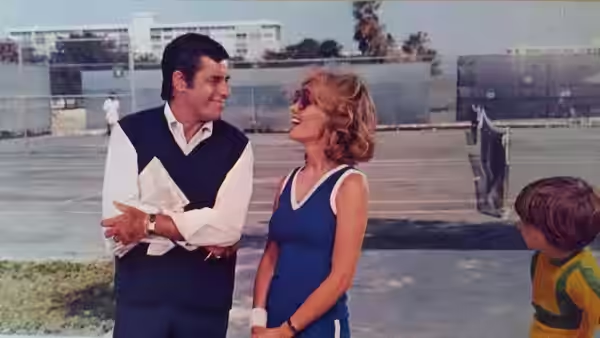
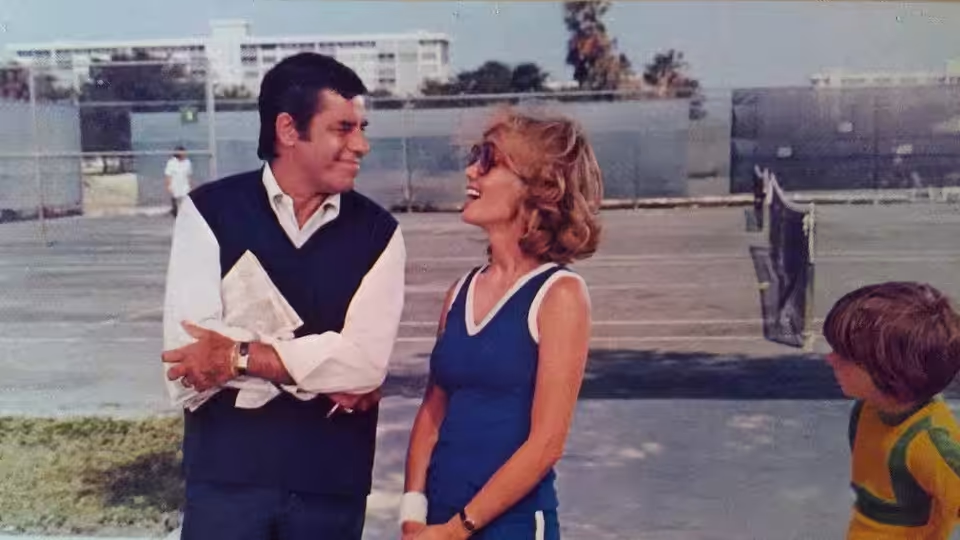
Bo Hooper (Jerry Lewis) talking with a woman beside a tennis court as a child watches
Film review

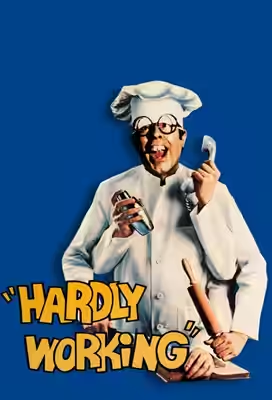
Hardly Working

1980 · Directed by Jerry Lewis · 1h 31m

In a sentenceA clown loses his circus and spends ninety minutes auditioning for jobs, sympathy and a comeback, in that order

Bo Hooper (Jerry Lewis) is a circus clown, and the circus has just closed. With no act and no savings he moves in with his sister Claire (Susan Oliver) and her husband Robert (Roger C. Carmel), who has an office to go to in the morning and a short supply of patience. Bo wants work, any work, and sets out to find it: a petrol station forecourt, a bar, a Japanese restaurant, a disco. Each job ends the same way, with something broken and Bo back on the pavement in his street clothes. Then he applies at the post office, where Frank Loucazi (Harold J. Stone) runs the sorting room and his daughter Millie (Deanna Lund) works the counter, and for the first time somebody is prepared to give him a second morning.

Fi1m review

Jerry Lewis returns to directing with a clown who cannot hold down a job, and the film cannot hold down a shape. Two or three gags remind you what he could do; the rest is slack, sentimental and, once, plainly in bad taste.

Hardly Working is the first film Jerry Lewis had directed in ten years, and it begins by showing us clips from the old ones. That is a confident way to open and a dangerous one, because for the next 91 minutes we are invited to compare. Lewis directs, stars and shares the screenplay with Michael Janover, who also supplies the story, and the story is this: a clown called Bo Hooper loses his circus and tries to be something else. It is not a bad idea. Lewis has always been best as a man whose body refuses to do the ordinary thing, and a film about a clown who cannot stop being a clown ought to suit him.

It does not, mostly, and the reason is that nobody has built anything around the idea. Janover and Lewis move Bo from job to job the way a sketch show moves from set to set. He arrives, he is shown what to do, he does something else, he is sacked. Then the next one. There is no reason the petrol station comes before the bar, or the bar before the disco, and a film that could be shuffled is a film that has not been written so much as collected.

The petrol station is the best of them, and for a few minutes we remembered why people queued. Bo tries to fill a car and ends up fighting the hose, the pump and his own trousers, and Lewis, who was in his fifties when he made this, still lands every fall exactly where he means to. The timing is in the body, not the cutting. Michael Luciano lets most of the gags run past their end, a tumble, a reaction, a second reaction, a look to the heavens, and it is only here, where Lewis is moving too fast to be caught, that the slack does not show.

Then there is the Japanese chef. Bo takes a job in a restaurant, Lewis puts on make-up and an accent, and the film gives him the better part of a scene to do a routine that was tired before the war. We winced, and then we felt sorry for everyone in the restaurant, including the extras pretending to enjoy their dinner. It is not that the film is spiteful; it plainly thinks this is a fond throwback. But the camera sits and admires it, and that is the moment the comeback curdles.

James Pergola lights all of this flat and bright, in hard sunshine and white interiors, so that the film looks like a daytime serial with a bigger star. Morton Stevens scores it with a soft, sorrowful theme that arrives every time Bo is alone, and it tells us to pity him before he has done anything pitiable. Susan Oliver is the one quiet success: her Claire watches her brother wreck the kitchen with an affection that is not written anywhere in the script, and the two or three scenes she anchors are the only ones in which Bo seems like a person rather than a routine. Roger C. Carmel, as the brother-in-law, gets to be exasperated and is good at it. Harold J. Stone and Deanna Lund are handed the post office and the romance and do what they can with both.

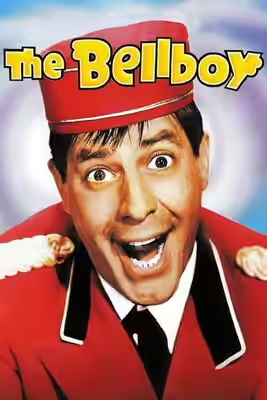
Lewis’s own standard is the problem. The Bellboy was a string of gags too, but it was 72 minutes of them and it knew exactly what each one was for. The Nutty Professor had a shape, and a cruelty it understood. This one has the sentiment of those films and much less of the discipline, and the second half, which we will not describe in detail, leans so hard on Bo’s sorrow that the comedy begins to feel like an apology for it.

If you loved him then, there are perhaps four minutes here that are worth your evening, and you will know where they are. The poster calls him the world’s funniest funny man. The film spends an hour and a half insisting on it and about four minutes proving it.

Critical consensus AI synthesised

2 of 6
Positive
0
Mixed
1
Negative
1
The New York Times
3 April 1981
61*

The accessible page does not reveal the critic’s verdict. It also does not show what the critic praised or criticized.

Read the full review →
The New Yorker
30*

The capsule finds the film’s amiable tone undercut by a troubling streak of cruelty. It singles out Lewis’s parody of a Japanese chef as an especially embarrassing example.

Read the full review →

Straight answers AI written, from our review

Is Hardly Working worth watching?
Hardly Working is worth watching only for devoted Jerry Lewis admirers, and we scored it 45. The petrol station routine shows he could still land a fall in his fifties, but the rest is a loose string of job sketches, soft with sentiment, and one Japanese chef scene in plain bad taste. Newcomers should start with his earlier films.
How long is Hardly Working, and what is it rated?
Hardly Working runs 1h 31m. It is a comedy film.
Where can I watch Hardly Working in the UK?
Hardly Working is not on any streaming or rental service in the UK at the moment. Availability is checked daily.
How does Hardly Working compare to PlayTime?
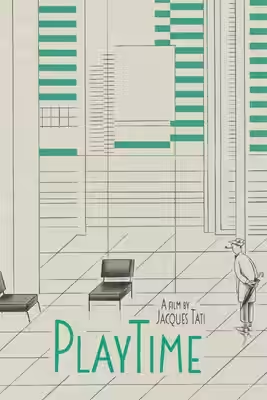
Hardly Working and PlayTime both send a clown into a modern world that will not have him, and Tati's is the better film by a wide margin. Lewis moves Bo from job to job like a sketch show, while Tati builds one exacting glass city and hides his gags in it. Lewis is the easier watch; PlayTime rewards the effort it asks.
What should I watch after Hardly Working?
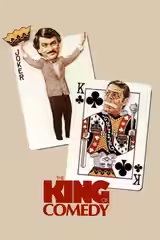
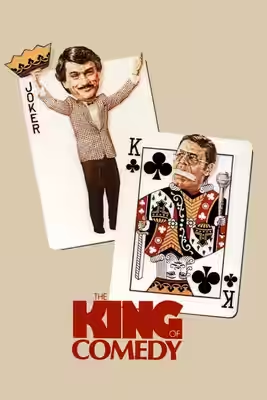
After Hardly Working, try Playtime (1967, Fi1m 88): Tati’s clown loose in a glass city; the modern world defeats him far more elegantly. Then The King of Comedy (1982, Fi1m 88): Lewis acting for Scorsese, dry and furious, the best thing he did in the decade; and Toni Erdmann (2016, Fi1m 86): A father who puts on false teeth to reach his daughter; the pathos earns itself.

Cast

If you liked this, try…

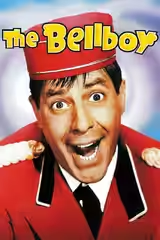
  1. The Bellboy (1960) · not reviewed yetLewis’s first film as director: the same gag-string idea, with the discipline this one lacks.

  2. Playtime (1967, Fi1m 88)Tati’s clown loose in a glass city; the modern world defeats him far more elegantly.

  3. The King of Comedy (1982, Fi1m 88)Lewis acting for Scorsese, dry and furious, the best thing he did in the decade.

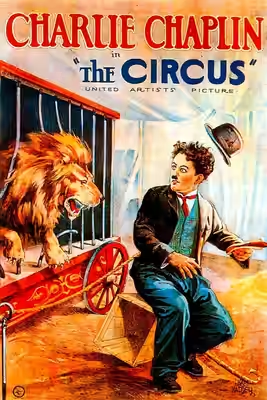
  4. The Circus (1928) · not reviewed yetChaplin’s clown who can only be funny by accident, told in 70 minutes with a shape.

  5. Toni Erdmann (2016, Fi1m 86)A father who puts on false teeth to reach his daughter; the pathos earns itself.

Free account

Know what to watch tonight

Two lists that know where things are streaming, collections you can share, your own score beside ours, and Discover that remembers what you have seen.

  • Want to see, sorted by what is streaming now
  • Seen, with your score out of ten
  • No adverts, ever