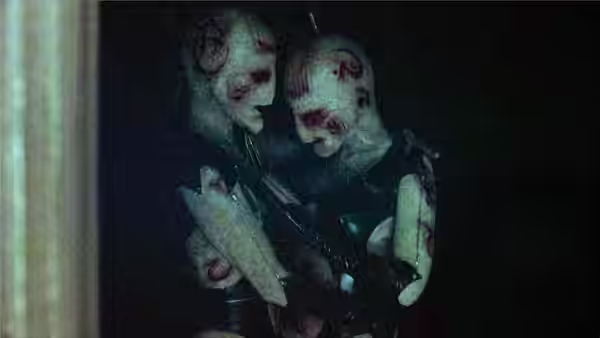
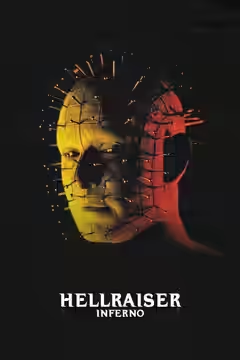
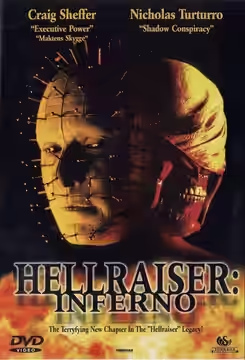
Pinhead (Doug Bradley) standing in a dimly lit interior
Film review

Hellraiser: Inferno

2000 · Directed by Scott Derrickson · 1h 40m · FSK 18

In a sentenceA detective, a serial killer and Pinhead, who seems to have been invited to a different film

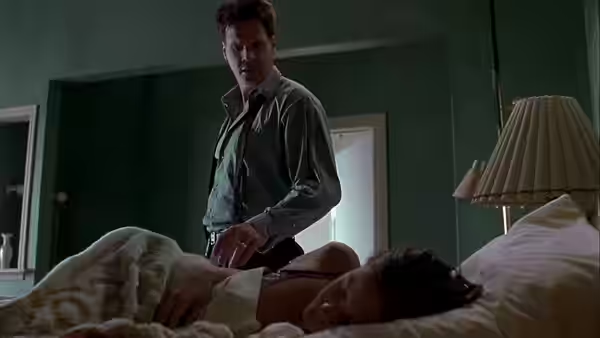
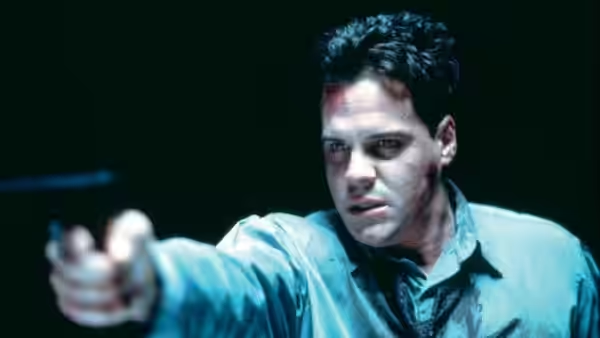
Det. Joseph Thorne (Craig Sheffer) pursues a serial killer in a case that takes him beyond the familiar routines of police work. Around him are Det. Tony Nenonen (Nicholas Turturro) and Dr. Paul Gregory (James Remar). Thorne wants to find the killer, but the investigation grows stranger as the detective thriller gives way to a nightmare. The horror includes Pinhead (Doug Bradley), while the focus remains on Thorne and his pursuit. With Thorne leading the search, police procedure gives way to increasingly surreal and disorientating encounters.

Fi1m review

Scott Derrickson gives this detective horror an unpleasant, dreamlike atmosphere, but the investigation is wearying and its lead offers little reason to stay. We cannot recommend it on atmosphere alone.

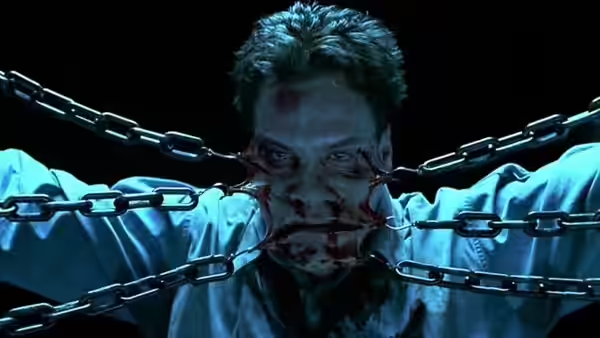
Hellraiser: Inferno tries to turn a police investigation into a nightmare, and Scott Derrickson finds some unpleasant images along the way. A detective’s pursuit of a serial killer becomes increasingly strange, with the familiar business of detection gradually losing its reassuring shape. There is conviction in that change, enough to distinguish the film from a routine exercise in catching a murderer. We still cannot recommend it: the investigation is tired, and the detective at its centre does too little to hold our attention.

Craig Sheffer plays Det. Joseph Thorne with a narrowness that becomes wearing. An unpleasant detective can be compelling company, provided the performance gives us something to study beyond his unpleasantness. Here, too few changes in the acting make the sustained attention worthwhile. We soon stop wondering what else there might be to this man. That is a substantial problem for a film which keeps him so firmly at its centre and asks us to follow him into increasingly strange territory.

Nathan Hope’s cinematography is more persuasive, particularly as the police thriller becomes dreamlike. The grubby appearance suits the material, making the horror feel unhealthy without requiring constant escalation. Production designers Dorian Vernacchio and Deborah Raymond help sustain that oppressive atmosphere, giving the images enough ugliness to discourage any comfortable admiration. We were unsettled by the sensuality amid the grime. Those passages briefly make the film feel unpredictable, and give us something to respond to beyond the mechanics of the case.

The screenplay by Paul Harris Boardman and Scott Derrickson has a harder time making the investigation worth following. Its movement towards the surreal is welcome, but it also exposes how little interest the familiar police material has generated. A mystery can survive our dislike of its investigator if the pursuit has enough tension of its own. Here the unpleasantness does too much of the work, and the grim manner becomes repetitive. The occasional absurdity offers some relief, suggesting possibilities that the dogged detective story does too little to develop.

Kirk M. Morri’s editing has to negotiate the movement from investigation to nightmare, and the result feels uneven. The disorientation sometimes works, though the stretches of routine detection make the pace feel sluggish. At 100 minutes, the film has room to develop its mystery and its horror, yet too much of that time feels spent waiting for the stranger material to return. Walter Werzowa’s music is useful at maintaining unease during those stretches, without making the pursuit much more urgent.

Doug Bradley’s Pinhead brings another difficulty: the surrounding detective material struggles to justify sharing a film with him. Judged as investigative horror, this needs a stronger connection between the case and the nightmare it becomes. The sensual and absurd moments suggest that Derrickson is willing to stray from the expected, which makes the conventional police plotting more frustrating. There is enough visual unease here to explain its appeal to devotees of grubby horror. Anyone chiefly looking for a compelling investigation should look elsewhere.


Critical consensus AI synthesised

2 of 6
Positive
1
Mixed
0
Negative
1
Den of Geek
9 October 2022 · Jack Beresford
75*

The critic views Hellraiser: Inferno as an underrated entry in the series, praising Scott Derrickson's direction for creating a scuzzy, surreal nightmare atmosphere that evolves from a detective thriller into something more dreamlike and visually striking.

Read the full review →
Eye for Film
24 May 2017 · Jennie Kermode
30*

The critic finds little to recommend in this fifth Hellraiser entry, describing it as a tired cop-vs-serial-killer story awkwardly grafted onto the franchise with mostly unappealing results. She singles out the unlikeable protagonist and limited acting range as major flaws, while noting a few absurd or sensual moments as minor positives.

Read the full review →

Straight answers AI written, from our review

Is Hellraiser: Inferno worth watching?
Hellraiser: Inferno earns 54/100 from us: its unpleasant, dreamlike atmosphere is effective, but we cannot recommend it on that alone. Devotees of grubby horror may find enough visual unease to hold their attention; the tired investigation and wearing central performance offer little for anyone seeking a compelling detective thriller.
How long is Hellraiser: Inferno, and what is it rated?
Hellraiser: Inferno runs 1h 40m and is rated 18 by the FSK in Germany. It is a horror and thriller film.
Where can I watch Hellraiser: Inferno in Germany?
Hellraiser: Inferno is not on any streaming or rental service in Germany at the moment. Availability is checked daily.
How violent or frightening is Hellraiser: Inferno, and is it suitable for children?
Hellraiser: Inferno has a UK 18 certificate and is not suitable for children; its oppressive atmosphere, unsettling sensuality and disorientating nightmare imagery also warrant caution for sensitive adults. We find the sensuality amid the grime particularly unsettling, though our review does not establish how graphic or frequent the violence is.
How does Hellraiser: Inferno compare to Jacob's Ladder?
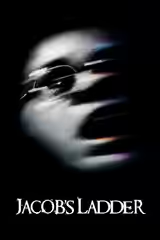
Hellraiser: Inferno is the weaker choice beside Jacob’s Ladder, which we recommend for nightmare imagery grounded in a more compelling central performance. Both move through disorientating horror, but Tim Robbins gives the hallucinations a human cost that Craig Sheffer’s detective struggles to provide, even if Jacob’s Ladder sometimes labours its significance and tangles its explanations.
What should I watch after Hellraiser: Inferno?
After Hellraiser: Inferno, try Jacob's Ladder (1990, Fi1m 80): For nightmare imagery that makes the person experiencing it matter. Then The Element of Crime (1984, Fi1m 63): Police procedure sinks into a feverish landscape of decay and obsession; and Kill List (2011, Fi1m 82): Criminal work and domestic misery lead towards an increasingly disturbing horror.

Cast

If you liked this, try…

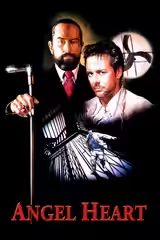
  1. Angel Heart (1987) · not on Fi1m yetAnother detective follows a case into horror, with considerably more atmosphere.

  2. Cure (1997) · not on Fi1m yetA murder investigation becomes deeply unsettling through patience, repetition and uncertainty.

  3. Jacob's Ladder (1990, Fi1m 80)For nightmare imagery that makes the person experiencing it matter.

  4. The Element of Crime (1984, Fi1m 63)Police procedure sinks into a feverish landscape of decay and obsession.

  5. Kill List (2011, Fi1m 82)Criminal work and domestic misery lead towards an increasingly disturbing horror.

Hellraiser: Inferno (2000) review: Grimy horror, but a thin plot (Germany) | Fi1m