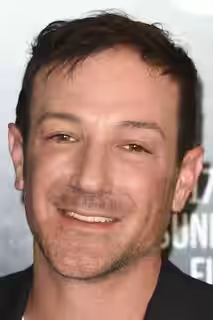
Bryan Fogel set out to film himself cheating at amateur cycling and ended up with the man who ran Russia’s anti-doping laboratory telling him everything. The first hour is self-indulgent; the second is a proper thriller, and nearly all of it is Grigory Rodchenkov.
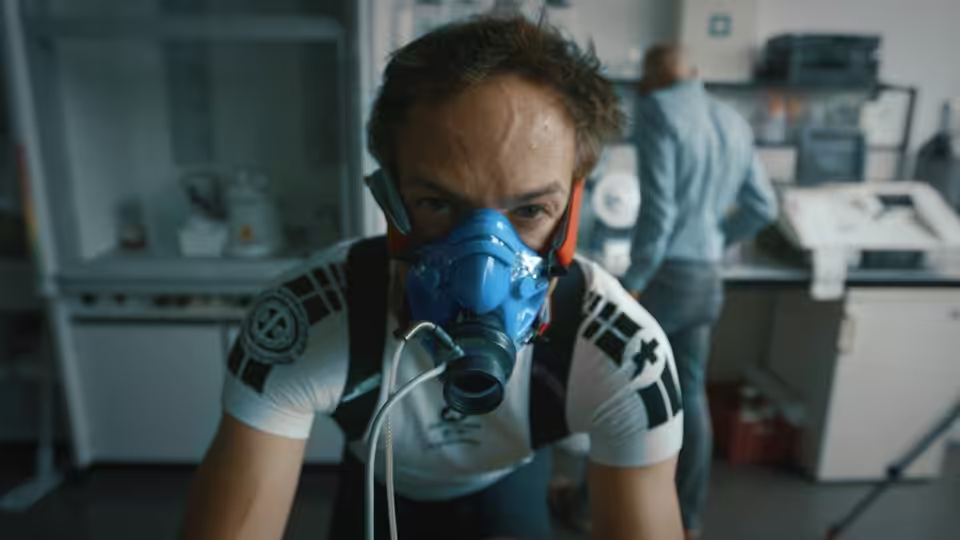
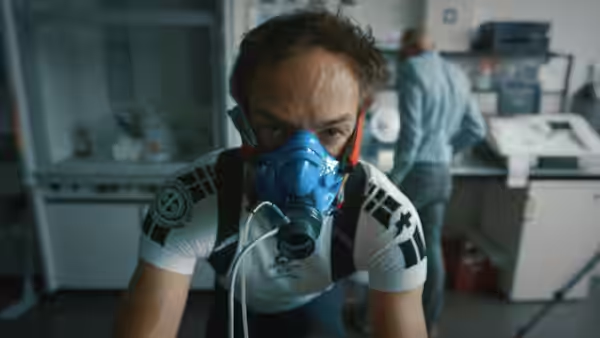
Bryan Fogel is a filmmaker who rides bicycles seriously, and in 2014 he had an idea. He would ride the Haute Route, an amateur stage race through the Alps, once clean and once on a full doping programme, and film himself beating the tests that had finally caught Lance Armstrong. It is a stunt, and the film admits as much. Then, about an hour in, the man advising him on his injections turns out to be at the centre of the Russian doping scandal, and ready to talk, and Icarus becomes a different and far better film. It is worth your evening, as long as you can forgive the first hour for being the price of the second.
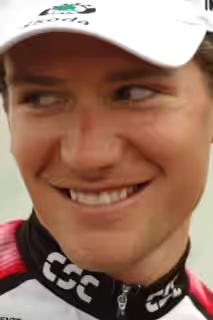
That first hour is thin. Fogel injects testosterone into himself in his kitchen, fills his fridge with labelled bottles of urine, and rides up mountains while Jake Swantko and Timothy Rode shoot him from the bike and from the chase car. Don Catlin, who founded the anti-doping laboratory at UCLA, listens to the plan and then quietly removes himself from it. Dave Zabriskie, a retired professional rider, explains what the drugs do to a body and what they did to the sport. Fogel is not an interesting enough subject to carry a feature, and the film keeps cutting to Armstrong on television to borrow a weight it has not earned.
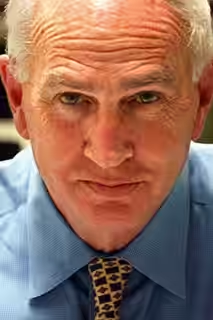
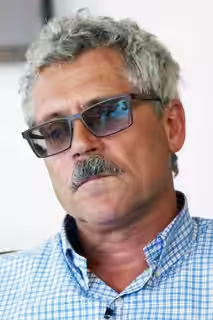
What rescues it is the man Catlin passes him to. Grigory Rodchenkov ran Russia’s anti-doping laboratory in Moscow, and he appears in a Skype window grinning, telling Fogel what to take and when to stop so that a test will come back clean, with the good humour of a man teaching a cookery class. He quotes Orwell. He finds the whole business hilarious. We laughed with him, and liked him, and then caught ourselves, because the film has just shown us that the person charged with catching cheats is coaching one. Fogel does not push him on this. He is too pleased to have him.
Then, in late 2015, an independent commission into Russian athletics, led by Richard Pound, publishes its report, and Rodchenkov’s laboratory is in it. What follows we will describe only in outline. The film becomes a whistleblower story, and Fogel finds himself holding the camera while a man’s life comes apart in front of it. Rodchenkov begins to tell what he says was done at the Winter Olympics in Sochi, and we will leave him to tell it. It is here that we were frightened for him, plainly and for a long stretch, and the fear came not from the music but from his face, which stops grinning.
The second half is cut by Jon Bertain, Kevin Klauber and Timothy Rode as a run of podiums and denials. Thomas Bach, Sebastian Coe and Vitaliy Mutko say, in archive footage, that there is nothing to see, and the editors lay their words against Rodchenkov’s diaries and his account. Richard McLaren, the lawyer brought in to investigate, is patient and exact. Adam Peters’s score drops to a low pulse under all this, which does the job without trusting the pictures to do it; the quiet scenes of Rodchenkov alone in borrowed rooms are stronger than any cue.
The flaws are real. Fogel stays in the frame long after he has stopped being the story, and the chapter headings taken from Nineteen Eighty-Four tell us what to think when Rodchenkov has already made it obvious. The film never asks its subject the hard question about his own part in what he describes; it lets him be charming instead. At 121 minutes it carries about twenty that belong in a shorter film about an amateur cyclist, and that film was never going to be good.
Alex Gibney had something similar happen to him with The Armstrong Lie (2013), which set out to record a comeback and ended up recording a confession. Gibney kept his distance. Fogel cannot, and the result is messier and, in its second half, more alarming. Watch it at home, where you can pause to take in what Rodchenkov has just said. He grins through most of it. We stopped grinning around the halfway mark and did not start again.