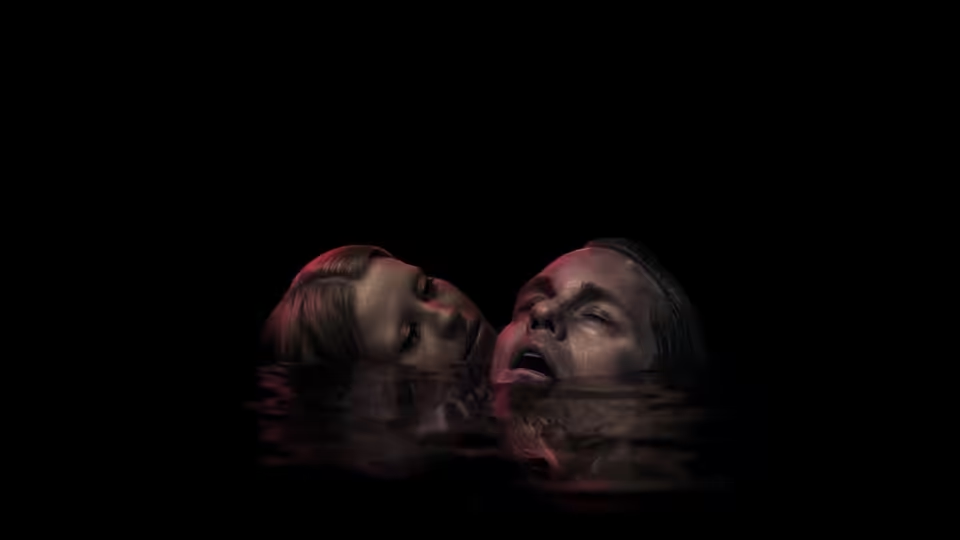
David Cronenberg’s has a premise most horror films would envy, an hour that uses it well and an hour that repeats it. Mia Goth, grinning and bellowing as the tormentor by the pool, is the reason to stay to the end.
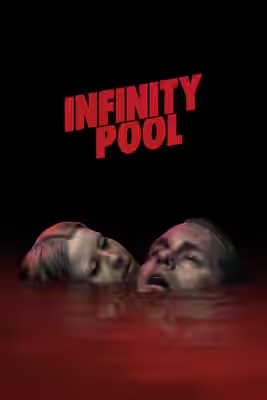
David Cronenberg’s’s third film opens at a luxury resort on a poor island where the guests are told not to leave the compound. The local law, it turns out, is for sale. A man who kills here can be executed, or he can pay to have an exact double of himself grown and executed in his place, provided he sits and watches. That is the idea and it is a fine one. Infinity Pool uses it well for about an hour, then does it again, louder. Mia Goth carries the second hour alone.
James Foster (Alexander Skarsgård) is a novelist with one book behind him and no second in sight, on holiday with his wife Em (Cleopatra Coleman), whose money is paying. Gabi (Goth) stops him by the pool to say she loved the book, and she and her husband Alban (Jalil Lespert) take the Fosters out past the fence for a day. Driving back in the dark, James hits a man on the road and kills him. A few scenes later he is in a bare room watching a copy of himself being led out to die. Cronenberg, who also wrote the script, holds on this for a long time, and we were horrified: not by the blood, which is brief, but by Skarsgård’s face watching Skarsgård’s face, one frightened and one curious.
Karim Hussain shoots the resort in flat, overlit daylight and then starts tipping the camera, so that whole conversations play on a tilt or upside down. When the tourists take a local drug, he and the editor James Vandewater turn the screen into a churn of skin, teeth and coloured light, cut so fast the frame stops being anywhere. Tim Hecker’s score is drones and smeared brass, a low pressure under every scene that swells when nothing on screen has asked it to. Zosia Mackenzie designs the compound in beige wicker and white walls, and Mária Fatér dresses the guests in resort linen and Gabi in things chosen to be seen from the far side of a pool.
Goth plays Gabi as a woman who has found the one place on earth where her cruelty is legal, and is delighted. She grins, she needles, she bellows James’s name across a hillside in a voice that could strip paint, and every hostile thing she says has the lilt of a hostess offering a drink. Skarsgård does the opposite job, going smaller and blanker as the film goes on, a large handsome man shrinking inside his own body. There is a scene in which he is made to go about on all fours, and the film means us to laugh, and we did, and then felt slightly ashamed of ourselves.
The trouble is that the film has said what it means by the end of the first act: the rich can buy their way out of anything, including their own deaths, and once they know it they go looking for things to be forgiven for. The second hour shows them doing exactly that, in set pieces each bloodier than the last, none of which tells us anything the execution room had not. The script loses interest in Em once the plot is running, which wastes Coleman, and the other tourists (Amanda Brugel, Jeff Ricketts, Caroline Boulton) are dressed, named and given nothing to do but drink and leer. By the fourth outrage we were checking how long was left, and then cross that a film this well made had let us.
Against Cronenberg’s own record it is a step sideways. Possessor (2020) had one violent idea and kept turning it, so that each scene put the idea somewhere new. This has a better idea and moves it less. Since every review mentions his father, we will too: David Cronenberg’s Dead Ringers (1988) also gave a man his own face on someone else, and it knew what to do with the fear for the whole running time.
It carries an 18 certificate and uses every minute of it. See it for the first hour and for Goth, with someone who will not mind being told how bad rich people are. If you find yourself around the seventy-minute mark wondering why any of these people are still on the island, so were we. It runs 118 minutes.