Lanthimos reunites with Efthimis Filippou for three cold fables about doing as you are told, and the first is as sharp as anything he has made. The other two repeat its lesson, and 164 minutes is a long time to be taught one thing.
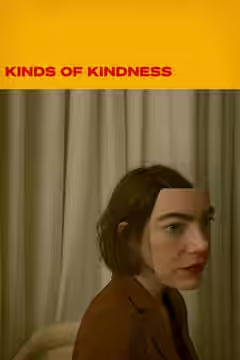
Yorgos Lanthimos has followed Poor Things with something closer to the films that first got him noticed. Kinds of Kindness is three stories of roughly fifty minutes each, played by the same handful of actors in different parts, and each is about a person who has handed their life to someone else and is now finding out what that costs. He wrote it with Efthimis Filippou, who wrote Dogtooth and The Lobster with him, and the tone is theirs: flat, exact, and funny in a way that makes you check whether anyone else in the room is laughing. The first story is as good as anything Lanthimos has made. The other two say the same thing again, and the whole runs 164 minutes.
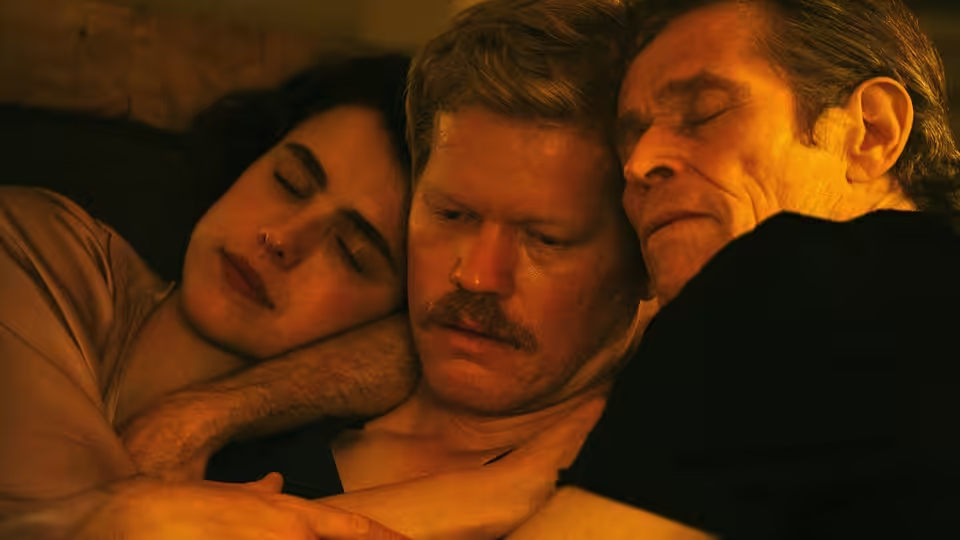
Robert (Jesse Plemons) works for Raymond (Willem Dafoe), who decides what Robert eats, what he reads, how much he weighs and when he sleeps with his wife, Sarah (Hong Chau). Robert has agreed to all of this and believes he is happy. Then Raymond gives him a new instruction, involving a car and a stranger, and Robert hesitates for the first time. Plemons plays him with a small fixed smile and eyes that keep sliding towards Dafoe for approval, and we laughed, often and a little uneasily, at how completely the smile stops working once the approval is withdrawn. Dafoe, meanwhile, is all warmth: the tyrant as a fond uncle, handing out gifts and never once raising his voice.
The second story gives Plemons a policeman, Daniel, whose wife Liz (Emma Stone), a marine researcher, has been lost at sea. She comes home. Daniel decides she is not his wife: her feet are the wrong size for her shoes, she eats chocolate when she used to refuse it. Stone plays Liz as a woman so afraid of losing him that she will agree to anything, and Lanthimos tests exactly how far that goes. There is a scene at a kitchen table, some way into this section, that we watched through our fingers and will not describe. It is the one point in the film where the cruelty is plainly about something, and it works because Robbie Ryan’s camera stays on Stone’s face rather than on what her hands are doing.
The third story is the longest and the slackest. Emily (Stone) and Andrew (Plemons) drive around town for a cult led by Omi (Dafoe) and Aka (Chau), looking for a woman who can raise the dead; Emily has left a husband (Joe Alwyn) and a small daughter to do it, and Margaret Qualley turns up as twins, one of whom may be the woman they want. The premise is the best of the three and the film does the least with it. The point about obedience has already been made twice, and Lanthimos fills the extra time with rituals, a sauna and a swimming pool, none of which tell us anything the first hour did not.
Ryan, after the fisheye lenses and candlelight of Poor Things, shoots this straight: wide lenses, hard daylight, beige offices and hospital corridors. Anthony Gasparro’s rooms are anonymous on purpose, the sort of American interiors where nothing is older than the carpet, and Jennifer Johnson puts Robert in suits so neat they look chosen by somebody else, which they were. Jerskin Fendrix’s score is the funniest thing here after Plemons: single piano chords struck too hard, a choir that bursts in for a bar and stops as if someone had shut a door on a rehearsal. Yorgos Mavropsaridis cuts each story cleanly and cuts none of them enough; every one could lose ten minutes and be better for it.
Against Lanthimos’s own record this sits nearer The Killing of a Sacred Deer than The Favourite. Dogtooth made a similar case about the family as a small dictatorship and was done in an hour and a half. Here the same case is made three times in a row, and each retelling is a little more pleased with itself than the last.
See it for the first story, which is close to perfect, and for Plemons, who is different in all three parts and best in the one where he is allowed to be frightened. It carries an 18 and it earns it. And if you are watching at home and the second title card comes up, there is no shame in deciding that you have already seen a good film and going to bed.