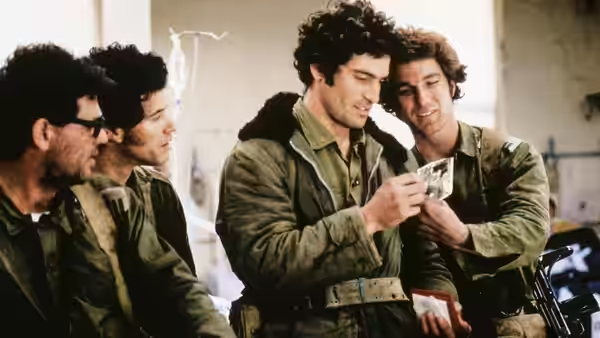
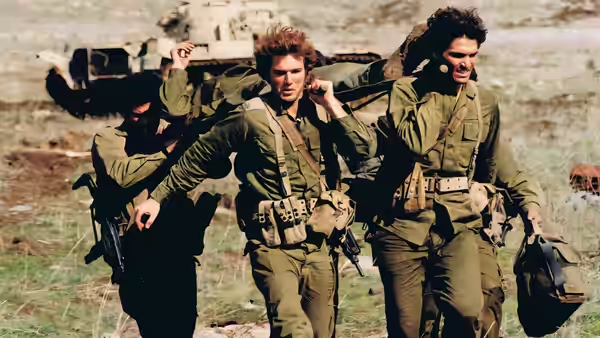
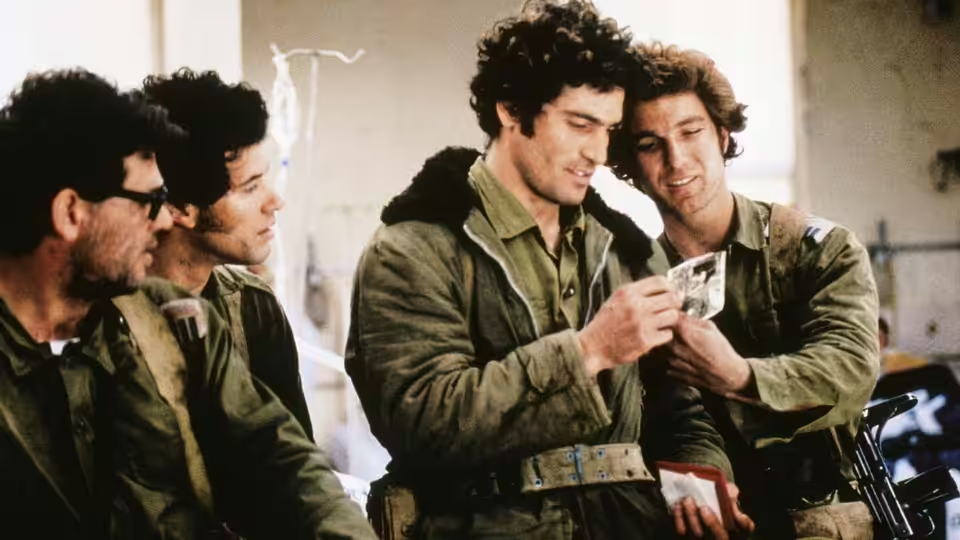
A scene from Kippur
Film review

Kippur

2000 · Directed by Amos Gitai · 1h 57m

In a sentenceFirst aid should not require this much courage

The surprise attack of 1973 takes Weinrub (Liron Levo) from his private life with his girlfriend into the work of a first-aid team. Ruso (Tomer Russo) and Klausner (Uri Klauzner) are among the men caught up in the conflict. At the battlefront, the immediate task is to help the wounded, but the fighting leaves those providing medical care exposed to danger themselves. Their work takes place within a war that gives them little control over the conditions in which they must carry it out.

Fi1m review

Amos Gitai’s Kippur is a forceful war film built around the work of a first-aid team. Its opening feels unnecessary, but the battlefront sequences are worth the discomfort, provided you can face a punishing evening.

Kippur is a war film we recommend, with a warning that its strongest scenes are also its hardest to watch. Amos Gitai follows a first-aid team after the surprise attack of 1973, making the effort to help the wounded the centre of our attention. There is enough drama in that work without treating every useful act as a heroic achievement. The battlefront sequences are forceful because being able to do something for another person offers so little protection from what is happening around them.

Liron Levo plays Weinrub, with Tomer Russo as Ruso and Uri Klauzner as Klausner. The performances make sense within a film concerned with people trying to be useful under conditions they cannot control. We were shaken by the first-aid work at the battlefront, where the danger does not recede just because someone needs medical help. The director gives that simple, dreadful predicament enough attention for us to feel how little these men can take for granted while doing their jobs.

Renato Berta’s cinematography gives these passages their uncomfortable immediacy. We feel close to the work, without the pleasurable sense of command that an action sequence can offer. Miguel Markin’s production design also serves the practical demands of the scenes: the battlefront feels like a place in which people must function, despite having little control over it. The result is convincing without requiring us to stop and admire how convincingly the war has been recreated.

Editors Monica Coleman and Kobi Netanel make the accumulating strain count. The time spent with the team feels necessary because the job itself is difficult enough to hold our attention, without an extra dramatic reward attached to every passage. Jan Garbarek’s music adds to the unease, although the film scarcely needs further help in making this situation distressing. At 117 minutes, Kippur asks for sustained attention, and the battlefront material earns it.

The opening with Weinrub and his girlfriend is the clear weakness. A glimpse of private life ought to give us a person to hold on to when the fighting begins, but this introduction feels detached from what makes the rest of the film persuasive. The writing by Amos Gitai and Marie-Jose Sanselme is stronger when the first-aid team’s task gives the scenes a direct purpose. We would lose little by arriving at that work sooner; the opening delays our involvement.

The focus on first aid matters to how we judge the courage on display. Helping somebody is worthwhile even when it cannot make the larger situation any less appalling, and the film lets that be enough. Viewers tired of being asked to enjoy the machinery of battle will find something worth their attention here. Watch Kippur if you can bear to spend an evening with the people left to deal with the damage.

Critical consensus AI synthesised

74
Positive
2
Mixed
3
Negative
0
Film Comment
· Robert Sklar
90*

Sklar presents Kippur as a major breakthrough and one of the great war films. He praises its treatment of the 1973 invasion as especially significant.

Read the full review →
Variety
23 May 2000 · festival review · David Stratton
85*

Stratton finds the film a cumulatively devastating and visceral depiction of war, driven by confrontational realism. He especially praises the battlefront sequences, while criticizing the unnecessary opening and closing scenes with Weinraub and his girlfriend.

Read the full review →
The New York Times
5 October 2000 · festival review
66*

The accessible page does not reveal the critic’s verdict or specific praise or criticism. The URL identifies this as a film-festival review of Kippur.

Read the full review →
Screen Daily
25 May 2000 · Allan Hunter
64*

The page identifies this as a review, but the review text is unavailable. Its verdict and any specific praise or complaint cannot be determined from the visible content.

Read the full review →
Time Out
· GA
64*

The page identifies this as a review, but provides no accessible critical verdict. Its description identifies the subject as Gitai’s account of a first-aid team after the surprise attack.

Read the full review →

Straight answers AI written, from our review

Is Kippur worth watching?
Kippur is worth watching for its forceful account of a first-aid team working under fire, and we score it 80 out of 100. We find the opening with Weinrub and his girlfriend detached from the stronger material, but recommend the film to anyone seeking a war drama about helping the wounded rather than enjoying the battle.
How long is Kippur, and what is it rated?
Kippur runs 1h 57m. It is a drama and war film.
Where can I watch Kippur in South Korea?
Kippur is not on any streaming or rental service in South Korea at the moment. It is available in 4 other countries; change your country at the top of the page to see where. Availability is checked daily.
How violent or frightening is Kippur, and is it suitable for children?
Kippur is a distressing war drama that we would not recommend for children; it has no listed UK or US certificate to provide an age guide. We were shaken by the battlefront first-aid sequences, where treating the wounded leaves the rescuers exposed to danger themselves. Squeamish viewers should approach cautiously: the sustained strain makes this a punishing evening.
How does Kippur compare to The Ascent?
Kippur and The Ascent both make wartime suffering hard to watch, but we recommend them for different reasons. The Ascent is the stronger choice for a severe examination of conscience, following partisans into a collaborator’s interrogation room; Kippur concentrates on the practical difficulty and danger of helping the wounded. Neither offers much relief, and Kippur has a less persuasive opening.
What should I watch after Kippur?
After Kippur, try The Ascent (1977, Fi1m 88): Another war film that makes physical suffering difficult to keep at a distance. Then No Man's Land (2001, Fi1m 77): Men trapped between enemy lines find that help brings complications of its own; and The Hurt Locker (2008, Fi1m 86): Dangerous practical work holds the attention while the larger war remains unresolved.

Cast

If you liked this, try…

  1. The Ascent (1977, Fi1m 88)Another war film that makes physical suffering difficult to keep at a distance.

  2. The Burmese Harp (1956) · not on Fi1m yetA patient account of soldiers confronted with the human cost of war.

  3. Men in War (1957) · not on Fi1m yetAn isolated platoon makes exhaustion and uncertainty the main business of survival.

  4. No Man's Land (2001, Fi1m 77)Men trapped between enemy lines find that help brings complications of its own.

  5. The Hurt Locker (2008, Fi1m 86)Dangerous practical work holds the attention while the larger war remains unresolved.

Kippur (2000) review: forceful war drama with an awkward opening (South Korea) | Fi1m