Po’s fourth outing is brisk, bright and fitfully funny, with Viola Davis’s shape-shifting sorceress the one new thing in it. What is missing is the feeling the earlier films kept underneath the slapstick, and without it the film passes pleasantly and leaves nothing behind.
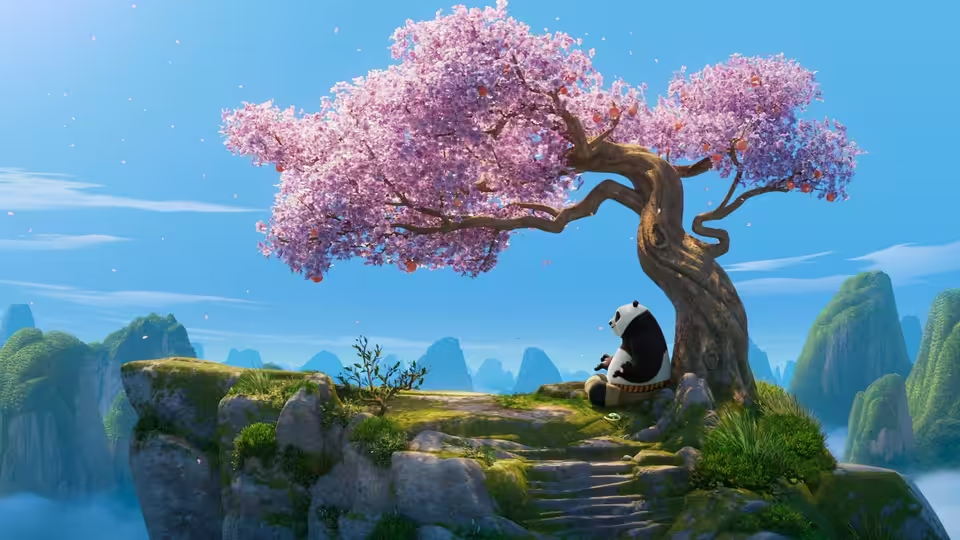
Eight years after Kung Fu Panda 3, Po is back, and the first thing anyone says to him is that he should stop. Shifu wants him to give up the title of Dragon Warrior, pick a successor and become Spiritual Leader of the Valley of Peace, a job that as far as Po can tell involves sitting still. Po would rather not. Then a fox thief called Zhen is caught in the Jade Palace with news of a sorceress in Juniper City who can take any shape and means to bring back every villain Po has ever beaten. Mike Mitchell’s film is quick, bright and cheerful, and it has nothing much underneath it. That is the whole verdict, and it took us about half an hour to reach it.
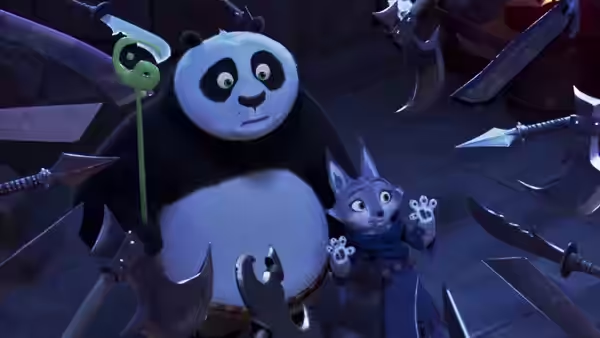
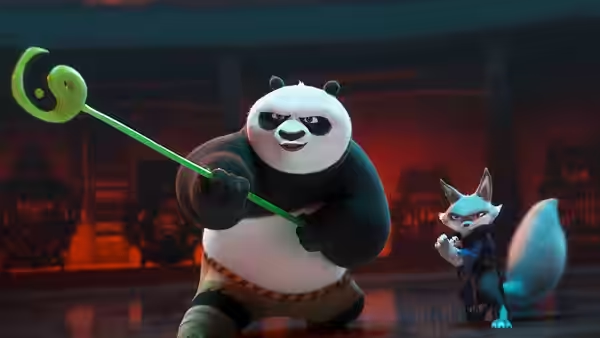
The good things are real. Jack Black still plays Po as a man delighted to be in his own film, and Awkwafina’s Zhen, dry and fast and a beat ahead of him, is the right partner for him: he talks, she rolls her eyes, he turns out to be right anyway. Paul Duncan’s Juniper City is the best new thing to look at, a port built on top of itself, roofs stacked like plates, washing strung between them and lanterns in every colour the earlier films saved for festivals. Below it is a den of thieves where Ke Huy Quan plays Han, a pangolin who curls into a ball at the first sign of trouble, and Ronny Chieng plays a fish who lives inside a pelican’s beak and does his talking from there. We laughed at both, properly and more than once.
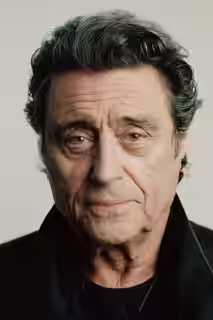
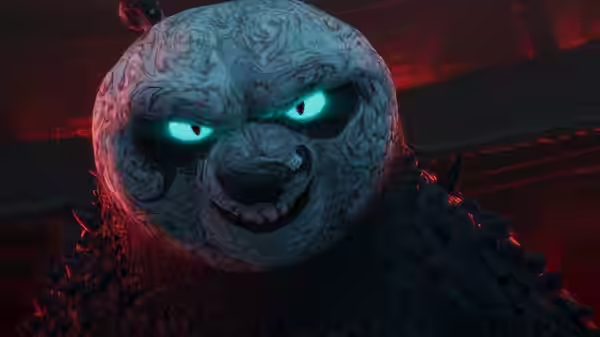
Viola Davis’s Chameleon is the one idea the film has that the others did not. She speaks low and without hurry, and the animators let her scales ripple and re-form as she becomes a rabbit, a bull, a panda, so the joke and the threat arrive in the same shot. Her plan brings back Tai Lung, and when Ian McShane’s voice came out of the dark we felt a small lift; he was the frightening one in 2008 and the sound of him has not aged. The film then does with him what it does with everything: a gag, a fight, on to the next thing. He is a cameo in his own comeback.
The trouble is pace, and the film chose it. Christopher Knights cuts as if a still frame would lose the audience, so nothing sits for longer than a joke takes to land, and nothing is allowed to be sad for more than a beat. Po’s two fathers, James Hong’s Mr Ping and Bryan Cranston’s Li, set off after him with a noodle cart and a bad plan, and the script by Jonathan Aibel, Glenn Berger and Darren Lemke gives them a sitcom, one anxious dad and one gung-ho one, that repeats rather than develops. The Furious Five are gone for almost the whole running time; Seth Rogen’s Mantis gets a line. Hans Zimmer and Steve Mazzaro bring back the old themes and hit the drums hard in the fights, and it sounds like the earlier films, which is what it is for.
Here is what we felt. Around the hour mark we noticed we had laughed several times and cared not once whether Po picked a successor, and that the film had not asked us to. The words “inner peace” are spoken and nothing on screen is about them. Po has a task, and the fights are about the task; nothing he wants is at stake in any of them.
The finale, in the Chameleon’s tower, is loud and crowded and we will not describe it, except to say that it settles the question the film opened with in the way the first act told you it would. Against the series’ own standards this is the slightest entry: it has a list of things to do and gets through it in 94 minutes.
It will hold a six-year-old for all of them and give the adults three good laughs and one good villain. It carries a PG, and it is the first film in the series we would not have minded missing.