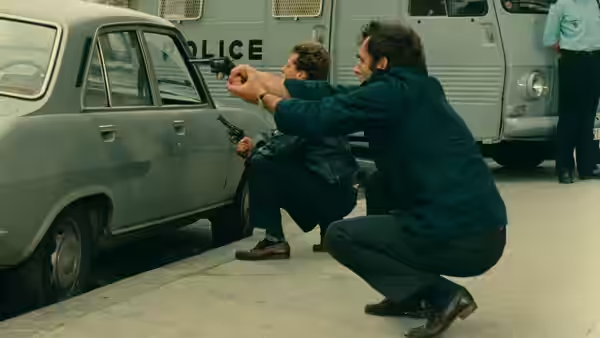
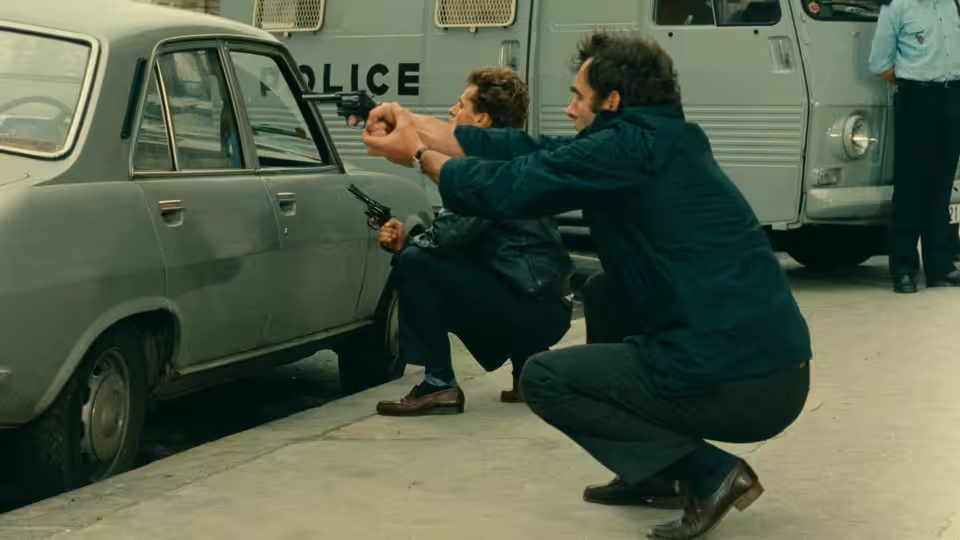
Two men crouch beside a parked car as police officers stand nearby
Film review

L'Argent

1983 · Directed by Robert Bresson · 1h 25m

In a sentenceEighty-five minutes of hands, doors and cash drawers, and we have rarely been so frightened by a shop counter

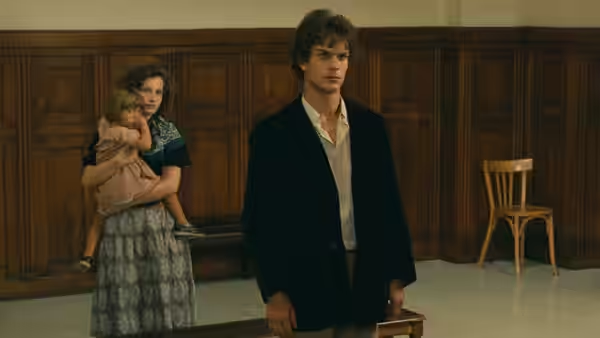
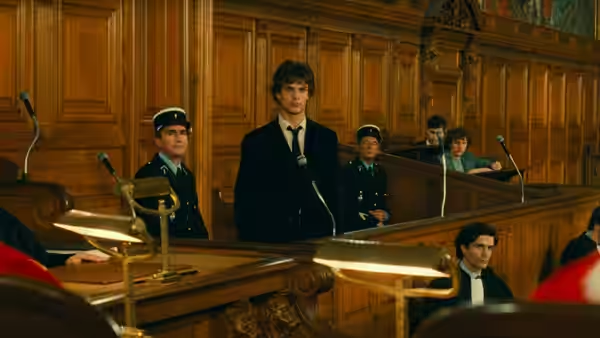
Norbert (Marc Ernest Fourneau), a schoolboy whose father will not raise his allowance, pays off a debt with a forged 500-franc note a friend has passed him. The two boys spend it in a photography shop. When the owners notice, they decide not to be the ones who lose, and hand it on with two more to Yvon Targe (Christian Patey), a delivery man who has come with heating oil. Yvon tries to pay for lunch with the notes and is arrested. In court the shop’s assistant, Lucien (Vincent Risterucci), swears he has never seen him. Yvon comes out with his name on a record and without his job, and a wife, Elise (Caroline Lang), and a small daughter, Yvette, to keep.

Plays from YouTube when you press play; nothing loads from them until then.

Fi1m review

Robert Bresson’s last film follows a forged banknote from a schoolboy’s pocket to a delivery man’s ruin, and shows almost nothing but hands, doors and tills while it does so. It is severe, exact and it left us shaken. Its flat acting takes some getting used to.

L’Argent was Robert Bresson’s last film, and there is nothing in it of the farewell. It runs 85 minutes. It takes a story by Leo Tolstoy about a forged banknote and follows the note from a schoolboy’s pocket through a photography shop to the cab of a heating-oil lorry, and then follows the man who drove the lorry. Nobody explains themselves. Nobody makes a speech. We would tell you to see it, with one warning we will get to.

Bresson is interested in how a small wrong travels. Norbert (Marc Ernest Fourneau) wants pocket money and is refused; a friend gives him a fake 500-franc note; the shop that takes it would rather not lose the money and passes it on with two more to Yvon Targe (Christian Patey), who has only come to deliver oil. Each person in the chain is protecting something small, a reputation, a till, a job, and each hands the damage down to somebody with less. By the time the note reaches Yvon it is a police matter, and he is the only one in the chain without a shop behind him. The assistant Lucien (Vincent Risterucci) lies for his employers in court and is sacked anyway, and the film follows him too, for a while, to see what a man learns from that.

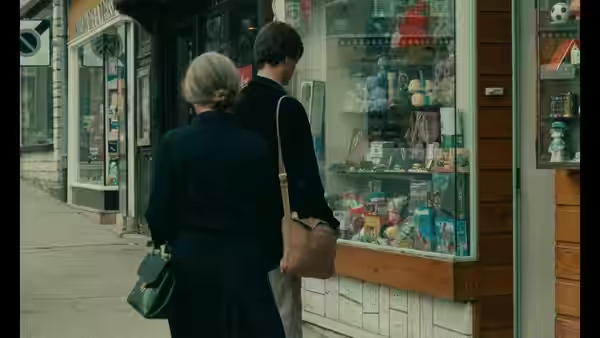
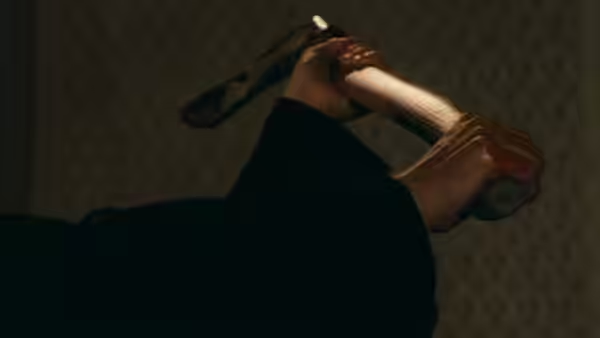
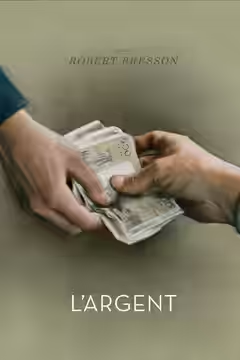
Pasqualino De Santis and Emmanuel Machuel photograph hands more than faces. A hand pushes a note across a counter; a hand opens a cash drawer; a hand turns a key. When somebody leaves a room the camera stays on the door until it has shut, and we had not realised how much of the film was doors until we started counting. Pierre Guffroy’s shop, café and flat are plain to the point of anonymity, cream walls and brown furniture, so that a banknote is the most coloured thing in most frames. Monique Dury dresses everyone in the clothes they would own. No composer is credited and there is almost no music; Bresson fills the track with engines, coins, feet on stairs and the clang of prison gates, and Jean-François Naudon cuts them together without a breath between.

Here is the warning. Nobody in it acts, in the usual sense. Lines are said flat, as if read off a card, and faces are held still. Patey’s Yvon has a large, handsome, empty face and says “I am innocent” the way you would give someone the time. For the first twenty minutes we found it hard to care about a man who did not appear to care about himself, and the one mixed review we have read is right that sympathy is uphill. Then something turns. Because the face gives us nothing, we start reading the hands and the objects, and when Yvon is in a cell and a letter from Elise (Caroline Lang) is opened in silence, it carried more than any weeping close-up would have. Lang, and late on Sylvie Van Den Elsen as a grey-haired woman who enters the last third, are held to the same flatness, and it works the same way.

The second half takes a turn we will not describe. We will say that there is violence in it and that Bresson shows almost none of it: a lamp, a wall, water running into a basin. We were horrified, and it took us a moment to work out by what, because we had been shown a hand and a sound and had supplied the rest ourselves. Nothing in a horror film has frightened us as much as that basin. We laughed once in the whole 85 minutes, at a wallet, and felt slightly ashamed of it.

Bresson keeps the camera on hands, and nobody’s hands in it are beautiful. What the film says about money is simple, that it passes downward and the poorest man is holding it last, and Bresson does not complicate it. The chain of coincidence that carries the story is arranged rather than likely, and he does not care about that either. We mostly did not.

Watch it alone, with the lights off and the phone in another room. It is over before you have adjusted to its manner, and you will still be adjusting the next morning.
Critical consensus AI synthesised

80
Positive
4
Mixed
1
Negative
0

With only 5 reviews in so far, the lean is clearly positive. Most critics take Bresson’s late film seriously as a rigorous study of how money corrupts and whether free will survives it, and the praise clusters on his austere control: oblique framing and precise editing that make the violence vivid while keeping it off screen. Several also single out the film’s brief glimpses of innocence as the moments that land hardest. The main reservation, raised by Empire, is that the stripped-down characters can be hard to warm to. Time Out describes the plot without committing to a verdict, so the spread is narrow rather than divided.

Slant Magazine
12 June 2005 · ★★★★/4 · Eric Henderson
100

Henderson calls the film mind-blowing, finding coherence between its rigid moral dogma and sympathetic complexity. He particularly praises Bresson’s razor-sharp, oblique framing and editing, which render the violence vivid without showing it.

Read the full review →
Sight and Sound
80*

The critic finds the film fiercely focused and a powerful meditation on evil and free will. They single out its devastating glimpses of innocence, especially Yvon’s daughter and the murdered family’s dog.

Read the full review →
The New York Times
24 September 1983 · festival review · Vincent Canby
80*

The review regards Bresson’s film as a serious, accomplished work. It singles out his austere, controlled filmmaking as a strength.

Read the full review →
Empire
24 March 2006 · David Parkinson
75*

Parkinson finds the film a compelling, morally rigorous tale, though its stripped-down characters can be difficult to empathise with. He singles out its probing examination of how money and temptation corrupt, alongside its glimpse of redemption.

Read the full review →
Time Out
· CPea
64*

The review's verdict cannot be determined from the available page text. Its description summarizes the plot but does not single out anything for praise or complaint.

Read the full review →

Straight answers AI written, from our review

Is L'Argent worth watching?
L'Argent is worth watching for anyone who can sit through 85 minutes of flat acting and near silence, and we scored it 88. Robert Bresson follows a forged banknote from a schoolboy's pocket to a delivery man's ruin, showing mostly hands, doors and tills, and it left us shaken. If you need faces to tell you what to feel, it will be hard going.
How long is L'Argent, and what is it rated?
L'Argent runs 1h 25m. It is a crime and drama film.
Where can I watch L'Argent in Poland?
L'Argent is not on any streaming or rental service in Poland at the moment. It is available in 1 other country; change your country at the top of the page to see where. Availability is checked daily.
How violent or frightening is L'Argent, and is it suitable for children?
L'Argent has no certificate in the UK or the US, and it is not a film for children. There is violence in its second half, but Bresson shows almost none of it directly, using a lamp, a wall and the sound of running water instead, and we found that more horrifying than anything a horror film has shown us. It suits patient adults, not the squeamish.
How does L'Argent compare to Pickpocket?
L'Argent is the harsher and, we think, the stronger of the two, while Pickpocket is the warmer and the easier way into Bresson. Both are about hands and theft and both hold their actors at a distance, but the earlier film makes the mechanics of stealing absorbing across its 75 minutes, where the later one follows a wrong down a chain of people to its end. Start with Pickpocket if you are new to him.

Cast

If you liked this, try…

  1. Pickpocket (1959, Fi1m 84)Bresson’s earlier film about hands and theft, and a great deal warmer than this.

  2. The Son (2002) · not on Fi1m yetThe Dardennes watch a carpenter’s back for ninety minutes and break your heart with it.

  3. The Match Factory Girl (1990) · not on Fi1m yetKaurismäki’s flat, cruel, faintly funny account of a woman the world keeps shortchanging.

  4. Le Cercle Rouge (1970) · not on Fi1m yetMelville’s heist film: silent men, empty rooms, and consequences that arrive on time.

  5. Ossos (1997) · not on Fi1m yetPedro Costa’s Lisbon slum drama, shot in Bresson’s spirit with even less said.

L’Argent (1983) review: Bresson’s last film, severe and shaking (Poland) | Fi1m