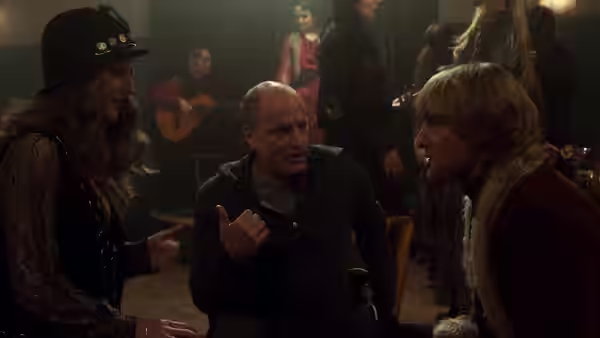
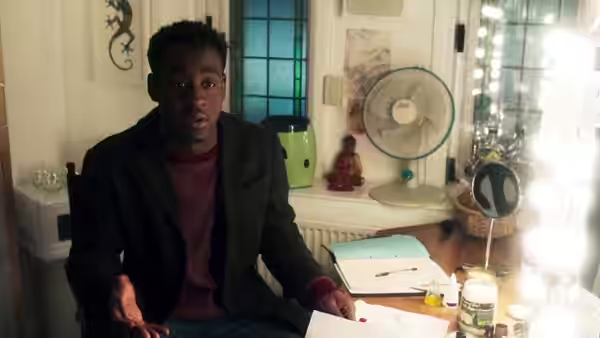
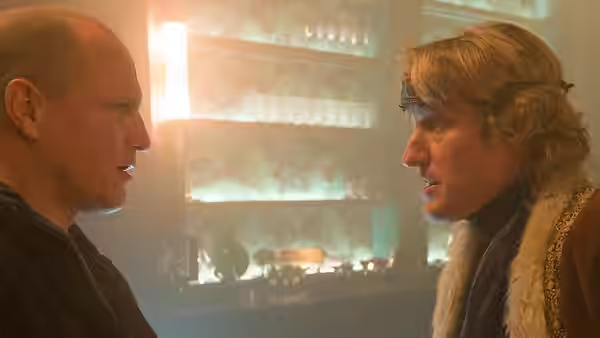
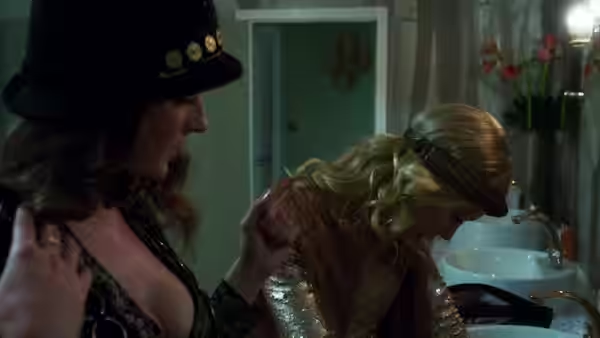
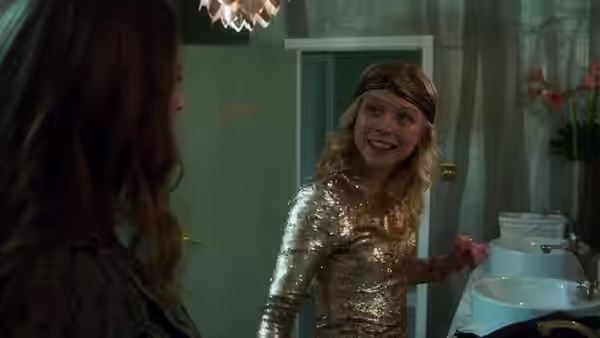
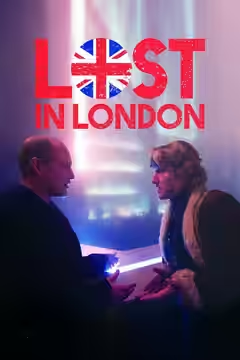
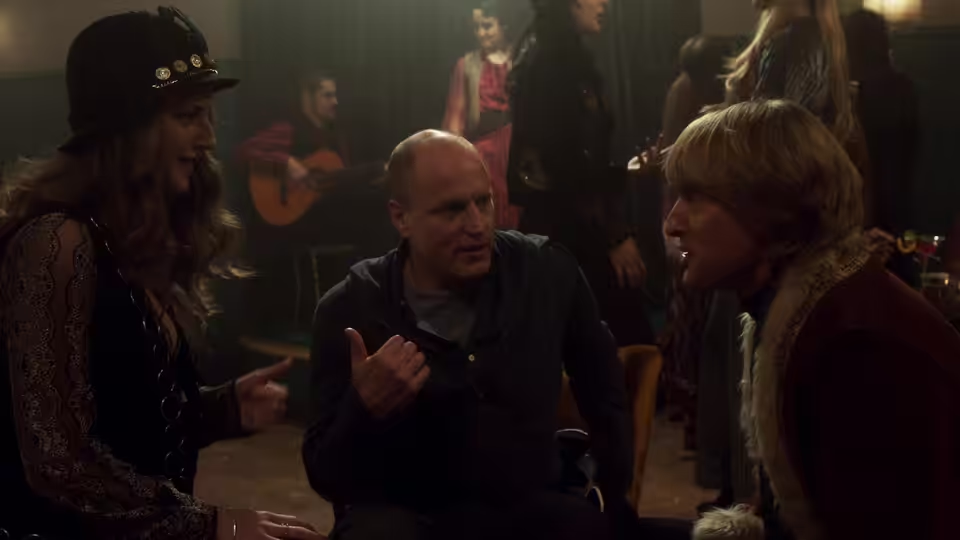
Woody Harrelson gesturing while speaking to Owen Wilson beside a woman in a bar
Film review

Lost in London

2017 · Directed by Woody Harrelson · 1h 43m

In a sentenceOwen Wilson arrives for an argument and briefly makes us forget to admire the camera

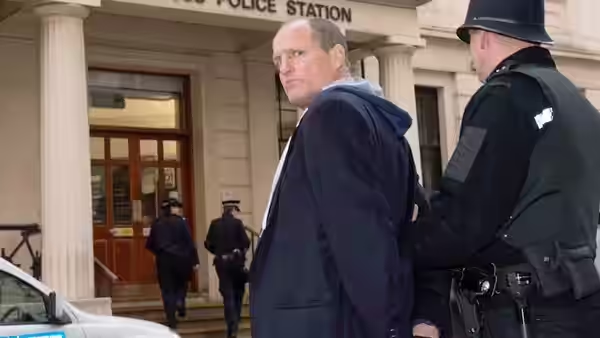
Woody Harrelson plays himself during a shambolic night in London, with his wife Laura (Eleanor Matsuura) among those caught up in the autobiographical story. Owen Wilson also plays himself, and the two actors find plenty of cause for a quarrel. Careers and celebrity status supply the ammunition as the evening becomes a comedy of embarrassment. Based on a real night in Woody Harrelson’s life, the film follows its misadventures in a single continuous take, performed and broadcast live rather than assembled from separate shots.

Plays from YouTube when you press play; nothing loads from them until then.

Fi1m review

Woody Harrelson’s live, single-take comedy has good jokes, especially when Owen Wilson joins the squabbling. But its looser stretches need the cuts that the premise will not allow.

Woody Harrelson’s Lost in London is an amiable, uneven comedy that deserves some affection without quite earning our admiration throughout. Filmed and broadcast live in a single take, it asks us to enjoy a bad night while appreciating how many things might go wrong in making it. That is a reasonable invitation, and the self-mockery is welcome. There are good laughs, especially in the celebrity quarrels, but long stretches need trimming.

As writer, director and star, Woody Harrelson gives himself plenty of opportunities to be foolish, and mostly resists asking for our sympathy afterwards. His version of celebrity is petty enough to make the self-satire worth pursuing, especially when Owen Wilson provides someone equally willing to quarrel. We laughed at their slanging match because the wounded pride is so much larger than anything worth defending. Both performers know how to make an argument sound important to the people having it and ridiculous to everyone listening.

Nigel Willoughby’s cinematography makes the continuous take workable without turning every passage into an invitation to applaud the camera. Keeping performances readable under that constraint is an achievement, and the film generally lets us attend to the actors. The difficulty comes when an exchange has given us its joke and still has time left to fill. At those points we start waiting for the next encounter instead of listening to the one in progress.

Sophie Becher’s production design gives the performers room without insisting that we admire their surroundings. In a film that cannot simply cut to a fresh angle, that restraint is useful: a conversation needs somewhere to happen and the camera needs somewhere to go. The music by Antony Genn and Martin Slattery makes less of an impression. It does little to rescue the slower passages, where the dialogue needs to supply the momentum.

The writing is the greater limitation. Woody Harrelson has found a good comic subject in his own embarrassment, but a succession of indignities needs to develop if it is going to sustain 103 minutes. Too often the film relies on recognition: we know the famous person, we understand the joke about being famous, and there is not enough beyond that. Character and story are squeezed by the need to keep the performance going, with the less amusing exchanges left longer than they can support.

The live broadcast explains some of the excitement around the film, but it should not become a permanent exemption from ordinary judgement. Background noise and small performance slips are easy to forgive; they suit an evening going badly and do little damage to the jokes. A scene that drags is another matter, because knowing how difficult it was to arrange does not make it funnier. A bad-night comedy needs mounting trouble, and this one too often settles for the next encounter.

There is enough warmth and comic timing here to reward an interest in celebrity farce, though the technique remains a distraction. Woody Harrelson is good company even when the writing is marking time. Go for the self-mockery and the exchanges with Owen Wilson, with some patience for the business of getting between them. A fondness for actors arguing about themselves will help.

Critical consensus AI synthesised

69
Positive
6
Mixed
1
Negative
1

Most critics respond warmly to Lost in London, with praise centred on the technical and logistical achievement of its live, single-take broadcast. The reviews also credit Harrelson’s self-mockery with giving the autobiographical misadventure much of its humour. His exchanges with Owen Wilson are the most consistently singled-out comic scenes, while the satire of fame and Hollywood in-jokes help make the experiment more than an exercise in keeping the camera running.

The disagreement concerns how well the comedy works beyond that achievement, and the spread is wide. The Evening Standard finds character and plot constrained by the single-take approach, even while enjoying the humour. Radio Times questions how much edge remains without the thrill of the live broadcast. IndieWire is the sharpest dissenter, finding the film slow, tone-deaf and more interested in dropping names than delivering jokes; most other reviews find enough comedy to forgive its limitations.

The Guardian
20 January 2017 · Peter Bradshaw
90*

The live single-take broadcast is a unique technical feat fusing wizardry with self-deprecating satire. The celebrity slanging match with Owen Wilson reaches euphoric comic heights.

Read the full review →
Little White Lies
20 January 2017 · festival review · Elena Lazic
80*

Harrelson delivers a unique live single-take cinema experience that succeeds despite the risks. The film combines technical audacity with an autobiographical story, highlighted by strong comedic scenes with Owen Wilson.

Read the full review →
Radio Times
★★★★ · Victoria Luxford
80

Harrelson directs and stars in a comedy based on a real shambolic night, using satire on fame to poke fun at his career. The desperate petty humour, especially exchanges with Owen Wilson, brings the misadventure to life, though it loses some edge without the live broadcast thrill.

Read the full review →
Evening Standard
20 January 2017 · Nick Curtis
70*

The critic finds Lost in London not a great film, as character and plot are constrained by the single-take concept, but praises it as a brilliant technical and logistical achievement from a first-time director. It is laced with self-mockery, very funny, and far better than expected.

Read the full review →
The Times
21 January 2017 · ★★★☆☆ · Kate Muir
70*

Harrelson stayed calm under pressure during the live single-shot event despite a bomb scare and other challenges, delivering a singular live cinema experience.

Read the full review →
Vulture
20 January 2017
70*

The critic reports that the livestream went pretty well overall, calling it shaggily competent and self-effacing in typical Harrelson fashion. The technical achievement of the single-take live broadcast is astounding, though background noise and minor flubs were noticeable.

Read the full review →

Straight answers AI written, from our review

Is Lost in London worth watching?
Lost in London is worth considering for fans of celebrity farce and Woody Harrelson’s self-mockery; we score it 68 out of 100. His quarrels with Owen Wilson supply the strongest laughs, but the live, single-take format leaves slower exchanges running beyond their jokes, so some patience helps.
How long is Lost in London, and what is it rated?
Lost in London runs 1h 43m. It is a comedy and drama film.
Where can I watch Lost in London in Estonia?
Lost in London is available to rent from Apple TV from €3.99. Availability is checked daily; the links above go straight to each service.
How violent or frightening is Lost in London, and is it suitable for children?
Lost in London has a UK 12A certificate, meaning children under 12 need an accompanying adult at the cinema. We describe celebrity quarrels and comic embarrassment rather than specific violence or scares, so we cannot offer a detailed warning about either; the certificate should not be taken as a blanket recommendation for younger children.
How does Lost in London compare to After Hours?
Lost in London is the looser, more amiable bad-night comedy; we recommend After Hours as the stronger film for its tighter comic escalation. Harrelson’s film suits an interest in celebrity self-mockery and live performance, while After Hours keeps its predicament funny and unnerving through sharper construction, strong performances and a restless camera.

Cast

If you liked this, try…

After Hours poster80

After Hours

1985 · Another bad night in a city, with much tighter comic escalation.

Victoria poster76

Victoria

2015 · For the continuous-take gamble, with more danger and less celebrity reassurance.

The Trip poster

The Trip

2010 · Actors playing themselves, nursing their pride and making competition sound like conversation.

Night on Earth poster

Night on Earth

1991 · Late-night encounters across several cities, with room for warmth alongside the embarrassment.

The Daytrippers poster

The Daytrippers

1996 · A family outing becomes an argument nobody can quite bring themselves to leave.

Lost in London (2017) review: funny farce held back by its format (Estonia) | Fi1m