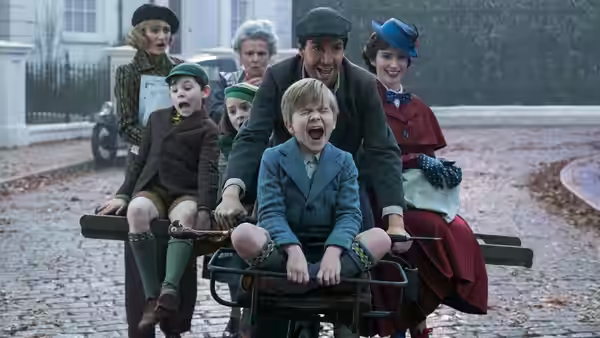
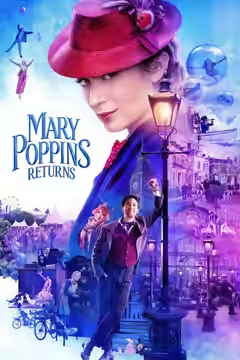
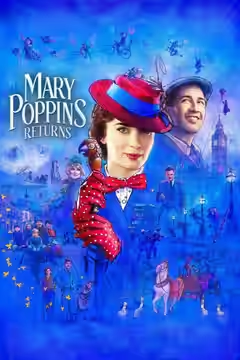
Mary Poppins (Emily Blunt) stands beneath her umbrella outside a London townhouse as petals swirl around her
Film review

Mary Poppins Returns

2018 · Directed by Rob Marshall · 2h 11m

In a sentenceEmily Blunt can make a reprimand more entertaining than an entire production number

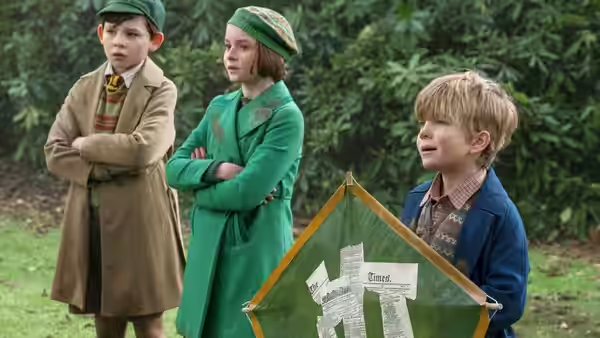
Mary Poppins (Emily Blunt) returns with firm manners and a taste for magical diversions. Michael Banks (Ben Whishaw), Jane Banks (Emily Mortimer) and Jack (Lin-Manuel Miranda) feature in a story of adults under strain and children trying to make sense of their worries. Annabel (Pixie Davies), John (Nathanael Saleh) and Georgie (Joel Dawson) join a company that also includes Ellen (Julie Walters) and Cousin Topsy (Meryl Streep). Music and dancing accompany the fantasy, while Mary Poppins approaches ordinary concerns with a briskness that leaves little room for fuss.

Fi1m review

Emily Blunt gives this cautious musical sequel welcome mischief and unexpected tenderness. It is pleasant family entertainment, though the forgettable songs and leisurely pace make it a qualified recommendation.

Rob Marshall’s Mary Poppins Returns is pleasant, overcautious family entertainment, with Emily Blunt doing much of the persuading. It wants the pleasure of returning to something familiar, and there is nothing wrong with that. The problem is how often familiarity becomes an excuse to avoid surprise. At 131 minutes, it gives its songs and dances more room than their modest charms can comfortably fill.

Emily Blunt is the chief reason to stay. Her Mary Poppins treats nonsense with such brisk authority that the sternness becomes funny, and she leaves just enough uncertainty about how much she is enjoying herself. That makes her interesting even when the story is following a familiar route. Lin-Manuel Miranda, as Jack, is generous and eager company, though the contrast sometimes favours the performer doing less. She can get a laugh without appearing to ask for one.

The quieter music gets further than the busiest numbers. We were moved by Emily Blunt’s rendition of ‘The Place Where Lost Things Go’, because her singing allows tenderness into a performance otherwise reluctant to display it. Marc Shaiman’s music works here without having to persuade us that everybody is having a wonderful time. Elsewhere the songs are agreeable in the moment but difficult to recall once the scene has ended. A musical can survive that, but it makes the repeated invitations to marvel rather tiring.

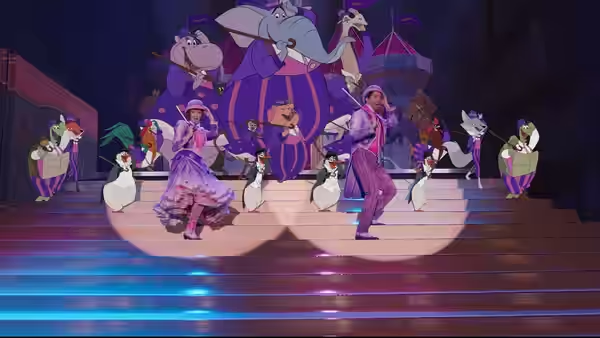
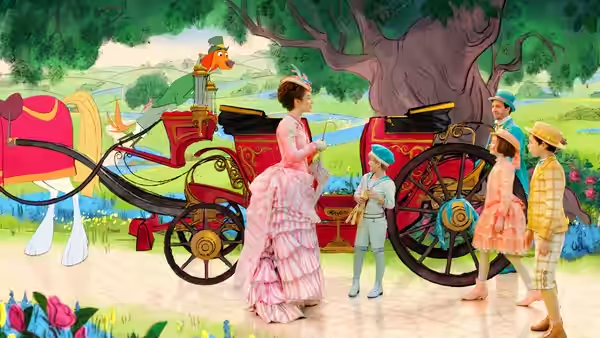
The excursion inside a china bowl offers a better reason to pay attention. The hand-drawn animation gives the musical fantasy a freedom that the surrounding storytelling could use more often. John Myhre’s production design is playful enough to reward looking around the performers, while Sandy Powell’s costumes occasionally demand attention when a face would be more interesting. Dion Beebe’s cinematography gives the busy musical staging welcome clarity, although the polish can make everyone look rather carefully arranged. The sequence has enough visual invention to carry us through its busier passages.

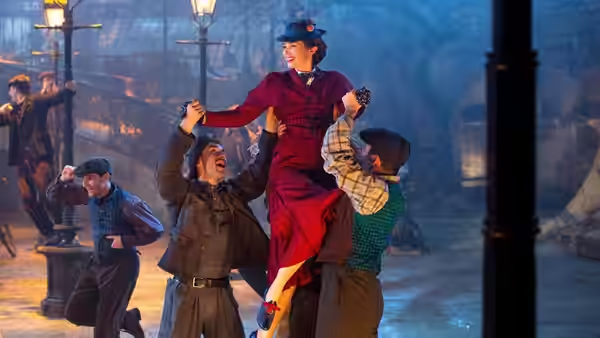
Wyatt Smith’s editing is brisk within the numbers; the drag comes from how often Rob Marshall lets another musical diversion interrupt the story. There is rarely a sense that a scene has been carelessly assembled, but several continue after their appeal has become clear. We can enjoy the choreography and still wish the next scene would arrive. Lin-Manuel Miranda supplies energy whenever it is needed, which is often, and his willingness to entertain helps keep the longer stretches agreeable.

David Magee’s screenplay is most useful when it leaves room for the adults’ difficulties and the children’s worries. Ben Whishaw gives Michael Banks enough feeling to keep those concerns from becoming mere preparation for another song. The predictable plotting is less persuasive, because the effort to repeat an established pattern is so apparent. A family musical need not be startling, but it should occasionally feel as though its characters have surprised the people making it. Here, too much seems settled before a scene has begun.

For a household already fond of musical fantasy, there is enough warmth here to make the evening worthwhile. The running time remains a practical reservation, especially when the music does so little to disguise it. Choose it for Emily Blunt, rather than for a new batch of songs to sing afterwards.


Critical consensus AI synthesised

68
Positive
15
Mixed
6
Negative
4

Most critics find Mary Poppins Returns a warm, enjoyable sequel, with Emily Blunt’s performance the clearest point of agreement: her comic timing, crisp authority and slyness win praise even in several lukewarm reviews. Enthusiasts also admire the energetic staging of the musical numbers, while Lin-Manuel Miranda earns approval for his warmth and showmanship. For many, the old-fashioned approach supplies enough charm and feeling to make the return worthwhile.

The reviews spread widely, however, from wholehearted affection to frustration with a sequel that follows its predecessor too closely. Reservations centre on forgettable songs, a predictable story and nostalgia that some critics find calculated; even sympathetic notices question how much stands on its own. The AV Club admires the technique but finds little emotional warmth, while the Los Angeles Times offers a sharper dissent, rejecting both the new songs and Blunt’s characterisation as part of an overworked, joyless recreation.

Total Film
12 December 2018 · ★★★★★ · Jane Crowther
100

Crowther finds the film a delightful, emotionally affecting throwback, though its old-fashioned perkiness may not suit everyone. She especially praises Emily Blunt’s more mysterious take on Mary and the warmth and showmanship of Lin-Manuel Miranda’s performance.

Read the full review →
The Hollywood Reporter
12 December 2018 · David Rooney
95*

Rooney calls the film an enchanting, thoroughly entertaining charmer that should become a family favorite. He particularly praises Emily Blunt’s performance and the film’s tuneful, lovingly crafted musical numbers.

Read the full review →
The Guardian
23 December 2018 · Mark Kermode
90*

Kermode gives the sequel a warmly enthusiastic verdict, saying it preserves the original’s magic despite not being perfect. He singles out Emily Blunt’s haunting rendition of “The Place Where Lost Things Go” as the moment that makes the film’s spell work.

Read the full review →
Empire
12 December 2018 · Olly Richards
85*

Richards finds it a charming, highly worthy follow-up that comes close to being practically perfect. He especially praises Emily Blunt’s comic timing and the imaginative, energetic staging of the musical numbers.

Read the full review →
Sight and Sound
24 December 2018 · Pamela Hutchinson
82*

Hutchinson finds the sequel a sprightly, heartwarming success that largely recaptures the original’s charm. She especially praises Emily Blunt’s crisp performance and Lin-Manuel Miranda’s energetic musical numbers.

Read the full review →
Evening Standard
20 December 2018 · ★★★★ · Matthew Norman
80

Norman finds the film a warm, old-fashioned success and praises Emily Blunt’s confident, distinctive Mary Poppins. He singles out the duet between Blunt and Lin-Manuel Miranda as a musical highlight.

Read the full review →

Straight answers AI written, from our review

Is Mary Poppins Returns worth watching?
Mary Poppins Returns is worth considering for families fond of musical fantasy, and we score it 67 out of 100. Emily Blunt’s brisk humour and unexpected tenderness make it agreeable company, but the forgettable songs and leisurely 131-minute running time keep our recommendation qualified.
How long is Mary Poppins Returns, and what is it rated?
Mary Poppins Returns runs 2h 11m. It is a fantasy and family film.
Where can I watch Mary Poppins Returns in Peru?
Mary Poppins Returns is streaming on Disney+ in Peru. Availability is checked daily; the links above go straight to each service.
How does Mary Poppins Returns compare to Paddington 2?
Mary Poppins Returns offers musical fantasy and Emily Blunt’s mischievous authority, but we recommend Paddington 2 more readily for its more consistent laughs and earned sentiment. Both find warmth in a courteous visitor; choose the former for songs and magical diversions, the latter for a funny, generous family comedy.
Is Mary Poppins Returns based on a true story or a book?
Mary Poppins Returns draws on P. L. Travers’s fiction, rather than a true story. Knowing the book is not essential to its accessible story of worried children and adults under strain; we find its strongest appeal in Emily Blunt’s performance, though the predictable plotting makes the storytelling less rewarding.
What should I watch after Mary Poppins Returns?
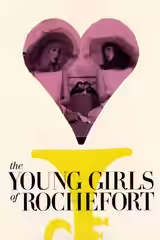
After Mary Poppins Returns, try Paddington 2 (2017, Fi1m 91): Another courteous visitor whose good manners survive considerable provocation, with more consistent laughs. Then The Young Girls of Rochefort (1967, Fi1m 84): For dancing that seems to spill naturally out into the street; and Kiki's Delivery Service (1989, Fi1m 86): Another practical young woman makes magic feel like a useful everyday skill.

Cast

Awards

Academy Awards, 2019

Nominated
Best Costume Design

BAFTA Film Awards, 2019

Nominated
BAFTA's Children & Young People Award - Feature Film

Kids' Choice Award for Favorite Movie, 2019

Nominated
Kids' Choice Award for Favorite Movie

If you liked this, try…

  1. Paddington 2 (2017, Fi1m 91)Another courteous visitor whose good manners survive considerable provocation, with more consistent laughs.

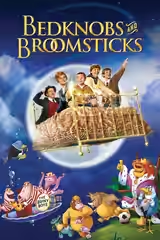
  2. Bedknobs and Broomsticks (1971) · not reviewed yetMore British magical housekeeping, with songs and animation given cheerful freedom.

  3. The Young Girls of Rochefort (1967, Fi1m 84)For dancing that seems to spill naturally out into the street.

  4. Kiki's Delivery Service (1989, Fi1m 86)Another practical young woman makes magic feel like a useful everyday skill.

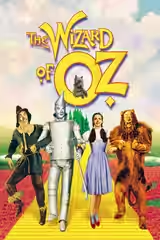
  5. The Wizard of Oz (1939, Fi1m 91)For a family musical whose songs linger long after the spectacle.