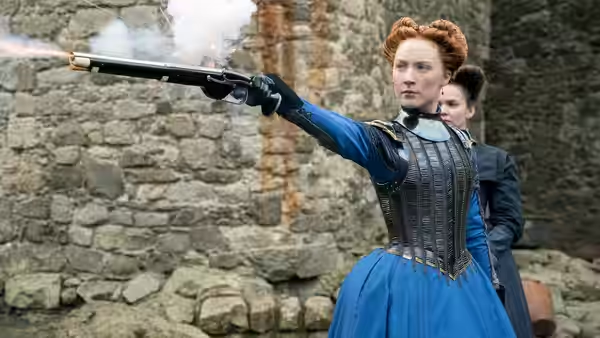
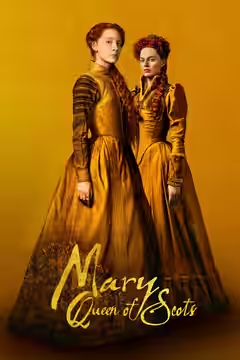
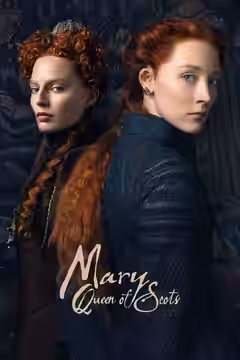
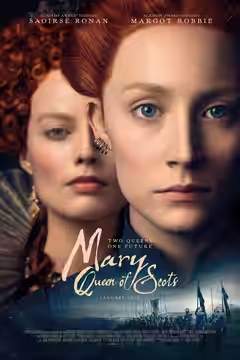
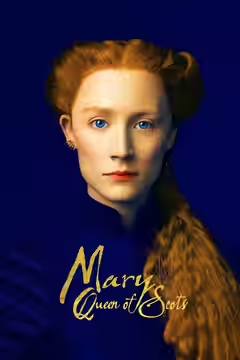
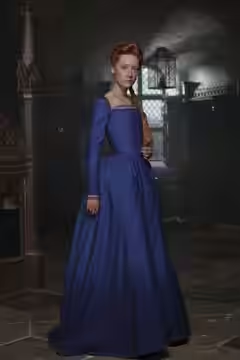
Mary Stuart (Saoirse Ronan) rides with armed companions across the Scottish countryside
Film review

Mary Queen of Scots

2018 · Directed by Josie Rourke · 2h 04m

In a sentenceTwo queens and a supporting cast who seem to have brought briefing notes

Mary Stuart (Saoirse Ronan) seeks to exercise her authority while Queen Elizabeth I (Margot Robbie) faces a threat to her throne. Their rivalry draws questions of female power and fertility into the business of government. Lord Darnley (Jack Lowden), John Knox (David Tennant) and William Cecil (Guy Pearce) are among the men surrounding the queens, whose rank does not shield them from interference. At court, personal decisions carry political consequences, and the two rulers must weigh their own wishes against the demands of those around them.

Plays from YouTube when you press play; nothing loads from them until then.

Fi1m review

Saoirse Ronan gives Mary Queen of Scots the authority its storytelling lacks. Josie Rourke’s historical drama has a strong cast and handsome craft, but its crowded court politics keep the two queens at an emotional distance.

Josie Rourke approaches Mary Queen of Scots as a drama about two women whose authority remains vulnerable to the men around them. That is a promising way into a historical drama, especially with Saoirse Ronan and Margot Robbie playing the rulers. But Beau Willimon’s screenplay spends so much effort explaining the political complications that it neglects the people caught in them. This is a mixed film with persuasive performances, fine visual work and a frustrating habit of making its central struggle harder to care about than it should be.

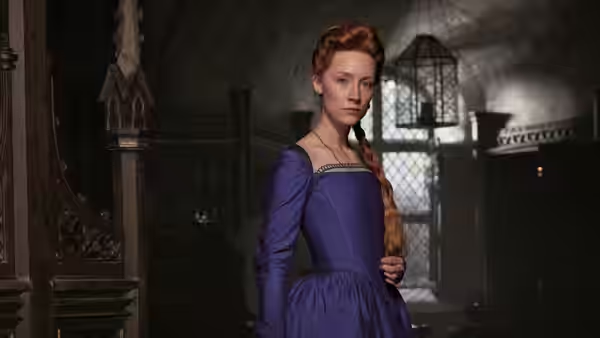
Saoirse Ronan gives Mary Stuart a determination that holds our attention even when the writing leaves her reasons unclear. Her confidence makes the character worth following without relying on our existing interest in royal history. We were frustrated by the court exchanges, because they repeatedly interrupted that interest with explanations instead of revealing what Mary thought. The dialogue supplies plenty of information about her position and too little about her thinking.

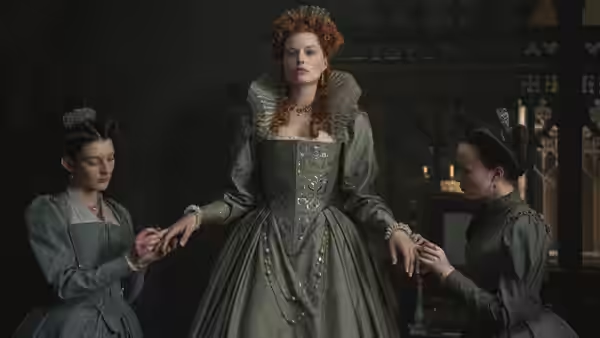
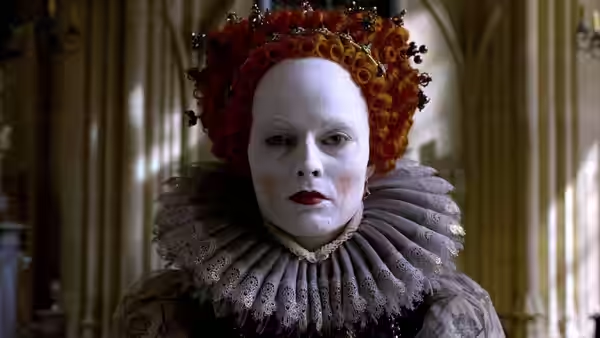
Margot Robbie gives Queen Elizabeth I a guardedness that is useful beside Mary’s more direct force. The contrast creates some feeling for women whose public standing does not protect their private lives. Yet the film keeps insisting on what the queens have in common, and its treatment of fertility narrows them just when it wants to enlarge our understanding. The supporting characters suffer more: too many have political functions where clear motives ought to be.

John Mathieson’s cinematography gives the court scenes an imposing formality, though that stateliness can make the talking feel slower. James Merifield’s production design makes the places of power persuasive enough that they do not need quite so much verbal explanation. Alexandra Byrne’s costumes help distinguish the queens as public figures, showing how much their appearance belongs to the job. There is pleasure in looking at this film. Too often, however, the people inside those carefully arranged surroundings are reduced to delivering information.

Chris Dickens’s editing has a difficult job keeping the competing interests legible, and the film never finds a comfortable pace for all its court business. The opening keeps us waiting for a reason to care, while the accumulation of intrigue does not bring a matching increase in urgency. Max Richter’s score provides emotional continuity, but the music cannot make an unclear relationship compelling on its own. At 124 minutes, the film has enough time to make the secondary figures matter more than they do.

A historical drama need not behave like a lesson, and accuracy alone would not make this one more involving. We do need to understand what somebody wants, what it will cost and why they cannot simply ask for it. Here the explanations are plentiful but the motives remain patchy, so the political manoeuvring becomes work. Josie Rourke is more convincing when she allows her leads to carry the feeling without making the dialogue announce its importance. Those coming for a gripping contest of royal wills should be prepared to do a good deal of untangling.


Critical consensus AI synthesised

55
Positive
6
Mixed
11
Negative
6

The consensus is mixed: most critics find more to admire in the performances than in the historical drama around them. Saoirse Ronan draws the most consistent praise for a commanding Mary, while many reviews also credit Margot Robbie with giving Elizabeth complexity and restraint. Several find the parallels between the queens emotionally compelling, particularly their struggles with male power. The costumes and visual presentation earn praise too, though handsome surroundings do not settle doubts about the storytelling.

Reservations cluster around blunt exposition, crowded court intrigue and uneven pacing, with secondary motives often left unclear. Robbie’s performance divides opinion more than Ronan’s, as does the strength of the connection between the leads. The spread is wide: The Wrap welcomes a refreshing account of women constrained by men, while Vulture finds the attempt to reshape Mary as a modern underdog awkward and short of compelling ideas.

Little White Lies
17 January 2019 · 3/4/2 · David Jenkins
80

Jenkins finds the film lifeless and overly focused on exposition, leaving its central drama hollow. He praises Saoirse Ronan’s magnetic performance and convincing Scottish accent.

Read the full review →
Empire
14 January 2019 · Helen O'Hara
70*

O'Hara finds the film compelling overall, despite moments of historical implausibility and a weakly staged meeting. She praises Saoirse Ronan and Margot Robbie’s performances and their clash of personalities.

Read the full review →
The Guardian
16 November 2018 · Benjamin Lee
70*

Lee finds the drama darkly compelling and entertaining, though its historical liberties and uneven execution keep it from being fully successful. He praises Saoirse Ronan’s commanding performance while criticizing Margot Robbie’s unconvincing Elizabeth.

Read the full review →
The Hollywood Reporter
15 November 2018 · festival review · Todd McCarthy
70*

McCarthy finds the film a spirited, timely take on a familiar story, though its exposition can feel blunt. He praises Ronan’s fierce performance and the compelling bond between the two queens.

Read the full review →
Screen Daily
16 November 2018 · Tim Grierson
64*

The review’s overall verdict is not available in the page text. It singles out Saoirse Ronan and Margot Robbie for strong performances.

Read the full review →
The AV Club
4 December 2018 · C+ · Jesse Hassenger
63

The review finds the film handsome and competent but ultimately lopsided and unsatisfying. It praises the compelling connection between Ronan and Robbie’s characters, especially their rare shared scene and the directness of the final shots.

Read the full review →

Straight answers AI written, from our review

Is Mary Queen of Scots worth watching?
Mary Queen of Scots is a mixed historical drama we score 56 out of 100, with more to offer admirers of Saoirse Ronan and Margot Robbie than anyone seeking a gripping royal rivalry. We admire the performances and carefully realised courts, but crowded political explanations, unclear motives and an uncomfortable pace keep the queens at an emotional distance.
How long is Mary Queen of Scots, and what is it rated?
Mary Queen of Scots runs 2h 04m. It is a drama and history film.
Where can I watch Mary Queen of Scots in Croatia?
Mary Queen of Scots is available to rent from Amazon Prime Video from HRK 3.99. Availability is checked daily; the links above go straight to each service.
How violent or frightening is Mary Queen of Scots, and is it suitable for children?
Mary Queen of Scots carries a UK 15 certificate, making it unsuitable for children under 15. That classification indicates adult content, but we cannot give a specific account of violence or frightening material from the detail available; the certificate is the clearest guide for parents and viewers sensitive to such content.
How does Mary Queen of Scots compare to The Lion in Winter?
Mary Queen of Scots is the less rewarding royal drama beside The Lion in Winter, which we recommend for its sharper wit and considerably clearer motives. Mary and Elizabeth’s struggle centres on female authority and male interference, while the other film makes succession a family quarrel; its plotting also circles, but its central performances keep the exchanges lively.
What should I watch after Mary Queen of Scots?
After Mary Queen of Scots, try The Lion in Winter (1968, Fi1m 81): A royal family argues over succession, with more wit and considerably clearer motives. Then Throne of Blood (1957, Fi1m 88): Ambition and marriage make power precarious, with far less patience for royal dignity; and The Favourite (2018, Fi1m 87): Court politics become intimate, spiteful and funny, with women allowed to behave badly.

Cast

Awards

Academy Awards, 2019

Nominated
Best Costume Design

If you liked this, try…

  1. The Lion in Winter (1968, Fi1m 81)A royal family argues over succession, with more wit and considerably clearer motives.

  2. Queen Margot (1994) · not reviewed yetReligious hostility and royal marriages turn court politics into something sweaty and dangerous.

  3. Throne of Blood (1957, Fi1m 88)Ambition and marriage make power precarious, with far less patience for royal dignity.

  4. Wolf Hall (2015) · not reviewed yetPatient performances and carefully explained court politics make every apparent courtesy worth watching.

  5. The Favourite (2018, Fi1m 87)Court politics become intimate, spiteful and funny, with women allowed to behave badly.