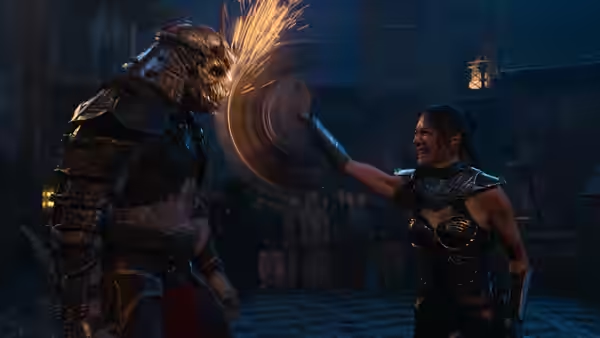
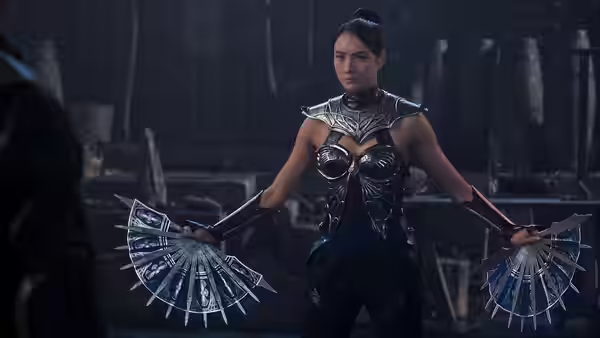
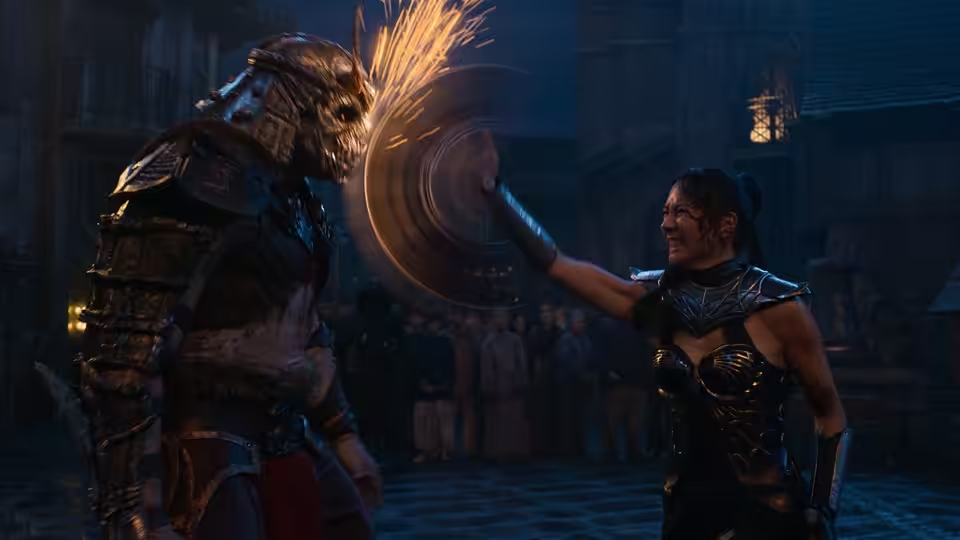
Kitana (Adeline Rudolph) wielding a spinning blade against an armored foe in a stone arena
Film review

Mortal Kombat II

2026 · Directed by Simon McQuoid · 1h 56m · MPA R

In a sentenceEveryone gets torn in half; only Karl Urban and Josh Lawson seem to be enjoying it

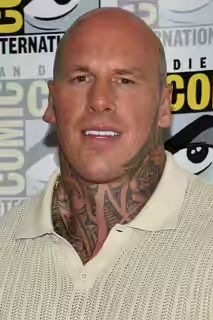
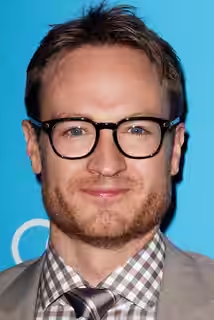
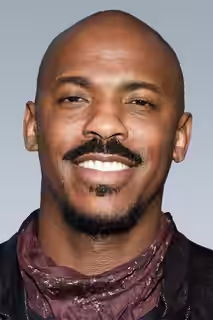
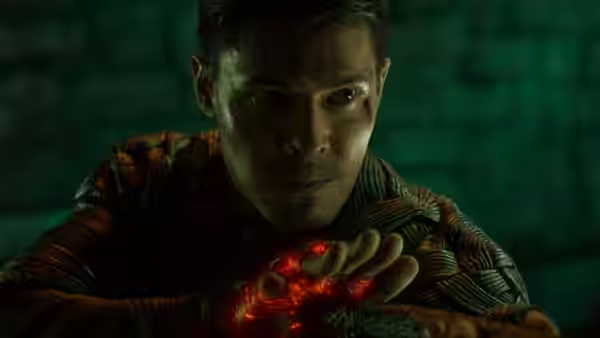
Earthrealm’s champions were promised a tournament, and this time they get it. Hollywood action star Johnny Cage (Karl Urban) is pulled out of his career and into Mortal Kombat, the contest that decides which realm rules the other. Alongside him stand Liu Kang (Ludi Lin), Sonya Blade (Jessica McNamee) and Jax Briggs (Mehcad Brooks), with the thunder god Lord Raiden (Tadanobu Asano) watching over them. On the other side is Shao Kahn (Martyn Ford), emperor of Outworld, who means to take Earth if the fights go his way, and who sends Outworld’s princess Kitana (Adeline Rudolph) and her companion Jade (Tati Gabrielle) into the arena. The sorcerers Shang Tsung (Chin Han) and Quan Chi (Damon Herriman) wait at the edges, and Kano (Josh Lawson) is on hand to say what everyone else is thinking.

Plays from YouTube when you press play; nothing loads from them until then.

Fi1m review

The tournament the first film promised finally arrives, and Karl Urban’s Johnny Cage is worth the wait. Little around him is: the fights blur into one another, Outworld looks unfinished, and the story is a run of cutscenes between the finishing moves.

Simon McQuoid’s first Mortal Kombat, from 2021, spent its running time promising a tournament and then stopped before the bell. The sequel, from a script by Jeremy Slater, puts that right with some force. The contest is under way early, Shao Kahn (Martyn Ford) waits at the top of the card as the prize the others are fighting towards, and roughly every quarter of an hour somebody is pulled apart on camera. It is a film that has read the complaints about its predecessor and answered each of them in turn, and it has spent most of its energy on the fixes.

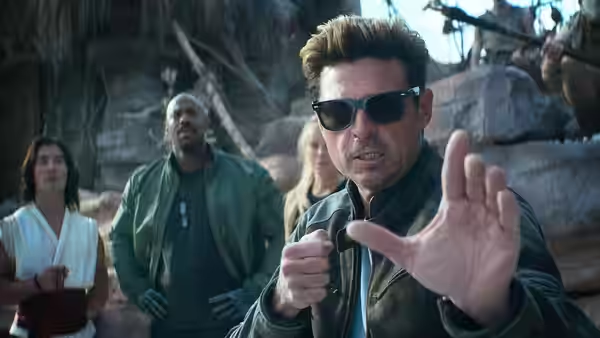
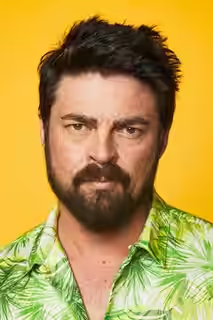
Karl Urban is the reason to go, if you go. His Johnny Cage is a Hollywood action star who arrives with an entrance, a catchphrase and a settled belief that the camera is on him, and Urban plays the vanity straight enough that the jokes come out of the man rather than being pinned to him. We laughed properly at his first walk into the arena. About forty minutes later we noticed we had not laughed since, because Slater has given him one joke and asked him to tell it in different rooms. Josh Lawson’s Kano works the same seam and gets slightly more out of it. Adeline Rudolph’s Kitana is the only person here with something like an inner life; she watches the fights as though the outcome will cost her, and the film is better whenever it remembers she is in it.

The early bouts are the best of it. They are one against one, the rules are clear, and the editor, Stuart Levy, lets each shot run long enough for a punch to be seen arriving and landing. The finishing moves are staged with real relish, spines and skulls and a great deal of arterial spray, and the 15 certificate is not a formality. Then the fights multiply. By the second hour the camera has moved in close, the cuts have shortened, and on more than one occasion we could not have told you who was hitting whom or why it mattered.

The world does not help. Stephen F. Windon shoots Outworld in slate and rust, and Yohei Taneda’s thrones, pits and stairways stand in front of skies that never seem further away than the back wall of a stage. Nothing has weight. A fighter is thrown thirty feet into a pillar and the pillar does not react. Cappi Ireland’s costumes are the one department that reads clearly: you can tell the combatants apart by what they are wearing long after you have stopped telling them apart by anything else. Benjamin Wallfisch’s score starts the drums when a fight starts and stops them when it stops.

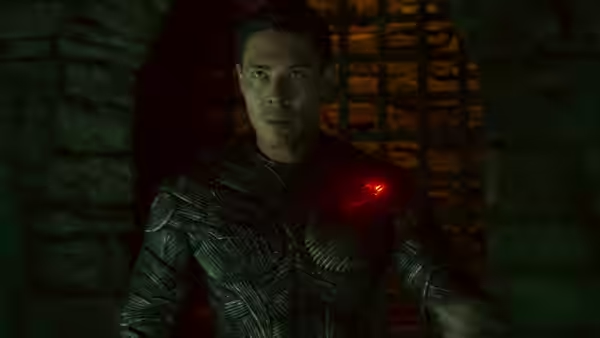
We were bored, somewhere around the fourth fight in the same arena, and then we were annoyed about being bored, because a film with this many people being cut in half ought not to feel like a wait. The trouble is that nothing connects one fight to the next except the fact that both are on the schedule. Liu Kang (Ludi Lin), Sonya Blade (Jessica McNamee), Jax Briggs (Mehcad Brooks) and Lord Raiden (Tadanobu Asano) are each handed a scene and then parked. Chin Han’s Shang Tsung and Damon Herriman’s Quan Chi hiss at each other across a throne room and are given no reason to. Joe Taslim, who carried The Raid in 2011, is here as Bi-Han and spends most of the film waiting for a cue.

Against the 1995 film this is bloodier, better acted and no more fun. Against the other game adaptations of the past few years it looks like something dug out of a cupboard: the same dim palette, the same stone corridors, the same idea that a tournament can stand in for a story. Most critics have split almost exactly down the middle on it, and having sat through it we understand both halves. The people who wanted the fatalities have got them. The people who wanted a film around them are still waiting.

At 116 minutes it is not long, and Urban and Lawson keep it moving for stretches. See it in a cinema if the finishing moves are what you paid for the first time and did not get; at home the arena shrinks and the jokes have nowhere to go. Either way, do not expect to remember the order of the fights by the weekend.
Critical consensus AI synthesised

52
Positive
7
Mixed
3
Negative
8

The reviews split almost down the middle. Where most agree is on what the film sets out to do: it delivers the tournament the first film only promised, and the fatalities are as bloody as fans expect. Karl Urban’s Johnny Cage draws the most consistent praise, named as the source of humour in reviews that otherwise disagree about almost everything else, with Josh Lawson’s Kano a frequent second. Several critics call it an improvement on the 2021 film.

The disagreement is about whether fights and gore are enough. The favourable reviews find the choreography imaginative and the silliness deliberate. The unfavourable ones, which include most of the British broadsheets, find the story wafer-thin, the fights choppy and the whole thing cheap and forgettable. The AV Club stands apart in finding even Cage humourless. The spread is wide, from open enthusiasm to outright dismissal, with little settled in between.

Slant Magazine
6 May 2026
89*

The critic praises the sequel as the most complete and gleefully kinetic live-action adaptation of the games since 1995, ravenous to get down to bloody business with wall-to-wall hard-hitting fights. It gets the mix of mythmaking, silliness, and gore right, standing victorious for fans.

Read the full review →
The New York Times
7 May 2026 · Glenn Kenny
80*

The critic praises the film's eye-popping pyrotechnics and gruesome fighter tournament spectacle as its own reward. The director unleashes another high-stakes battle to determine the fate of the universe.

Read the full review →
Empire
8 May 2026 · Amon Warmann
77*

The film improves on its predecessor by delivering the tournament and gory fatalities, with strong turns from Kitana and especially Johnny Cage. It compensates for a thin story with entertaining fights and humour, making for plenty of dumb fun overall.

Read the full review →
The Hollywood Reporter
6 May 2026 · Frank Scheck
52*

The critic finds the sequel delivers plenty of bone-crunching gory action for devoted fans but feels tacky and low-rent overall, with unexciting fight sequences and underwhelming effects. Urban provides fun as the self-aware Johnny Cage amid the non-stop carnage.

Read the full review →
Variety
6 May 2026 · Owen Gleiberman
50*

The critic finds the action dependable but faults the sludgy story in this old-school video-game trash extravaganza. The kombat hits the mark with minor force overall.

Read the full review →
IndieWire
6 May 2026 · Alison Foreman
49*

The review describes a muddy sequel that has its moments but not enough of them, with Kitana unable to save the doomed IP from another fatality. Director McQuoid returns with a film that struggles to deliver consistent thrills.

Read the full review →

Straight answers AI written, from our review

Is Mortal Kombat II worth watching?
Mortal Kombat II is worth watching only if the finishing moves are what you came for, and we scored it 50. Karl Urban's Johnny Cage and Josh Lawson's Kano are the reasons to stay, but the fights blur together by the second hour and nothing connects one bout to the next. Anyone wanting a story around the fatalities will still be waiting.
How long is Mortal Kombat II, and what is it rated?
Mortal Kombat II runs 1h 56m and is rated R by the MPA in the US. It is an action and fantasy film.
Where can I watch Mortal Kombat II in the US?
Mortal Kombat II is streaming on HBO Max, The Roku Channel, Hulu and Amazon Prime Video in the US, and it is also available to rent from Amazon Prime Video from $6.99. Availability is checked daily; the links above go straight to each service.
How violent or frightening is Mortal Kombat II, and is it suitable for children?
Mortal Kombat II is a 15 in the UK and an R in the US, and the certificate is earned: roughly every quarter of an hour somebody is pulled apart on camera, with spines, skulls and a great deal of arterial spray. It is not frightening so much as relentlessly gory, and it is not for children or the squeamish. Older teenagers who know the games will know what they are getting.
What should I watch after Mortal Kombat II?
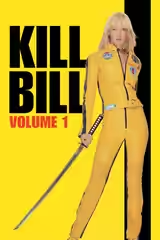
After Mortal Kombat II, try The Raid (2011, Fi1m 83): Joe Taslim in a tower block, and every hit lands on something that hurts. Then Kill Bill: Vol. 1 (2003, Fi1m 72): Blood by the bucket, but Tarantino knows why each fight is happening.

Cast

If you liked this, try…

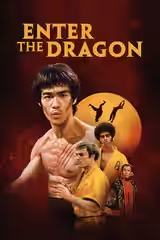
  1. Enter the Dragon (1973) · not on Fi1m yetThe island tournament done once, properly, with Bruce Lee and no computer in sight.

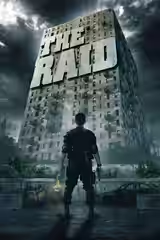
  2. The Raid (2011, Fi1m 83)Joe Taslim in a tower block, and every hit lands on something that hurts.

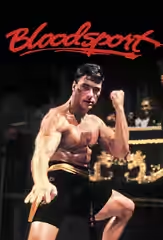
  3. Bloodsport (1988) · not on Fi1m yetVan Damme, a secret contest and the sincerity this one keeps apologising for.

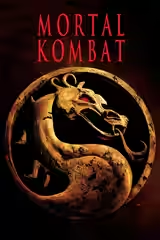
  4. Mortal Kombat (1995) · not on Fi1m yetCheaper, sillier and far more cheerful about what a video game film is for.

  5. Kill Bill: Vol. 1 (2003, Fi1m 72)Blood by the bucket, but Tarantino knows why each fight is happening.