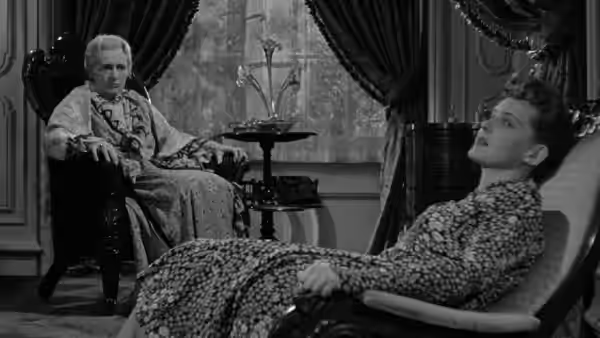
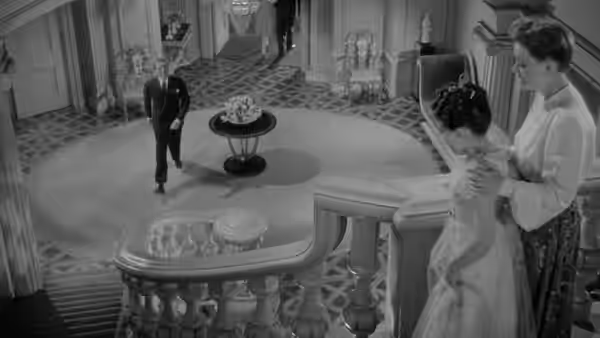
Bette Davis gives this indulgent romance enough nerve and uncertainty to make Charlotte’s transformation convincing. Irving Rapper lets the story wander, but we recommend it for a heroine whose independence matters as much as her love life.
Now, Voyager asks us to take a woman’s desire to change her life seriously, even when it arrives in the form of an extravagant romance. We think it earns that attention. Irving Rapper’s film is indulgent, sometimes awkwardly assembled, and moving because Bette Davis gives Charlotte Vale enough prickliness to resist being merely pitiable. The pleasure is in watching a heroine who cannot acquire confidence quite as easily as a romantic drama might like her to.
Bette Davis makes Charlotte’s transformation convincing without suggesting that becoming more desirable cures everything. Her sharpness remains visible alongside the vulnerability, so the character can seem newly hopeful and still liable to retreat. We were moved by that uncertainty in her performance. She gives us reason to care about Charlotte’s independence even when the romance seems ready to settle for making her happy in love.
Casey Robinson’s screenplay, adapted from the novel by Olive Higgins Prouty, keeps Charlotte’s wishes in view even when the romance threatens to take over. This is where the film makes good use of melodrama: the feelings are large because the choices matter to the person making them. Irving Rapper does not apologise for that scale, and we are glad he does not. A more embarrassed treatment would have missed much of the pleasure.
Sol Polito’s cinematography gives the romance a luminosity that suits its confidence in strong feeling. The flattering image could easily make Charlotte’s transformation look too simple; Bette Davis keeps something unsettled within it. Orry-Kelly’s costume design belongs to the same persuasive glamour, although the performance is what makes the change credible. We enjoy the clothes, but we keep looking because Charlotte still seems capable of being hurt.
The weaknesses are in the joins. The screenplay moves episodically, and Warren Low’s editing cannot quite make every passage feel necessary to the next. There are stretches when the film seems to have found another way of keeping Charlotte occupied rather than a compelling reason to carry her story forward. At 117 minutes, it has time for those diversions, but we occasionally wanted the director to be firmer about which scenes deserved our attention.
Max Steiner’s music is a less serious reservation. Its emotional insistence belongs to the film, and there is pleasure in hearing a romance take itself this seriously, but the acting does not always need the assistance. We sometimes wanted the score to leave Charlotte a little more room. That excess is easier to forgive than the episodic writing, because the film’s willingness to risk being too much is also part of its appeal.
As a romantic melodrama, Now, Voyager is unusually interested in how affection changes a woman’s opinion of herself. Bette Davis makes that interest felt without turning Charlotte into an example for anyone to follow. We recommend it with patience for the wandering script and an appetite for openly expressed feeling. Give her your attention even when the music is asking for it.