Film review

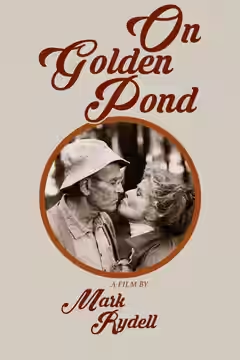
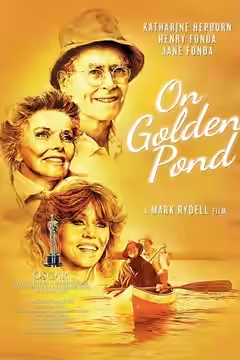
On Golden Pond

1981 · Directed by Mark Rydell · 1h 49m · MPA PG

In a sentenceTwo great actors, one beautiful lake, and a script that keeps plumping their cushions

DramaRomance

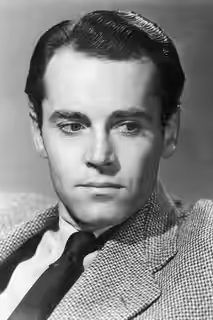
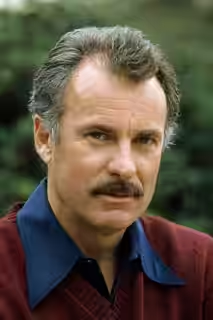
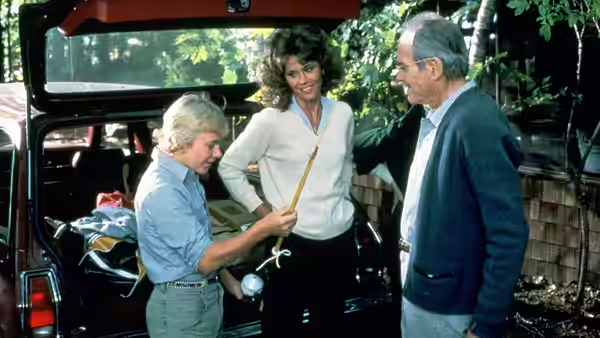
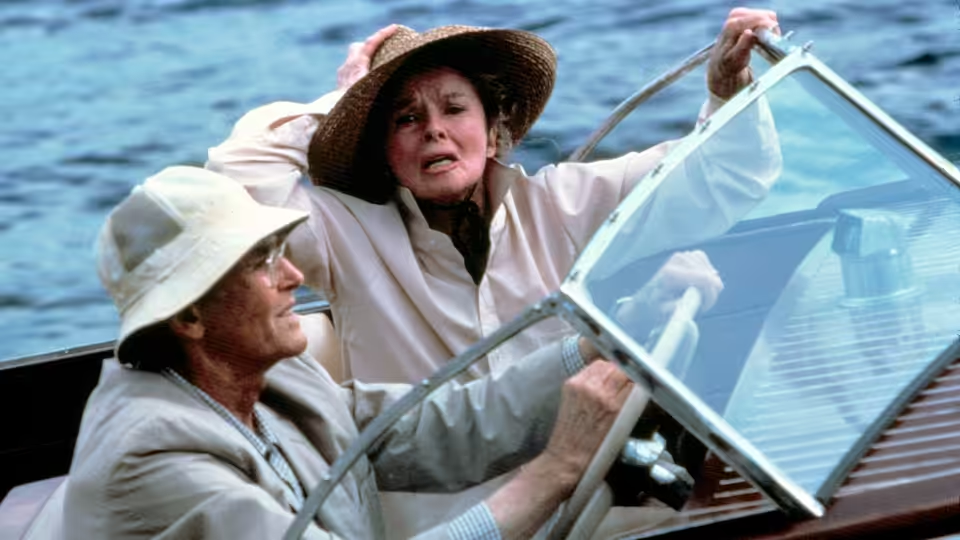
Norman Thayer Jr. (Henry Fonda) and his wife Ethel (Katharine Hepburn) open up their summer cottage on Golden Pond, a lake in New England. Norman is about to turn 80. He is a retired professor, deaf when it suits him, rude to the mailman, Charlie Martin (William Lanteau), and increasingly unable to find his way through woods he knows; Ethel talks to the loons and refuses to be frightened. For the birthday, their daughter Chelsea (Jane Fonda) drives up with her new partner, a dentist, Bill Ray (Dabney Coleman), and his thirteen-year-old son Billy (Doug McKeon). Chelsea and her father have not got on for years. Then the adults leave for Europe and Billy is left at the cottage with two old people he does not know.

Fi1m review

Henry Fonda and Katharine Hepburn, sharing a screen for the first time, play a long marriage so well that we forgave the film nearly everything. Nearly. Ernest Thompson’s script smooths every edge it finds, and the boy is a device.

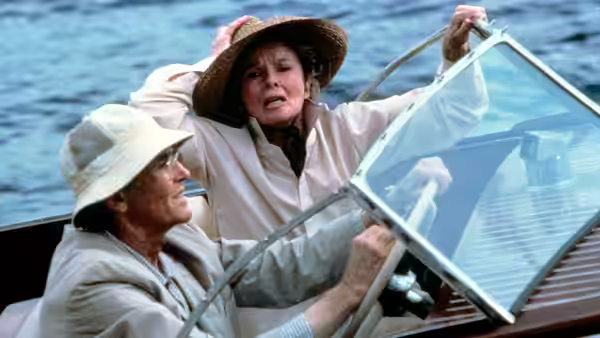
Ernest Thompson adapted his own play, and its shape is still visible: one house, one summer, a few arrivals and departures. Norman Thayer Jr. is about to be eighty. He forgets the names of things, jokes about his own funeral and treats every visitor as an intruder to be tested. Ethel has been married to him for most of her life and finds him funny, which is the only explanation the film offers for why she stayed. Mark Rydell directs it as a summer comedy with a shadow across it, and while the two old people are alone together it is a good one, worth your evening. When the family arrives it gets softer, and it was already soft.

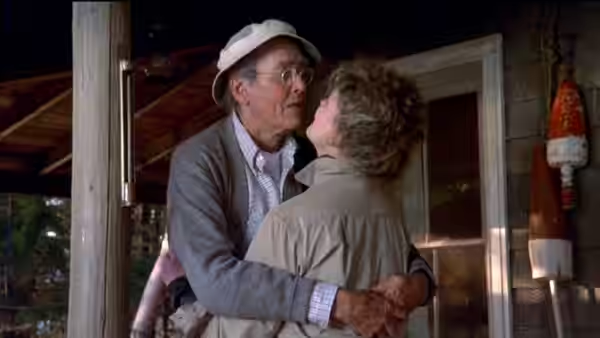
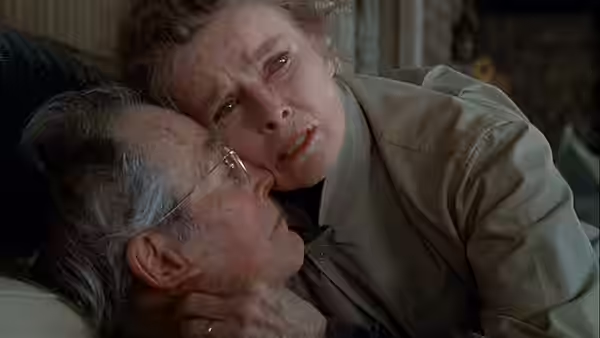
The reason to see it is Henry Fonda and Katharine Hepburn, who had never shared a screen before and go about it as if they had been doing it for years. Fonda plays Norman low and flat, the voice barely moving, the cruelty arriving as a mild enquiry. Hepburn pitches Ethel a little higher than everything around her, talking to the loons and calling her husband an old poop, and the two fit. The scene that got us comes early. Ethel sends Norman into the woods for strawberries and he comes back without them, because he could not find a path he has walked for decades. She holds his head against her and calls him her knight in shining armour, and we were moved more than the line deserves, because Fonda plays the fear as embarrassment: a proud man admitting he was frightened by trees.

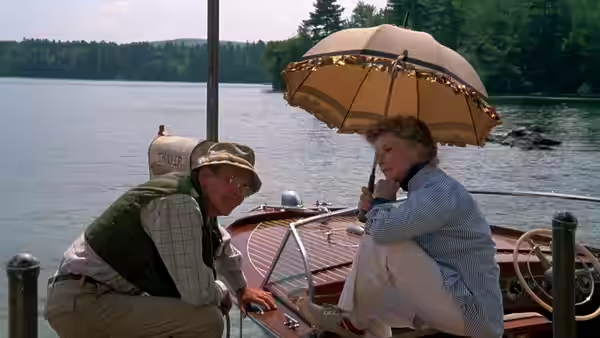
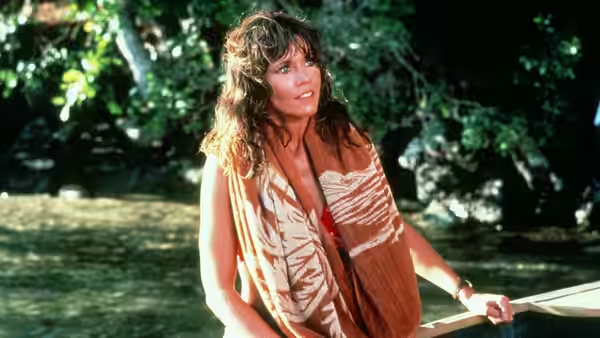
Billy Williams shoots the lake at dawn and dusk, mist on the water, the light low and gold, and it looks like the card you would send from there. Indoors he is plainer and better; the rooms are lit by windows and a lamp or two, and faces are allowed to be old. Stephen B. Grimes has filled the cottage with decades of clutter, hats on pegs, oars, photographs, a rack of fishing rods. Dorothy Jeakins puts Norman in a soft fishing hat and shapeless cardigans and Ethel in slacks and a man’s shirt. Dave Grusin’s piano theme is pretty, and it arrives whenever a feeling is on its way, so we are told about the feeling before the actors have produced it. Robert L. Wolfe cuts back to the loons more often than the loons can bear.

Then the visitors. Chelsea (Jane Fonda) arrives for the birthday with Bill Ray (Dabney Coleman), a dentist, and his son Billy (Doug McKeon), and the best-written scene outside the marriage follows almost at once. Norman, alone with Bill in the sitting room, needles him about the sleeping arrangements until Bill, who has been polite for ten minutes, stops. Coleman is excellent and Fonda plainly enjoys having someone to push against. Thompson can write a scene like that. He does not write many.

Billy is the problem. He is thirteen and talks the way a grown-up imagines a thirteen-year-old talks, all “suck face” and “bullshit”, and we winced at nearly every line he is given. He exists so that Norman can be gruff and then be kind, and the film hands the pair a boat, a rod and a legendary trout called Walter and lets the rest write itself. McKeon does what he can. A few of the fishing scenes work, because Fonda finds something real in a man deciding, late, to be curious about a child. Most of them are the film waiting for the parents to come back.

Jane Fonda plays the daughter who cannot please her father, opposite her own father, and everyone involved knew we would know that. It gives her scenes a charge the writing has not earned, and Thompson makes it worse by having Chelsea explain her grievances to her mother, in full sentences, in the kitchen. Hepburn answers them well. The second half has a scene we will not describe, and after it the family arranges itself into the shape a film like this requires. We did not believe the shape. We believed every word the two old people said to each other.

It was Henry Fonda’s last film, and he is as good in it as he ever was. Watch it for the two of them and be patient with the rest. At 109 minutes, the rest does not take long.
Critical consensus AI synthesised

74
Positive
5
Mixed
0
Negative
1

Most critics like it, and nearly all of them like it for the same reason. The praise clusters on the two leads: Henry Fonda and Katharine Hepburn, playing an elderly couple at their lakeside home, are credited with making a long marriage look lived-in through small details rather than speeches. Several reviews single out Fonda in particular, and one calls his work the thing that gives the film its bite. A near-death scene late on is mentioned more than once as the moment that lands.

The reservations are about the writing rather than the acting. Even admirers concede the plot is formulaic, the sentiment thick and the manipulation visible, and that the material backs away from a real fight when one is due. The spread is wide: two five-star verdicts sit alongside a lone dissent from Time Out, which finds the family reconciliations artificial and thinks the stars deserved better. The middle ground is that the leads rescue a script that does not quite earn them.

RogerEbert.com
1 January 1981 · ★★★★/4 · Roger Ebert
100

The film is a treasure because it makes believable the fragile emotions and growth in its characters despite a formulaic plot. Ebert singles out the standout acting, especially the chemistry and performances of Henry Fonda and Katharine Hepburn.

Read the full review →
The Times
14 December 2018 · ★★★★★ · Ed Potton
100

The critic describes it as a classy weepie about an elderly couple in their lakeside home, highlighting the authentic emotional shorthand of a long marriage between Henry Fonda and Katharine Hepburn in their late-career roles. It notes the Oscar wins and the mirroring of real-life family tensions with Jane Fonda's character.

Read the full review →
Empire
28 July 2006 · Ian Nathan
75*

The critic finds the film an extraordinary piece about parents and marriages with naturalistic acting that resonates through subtle details of life. It praises the portrayal of enduring relationships, especially Hepburn’s quiet love for her grouch of a husband, while noting it can cloy in places.

Read the full review →
The New York Times
4 December 1981 · Vincent Canby
70*

The screen version remains sentimental and manipulative but is elevated by its stars into something more substantial. Canby singles out Henry Fonda's great performance as the highlight that gives the film its bite and center.

Read the full review →
Variety
31 December 1980 · Variety Staff
70*

The film offers major roles for Hepburn and Fonda who work superbly together, with sufficient pleasures despite the play backing away from dramatic fireworks. It singles out the moving near-death scene and the stars' heartrending performance conveying intimations of mortality.

Read the full review →
Time Out
10 September 2012 · RM
30*

The critic calls it a calculated generation-gap tearjerker that fails its veteran stars. The artificial family reconciliations and sentimental contrivances are singled out as especially disappointing.

Read the full review →

Cast

Awards

Academy Awards, 1982

Nominated
Best Cinematography
Nominated
Best Director
Nominated
Best Film Editing
Nominated
Best Original Score
Nominated
Best Picture
Nominated
Best Sound
Nominated
Best Supporting Actress
Won
Best Actor
Won
Best Actress
Won
Best Writing, Adapted Screenplay

If you liked this, try…

Make Way for Tomorrow poster

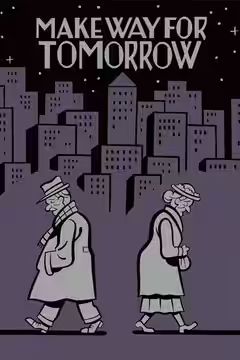
Make Way for Tomorrow

1937 · An old couple parcelled out among their children; McCarey never asks for your tears and gets them.

Tokyo Story poster92

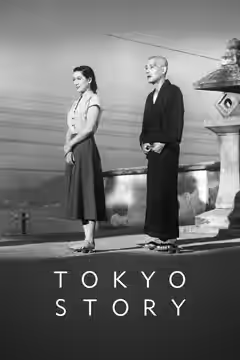
Tokyo Story

1953 · Ozu’s parents visit grown children who have no time; quieter and harder than Rydell’s film.

The Whales of August poster

The Whales of August

1987 · Two old sisters, a Maine island, Lillian Gish and Bette Davis; the same summer light, less sugar.

Still Walking poster

Still Walking

2008 · Kore-eda’s family reunion, one day, one house, and a father who cannot say what he means.

Amour poster88

Amour

2012 · Haneke’s long marriage at its end; everything On Golden Pond looks away from, looked at.