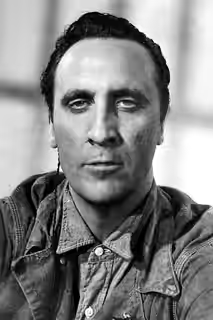
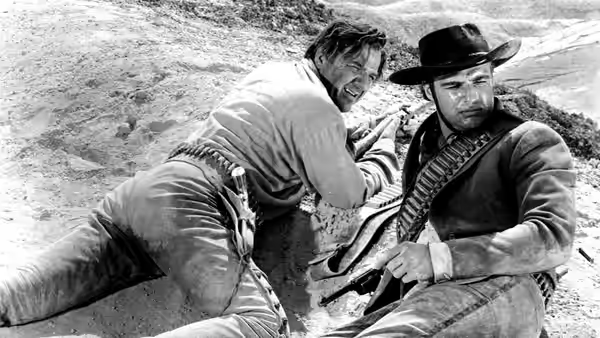
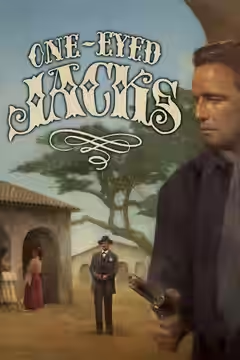
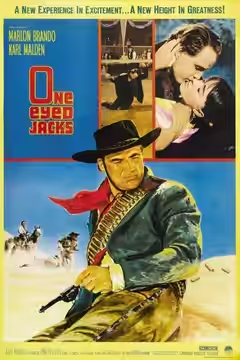
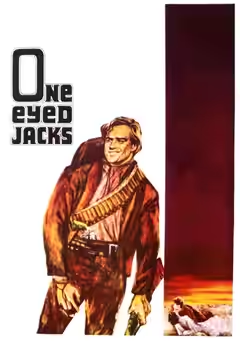
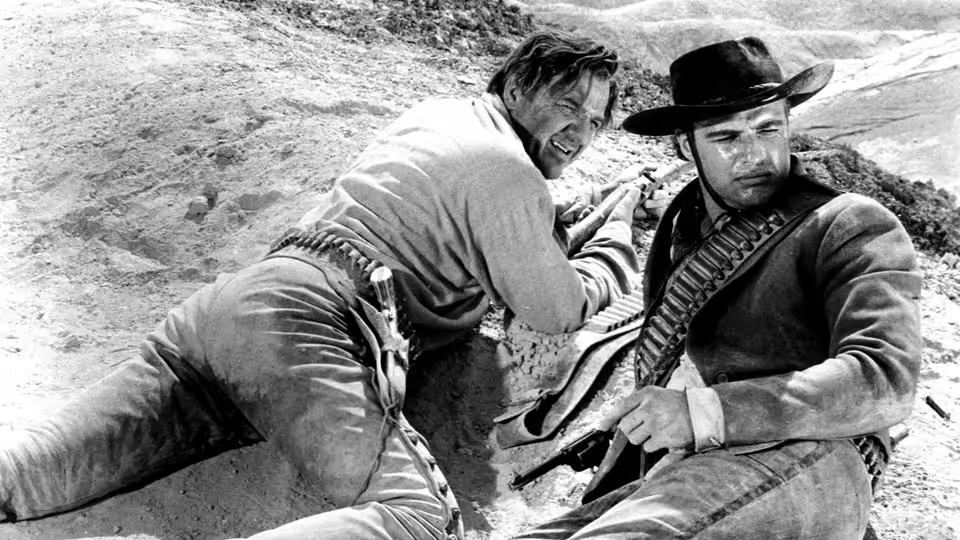
A man crouches beside a seated cowboy holding a rifle on a rocky hillside
Film review

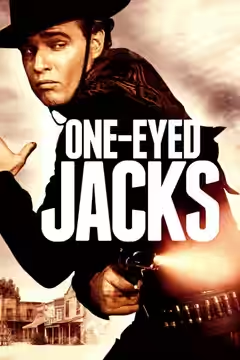
One-Eyed Jacks

1961 · Directed by Marlon Brando · 2h 21m

In a sentenceBrando spends 141 minutes deciding whether to shoot Karl Malden, and the coast looks lovely while he thinks about it

Sonora, Mexico, 1880. Rio (Marlon Brando) and Dad Longworth (Karl Malden) rob a bank together and ride out with the gold and the rurales behind them. When Rio’s horse gives out, Dad goes for fresh mounts and does not come back. Rio spends five years in a Mexican prison, breaks out with Chico Modesto (Larry Duran), and falls in with two bank robbers, Bob Amory (Ben Johnson) and Harvey Johnson (Sam Gilman), who have a job planned in Monterey, California. Rio has his own reason to go: Dad is the sheriff there now, with a wife, Maria (Katy Jurado), a house by the sea and a reputation. Rio arrives during a fiesta, smiles at his old partner, and settles in to wait.

Fi1m review

Marlon Brando’s only film as director is a revenge western that keeps putting off the revenge, and is better for the delay. Charles Lang’s Monterey coastline and two careful lead performances carry a film that runs long and knows it.

Marlon Brando directed one film, and this is it. One-Eyed Jacks, adapted by Calder Willingham and Guy Trosper from Charles Neider’s novel, opens as a plain revenge story: two bank robbers in Mexico, one of them left to the rurales while the other rides off with the gold. Rio (Brando) does five years for it. Dad Longworth (Karl Malden) becomes a sheriff on the California coast. Rio finds him. In most westerns that would take twenty minutes and the rest would be the shooting; here it takes twenty minutes and the rest is Rio not shooting.

It is a good film, worth your evening if westerns are yours, and an uneven one. The middle hour in Monterey sags, Brando the director never once tells Brando the actor to hurry up, and the smaller villains are drawn with a thick pencil. What holds it together is the pleasure Brando takes in watching people lie to each other, and the sea.

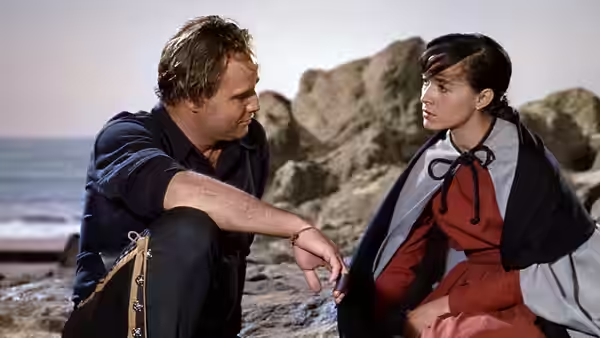
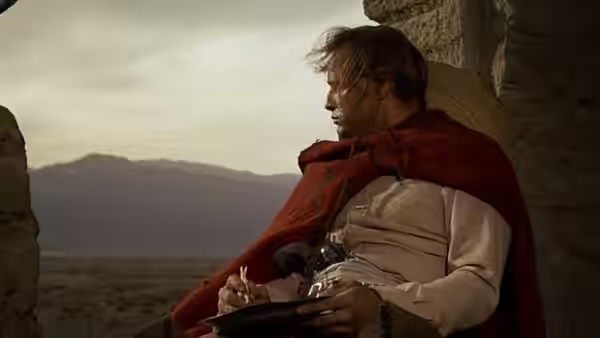
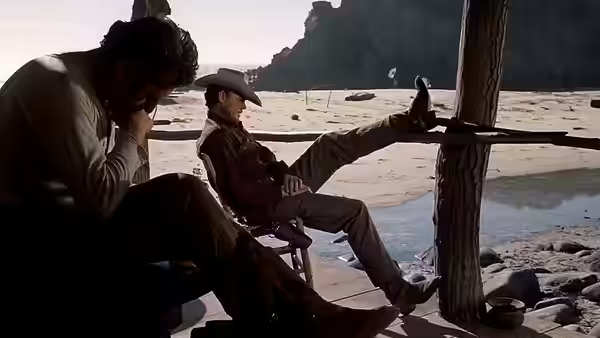
Charles Lang shot it, and he is the reason it is remembered as well as it is. The Sonora scenes are dust and hard light; the moment Rio reaches Monterey, the frame fills with green hills and grey surf, and Lang keeps the Pacific in the background of nearly every conversation, so that men discussing a bank robbery are dwarfed by water that does not care. Yvonne Wood dresses Rio in black with silver at the collar and Dad in a good suit that sits on him like a costume, which is the point. Hugo Friedhofer’s score is old-fashioned studio brass, big during the fiesta, and it has the sense to drop away on the beach.

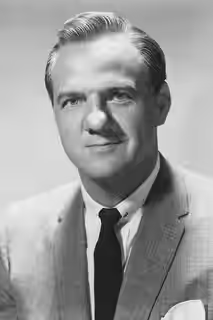
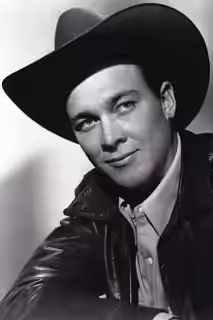
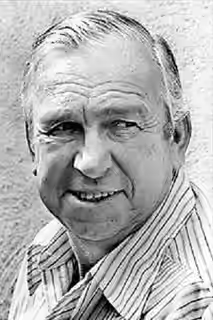
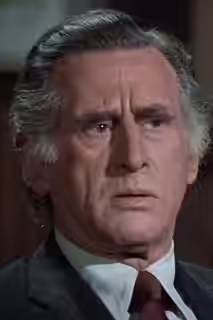
Brando plays Rio soft-voiced and watchful, a man who enjoys lying so much that he sometimes forgets what he is lying for. Malden gives the better performance. His Dad has built a decent life on one bad afternoon and would like to be forgiven without ever admitting to anything; every friendly scene between the two of them is really a negotiation, and Malden lets you see him counting. Katy Jurado, as Maria, is warm and sharp and given too little. Slim Pickens plays the deputy as a coward with a badge, and Ben Johnson’s Bob Amory is the only person in the film who wants to get anything done, which makes him oddly sympathetic. Timothy Carey turns up as a loud drunk in a cantina and is unforgettable in the way a car alarm is.

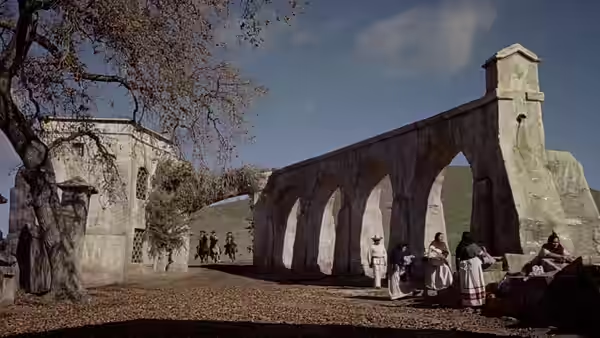
We were moved, more than we expected, by the fiesta. Brando fills the square with families, musicians and children who are not looking at the camera, and for a few minutes the film stops being about two men and becomes about a town. Later, in the second half, there is a public punishment in that same square which we will not describe. We watched it through our fingers. It was not the violence that did it, which is brief. It was Malden’s face, which is the face of a man doing his job properly.

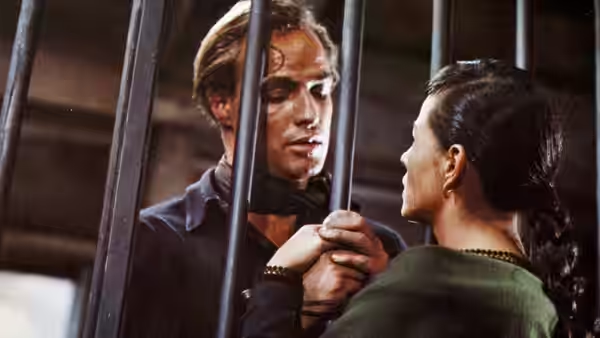
The flaws are real. Rio’s business with a young woman of Dad’s household is written first as a scheme and then as love, and the film does not manage the turn; it simply stops being one thing and starts being the other. Archie Marshek’s cutting lets scenes run a beat or two past their point, and it happens often enough that we started to notice the pattern rather than the scene. At 141 minutes, the film is asking for patience it has not always earned.

Set against the westerns of its own period, it is strange and a little ahead of itself. The hero has every reason to kill the villain and keeps asking himself whether he still wants to, and the film treats the question seriously rather than as delay. See it on the largest screen you can find, because Lang’s coastline needs the space, and allow for the length. It is a film that takes its time, and for about two-thirds of it we were glad to give it.
Critical consensus AI synthesised

80
Positive
7
Mixed
1
Negative
0

Most critics rate One-Eyed Jacks highly, and the praise clusters around Brando, both in front of the camera and behind it. His performance is singled out for its control of image and gesture, and his direction is called fascinating, powerful and, for a debut, remarkably assured. The Monterey coastline photography draws repeated notice, as does the film’s frankness about sadism and perversity for a Hollywood western of its period. Several critics place it as a revisionist western that looks forward to Peckinpah, and a recent restoration is credited with reviving its reputation.

The reservations are few and mild. Variety finds some of the secondary villains one-dimensional, and Time Out is more guarded, calling the direction fascinating without going much further. The spread is narrow and tilted upward: The Skinny gives full marks, and the single mixed notice sits closer to good than to poor. The New York Times is warm too, its only regret being that Brando never directed another film.

Slant Magazine
24 November 2016 · ★★★★½ · Chuck Bowen
90

Bowen celebrates the film as an influential, introspective western that merits renewed respect. He singles out Brando’s control of image and gesture, alongside Criterion’s ravishing restoration.

Read the full review →
The Guardian
22 June 2017 · Guardian staff reporter
85*

The critic considers the film possibly the best Western since Shane and praises its revival of period and community. They single out its family and fiesta scenes as capturing the communal humanity of the genre.

Read the full review →
Empire
1 January 2000 · William Thomas
80*

The critic calls the revenge western a remarkably powerful and winning directorial debut. They single out Brando’s performance, strong supporting turns, and especially the breathtaking Monterey coastline photography.

Read the full review →
Radio Times
★★★★ · Tony Sloman
80

Sloman calls the film a stunning, deeply satisfying psychological western. He praises its distinctive treatment of sadism and perversity for a Hollywood film of its period.

Read the full review →
Variety
31 December 1960 · Variety Staff
75*

The review finds the film strong in its central characterizations, though some secondary figures are one-dimensional villains. It praises Brando’s substantial performance, Malden’s vivid portrayal, and the production’s visual artistry.

Read the full review →
The New York Times
21 October 2001 · Elvis Mitchell
70*

The critic views the film positively and regrets that Brando made no other film as director. The article’s headline singles out its status as Brando’s sole directorial effort.

Read the full review →

Straight answers AI written, from our review

Is One-Eyed Jacks worth watching?
One-Eyed Jacks is worth watching if westerns are yours and you have patience for a slow one, and we scored it 78. Marlon Brando's only film as director keeps putting off its revenge, and Charles Lang's Monterey coastline and Karl Malden's careful, guilty sheriff carry it. At 141 minutes the middle hour sags, and we felt the length.
How long is One-Eyed Jacks, and what is it rated?
One-Eyed Jacks runs 2h 21m. It is a western and drama film.
Where can I watch One-Eyed Jacks in the UAE?
One-Eyed Jacks is not on any streaming or rental service in the UAE at the moment. It is available in 9 other countries; change your country at the top of the page to see where. Availability is checked daily.
How does One-Eyed Jacks compare to Johnny Guitar?
One-Eyed Jacks is the slower and quieter of the two; Johnny Guitar is fiercer, more theatrical and louder in its hatreds. Both are westerns about people who cannot forgive, but Brando's film spends its time watching two men lie to each other by the sea, while Nicholas Ray's stages its grudges at full pitch. Ray's is the more intense evening; Brando's the more patient one.
Is One-Eyed Jacks based on a true story or a book?
One-Eyed Jacks is based on a novel by Charles Neider, adapted for the screen by Calder Willingham and Guy Trosper, not on a true story. You do not need to know the book: the film stands on its own as a revenge western about a bank robber tracking down the partner who abandoned him. Our review does not judge how closely it follows the novel.

Cast

Awards

Academy Awards, 1962

Nominated
Best Cinematography, Color

If you liked this, try…

  1. Ride the High Country (1962) · not on Fi1m yetTwo old partners, one bad debt, and Peckinpah at his gentlest.

  2. The Great Silence (1968) · not on Fi1m yetAn Italian western in the snow where revenge costs more than anyone expects.

  3. Johnny Guitar (1954, Fi1m 84)Old grudges and hot colour; the west as a stage for people who cannot forgive.

  4. Pursued (1947) · not on Fi1m yetA western shot like a nightmare, about a man who does not know why he is hated.

  5. The Proposition (2005) · not on Fi1m yetAustralia’s outback as the frontier, with a bargain as poisonous as Dad Longworth’s.