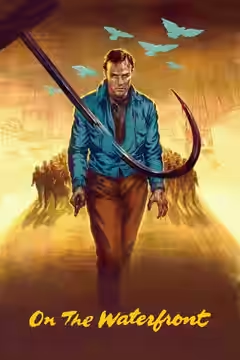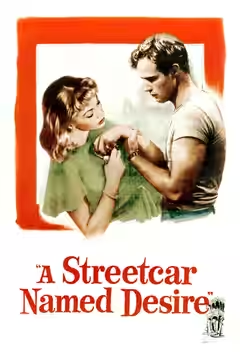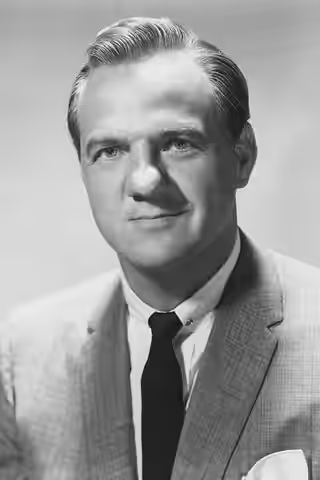
Karl Malden makes earnestness worth listening to. We value the urgency he brings to men trying to do right, though On the Waterfront shows how a script can keep preaching after the acting has made the point.
Fi1m perspective
Listen to Karl Malden's Father Barry in On the Waterfront (1954): he makes an exhortation sound as though it cannot wait. As the priest in Elia Kazan's film, he speaks with a conviction that makes the moral instruction difficult to dismiss. We were stirred by that urgency, even as the religious emphasis began to press harder than the performances required. There is nothing apologetic about the earnestness, and that is much of what we value in him.
The breakthrough was Mitch in A Streetcar Named Desire, first on stage in 1947 and then on screen in 1951. Supporting parts dominated the following two decades, often in Kazan's company, but sincerity did not confine Malden to agreeable men. His Archie Lee Meighan in Baby Doll (1956), his last film with Kazan, offered a frustrated character and a rare leading role. That is a useful corrective to remembering him only as the decent man brought in to steady a more magnetic star.
The trouble in On the Waterfront is that Schulberg's writing keeps insisting on a point the actors have made. Brando has already made us care about the dockside struggle; Malden has the harder job of putting its moral demands into words. Leonard Bernstein's music gives that struggle scale, though it too sometimes adds more emotional emphasis than the acting needs. We recommend the film warmly for its performances, but even Malden's conviction cannot make all that Christian symbolism feel necessary.
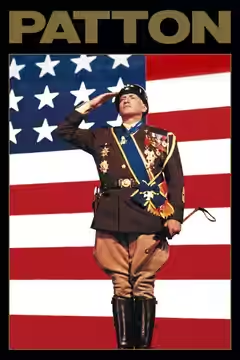
Later, he played General Omar N. Bradley in Patton (1970), before taking the television lead as Lieutenant Mike Stone opposite Michael Douglas in The Streets of San Francisco (1972–77). The television role put an actor long associated with supporting parts at the centre of a series. Priests, generals and policemen might suggest a narrow set of jobs, but his sincerity could accommodate inner conflict as well as certainty. Start with On the Waterfront for the acting, and allow for a little more instruction than we think necessary.
Biography
Karl Malden was an American actor. Born Mladen George Sekulovich in Chicago on 22 March 1912, he began his career on the New York stage in the 1940s, appearing in productions including Arthur Miller's All My Sons and Tennessee Williams's A Streetcar Named Desire.
Malden received an Academy Award for Best Supporting Actor for his role as Harold Mitchell in the 1951 film version of A Streetcar Named Desire. He was nominated for the same award for his performance as Father Barry in On the Waterfront (1954). Other notable film roles include General Omar N. Bradley in Patton (1970) and parts in One-Eyed Jacks (1961), Birdman of Alcatraz (1962) and How the West Was Won (1962).
From 1972 to 1977 he played Lt. Mike Stone in the television series The Streets of San Francisco. He served as president of the Academy of Motion Picture Arts and Sciences from 1989 to 1992 and appeared in American Express advertising campaigns.