Michel Hazanavicius’s spy spoof rebuilds the Fifties thriller exactly, then hands it to a fool. Jean Dujardin is the joke and the point; the look is right down to the back projection. The gags thin out late, and it likes its idiot too much.
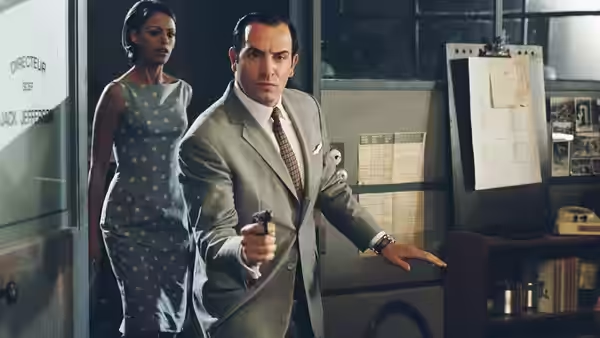
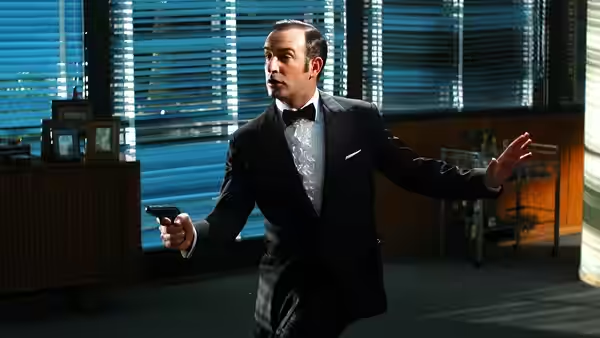
Michel Hazanavicius has taken a pulp hero that France once took seriously and made him an idiot. Hubert Bonisseur de La Bath, code name OSS 117, was invented by the novelist Jean Bruce as a straight secret agent. Here he is Jean Dujardin in a dinner jacket, sent to Cairo in 1955 to find his friend and fellow agent Jack Jefferson (Philippe Lefebvre), armed with a cover story about poultry, no Arabic and the serene conviction that everyone he meets is lucky he is French. It is a good joke and the film gets 99 minutes from it, about ten more than it can comfortably carry.
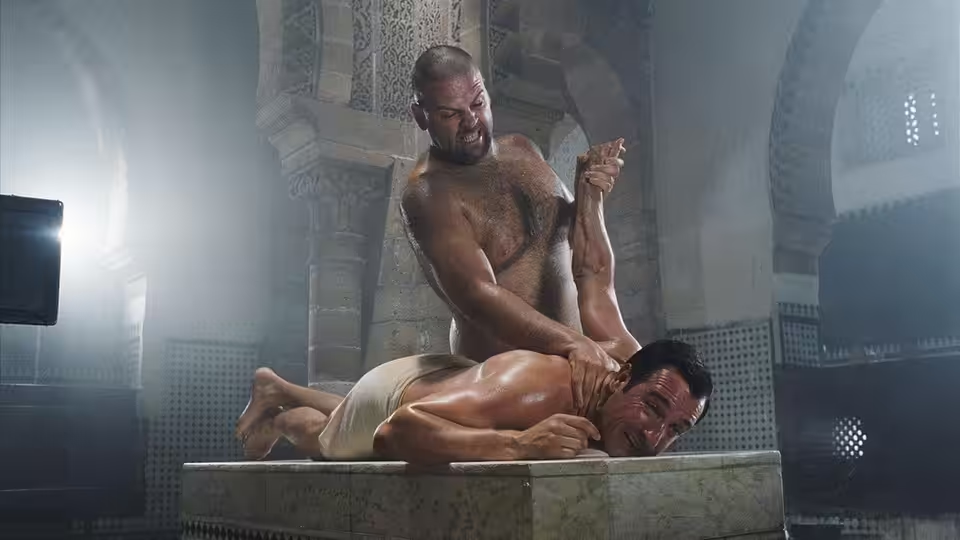
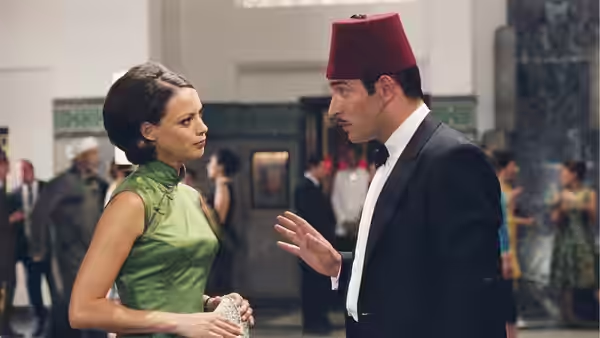
It looks right. Guillaume Schiffman shoots it the way a Fifties studio would have: hard key lights, saturated reds and turquoise, a back-projected street behind a car that does not quite match its speed. Maamar Ech-Cheikh’s Cairo is plainly built on a stage, a city of painted flats and a villa with a staircase made for entrances. Charlotte David cuts the suits a size too sharp. Ludovic Bource and Kamel Ech-Cheik supply brass, bongos and a wordless female chorus of the kind that used to mean “abroad”.
Dujardin is the film. He plays Hubert with the stillness of a man who has never had a doubt, chin up, teeth out, and gets his laughs by holding a smile a beat past where anyone sane would stop. He explains Islam to Muslims. He keeps remembering Jack, the two of them on a beach in white trunks, with a tenderness that tells us more about Hubert than he will ever know. We laughed hardest, and least proudly, at the fight in the chicken warehouse, where he ends up throwing live birds at his attackers. Reynald Bertrand cuts it on the squawk.
Bérénice Bejo is Larmina El Akmar Betouche, Jack’s assistant and Hubert’s contact, and she plays her as the only grown-up in it. She hears every insult, lets it pass, and the film is decent enough to hold on her face while she does. Aure Atika has fun as Princess Al Tarouk, both a lead and a distraction. Constantin Alexandrov’s Setine and Laurent Bateau’s Gardenborough are a Russian and an Englishman for Hubert to be rude to, and Saïd Amadis, as the Egyptian minister, keeps a straight face through the worst things Hubert says.
The trouble is the stretching. The jokes come in three kinds, Hubert is rude, Hubert is wrong, Hubert is unbothered, and by the final half-hour the film has told each of them several times, louder. The plot exists to get him from one room to the next and knows it, which is fine until every room starts to look alike. Bertrand’s cutting, so clean in the first hour, lets the late scenes run a sentence long.
The harder question is whether the film is laughing at Hubert or with him. The one serious dissent among the reviews says it lets him off too easily, and it has a point. He is wrong about colonialism, religion and women, and the film wants us to see it. It also wants us to like him, and being wrong never costs him anything. The scene where he is woken at dawn by the call to prayer and climbs the minaret to deal with it made us laugh, then made us look at our hands. The laugh was at Hubert. But the sequence was built so that the man he hits is the punchline, and we noticed.
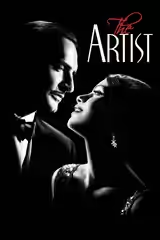
Hazanavicius, Dujardin, Bejo, Schiffman and Bource went on to make The Artist in 2011, and the same instinct is here: a liking for an old form and the patience to rebuild it exactly before bending it. This is the rougher, funnier draft. Beside the Austin Powers films it is a clear win; it never nudges you in the ribs.
Watch it with the subtitles and a drink and do not expect the story to matter. If Dujardin’s smile is funny to you in the first ten minutes, you will be fine for the next ninety; if it is not, nothing that follows will change your mind.