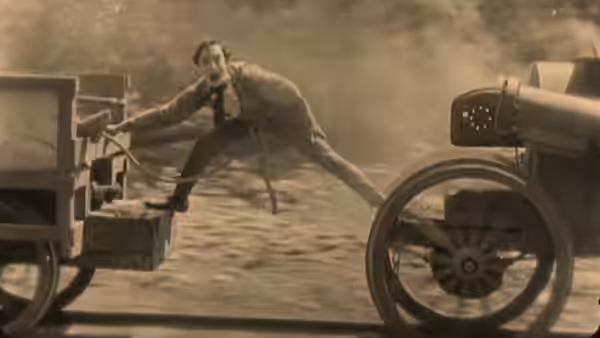
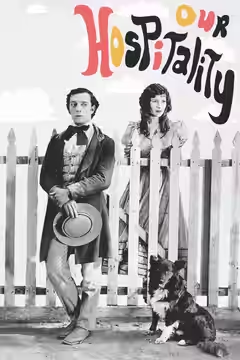
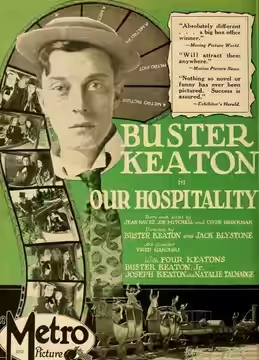
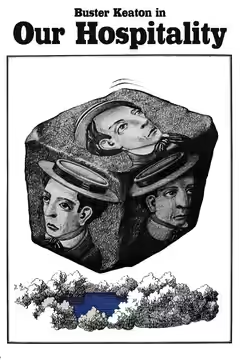
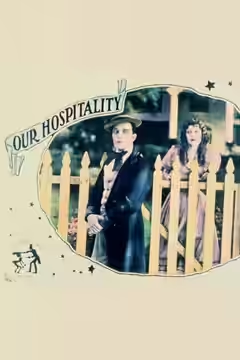
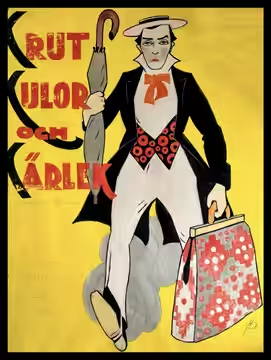
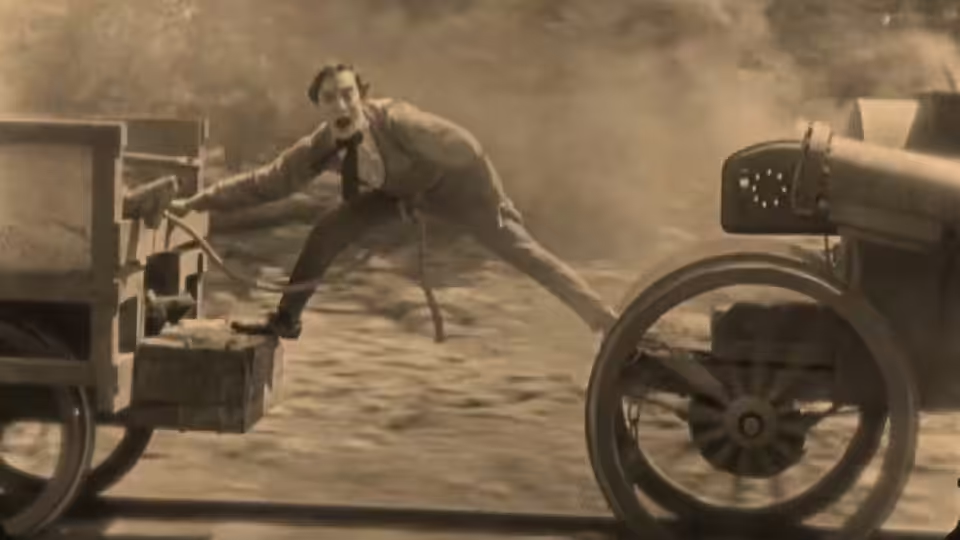
William McKay (Buster Keaton) stretches between the front and rear of a moving automobile
Film review

Our Hospitality

1923 · Directed by Buster Keaton, John G. Blystone · 1h 13m

In a sentenceA train takes its time, and for once we have no complaint

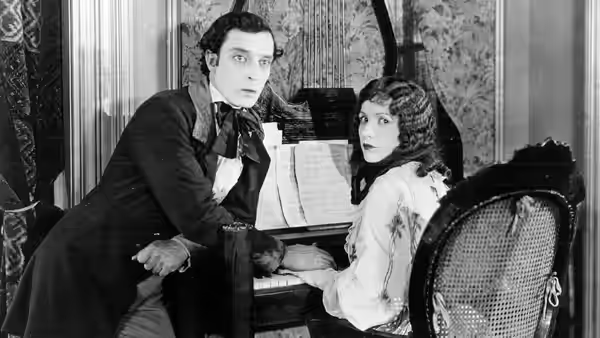
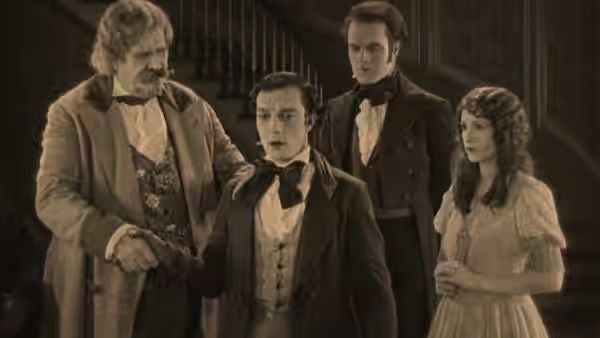
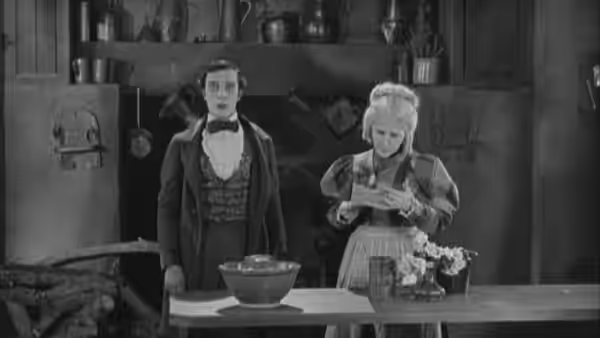
William McKay (Buster Keaton), Virginia Canfield (Natalie Talmadge) and Joseph Canfield (Joe Roberts) feature in a period story combining romance, physical comedy and danger. A railway journey brings a train and The Engineer (Joe Keaton) into the action, with travelling itself providing opportunities for mishaps. Clayton Canfield (Francis X. Bushman Jr.) and Lee Canfield (Craig Ward) also feature, alongside Aunt Mary (Kitty Bradbury). McKay’s romantic concerns share space with practical difficulties, while the railway becomes the setting for an extended passage of physical comedy.

Plays from YouTube when you press play; nothing loads from them until then.

Fi1m review

Buster Keaton’s railway comedy rewards patience and close attention, with physical invention that remains easy to enjoy. The romance is less engaging, and the pace occasionally slackens, but the comic workmanship earns our recommendation.

Buster Keaton and John G. Blystone give Our Hospitality time to work out its jokes, and the patience mostly pays off. This is an inventive, warmly enjoyable comedy whose railway business is more satisfying than its romance. Its particular pleasure is watching a performer give a practical difficulty his complete attention, without appearing to consider how funny he might look. There is affection in the film, but getting from place to place tends to produce the better entertainment.

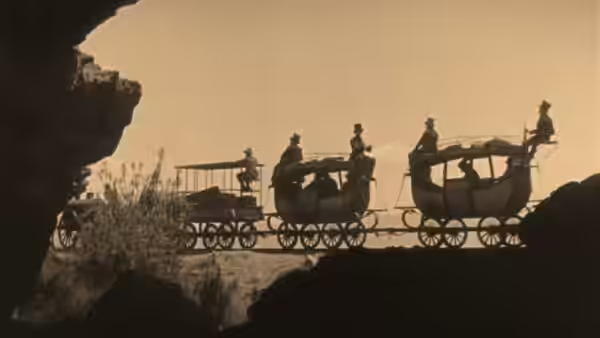
The period train sequence explains the appeal. We laughed at the railway journey because Buster Keaton treats its difficulties with such serious attention. He allows us to enjoy the absurdity without asking his character to acknowledge it, and the concentration makes the physical comedy feel oddly companionable. The train earns attention in its own right, rather than serving merely as transport between scenes, and the sequence benefits from being allowed to occupy so much of the film.

Gordon Jennings and Elgin Lessley make that physical business easy to follow. Their photography gives the relationship between the performer and his surroundings enough clarity for us to appreciate how carefully the comedy has been arranged. We need to understand a difficulty before we can enjoy the ingenuity of dealing with it. The images do that work without making the staging feel like a demonstration, which matters when so much of the pleasure depends on apparently spontaneous responses.

Buster Keaton’s William McKay is engaging because the physical precision never quite excludes vulnerability. The effort to cope gives us something recognisable to care about, even when the comedy becomes elaborate. Joe Roberts, as Joseph Canfield, suits the broader comic scale, while Natalie Talmadge’s Virginia Canfield feels less sharply defined. The romantic passages have warmth, but they lack the particularity of the railway business, and we sometimes find ourselves waiting for another practical problem.

Joseph A. Mitchell and Jean C. Havez’s screenplay, with a story credited to Clyde Bruckman, leaves generous room for the physical comedy. That freedom occasionally costs the storytelling some momentum: a passage can remain amusing after it has made its point. The romance needs a little more weight if it is to compete for our attention, especially alongside such resourceful comic movement. At 73 minutes, the film is short, though not every stretch feels equally necessary.

Walter J. Israel’s costume design helps the period setting feel comfortable enough for the antics to belong there. The clothes support the performances without persistently demanding separate admiration. That is useful in a film with so much carefully arranged physical business, where an overemphatic detail could make everything seem fussy. The photography and costumes share a restraint that keeps our attention on the people and their immediate difficulties.

Physical comedy asks us to pay attention to things that another kind of film might hurry past. Here, that attention is usually repaid, and there is no need to treat the humour as an exercise in appreciating film history. The pleasure is direct enough once we settle into its pace. Choose it when there is time to watch a journey properly, rather than simply wait for somebody to arrive.

Critical consensus AI synthesised

79
Positive
4
Mixed
0
Negative
0
Variety
31 December 1922 · Variety Staff
90*

The critic calls it an unusually entertaining comedy and praises its flawless direction and intelligent photography. They also single out the period railroad-train sequence as a comedy classic.

Read the full review →
The New Yorker
85*

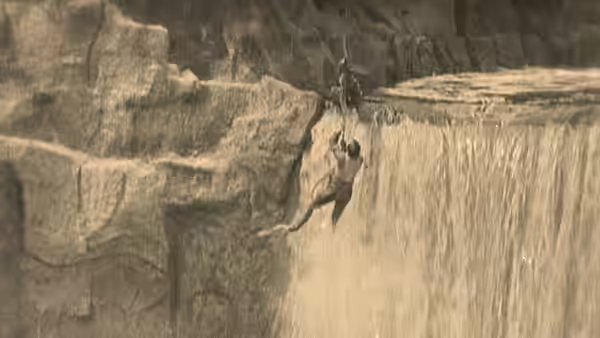
The capsule praises the film as an antic showcase for Keaton’s ingenuity and romanticism. It especially singles out the climactic waterfall stunt and the sly stagecraft.

Read the full review →
Slant Magazine
20 October 2019 · ★★★½ · Bill Weber
70

Weber praises the film as an early major work of Keaton’s peak era, while noting it lacks some of the surreal qualities of his later features. He singles out Keaton’s finely honed physical comedy and the exhilarating river-sequence climax.

Read the full review →
Time Out
· TR
70*

The available description suggests a positive verdict. It singles out Keaton’s films as funnier and more modern than Chaplin’s because they are made cinematically.

Read the full review →

Straight answers AI written, from our review

Is Our Hospitality worth watching?
Our Hospitality is worth watching for its inventive physical comedy, especially if a leisurely railway journey sounds like a pleasure; we score it 81 out of 100. We recommend it for Keaton’s patient handling of practical mishaps, though the romance is less engaging and even at 73 minutes the pace occasionally slackens.
How long is Our Hospitality, and what is it rated?
Our Hospitality runs 1h 13m. It is a comedy and romance film.
Where can I watch Our Hospitality in South Korea?
Our Hospitality is not on any streaming or rental service in South Korea at the moment. It is available in 14 other countries; change your country at the top of the page to see where. Availability is checked daily.
How violent or frightening is Our Hospitality, and is it suitable for children?
Our Hospitality has no UK certificate supplied and is rated NR in the US, so those labels offer no clear age guidance for children. The story includes danger alongside romance and physical mishaps, but we cannot establish the intensity of violence or frightening material from those descriptions alone, particularly for younger or sensitive children.
How does Our Hospitality compare to The General?
Our Hospitality offers patient railway comedy, while The General is the stronger choice for action and locomotive ingenuity. We recommend both for the attention Keaton gives machinery and practical difficulties, but the railway business in Our Hospitality occasionally slows the storytelling; in The General, the action more decisively outweighs a similarly thin romance.
What should I watch after Our Hospitality?
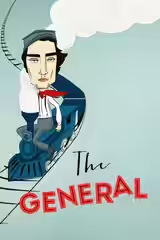
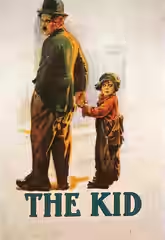
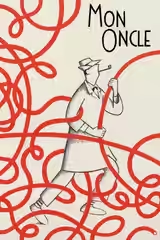
After Our Hospitality, try The General (1926, Fi1m 91): More railway comedy, with machinery given almost as much personality as the people. Then The Kid (1921, Fi1m 84): Physical comedy and affection, with a stronger pull towards open sentiment; and Mon Oncle (1958, Fi1m 82): Patient visual jokes about people struggling with objects supposedly built to help.

Cast

If you liked this, try…

  1. The General (1926, Fi1m 91)More railway comedy, with machinery given almost as much personality as the people.

  2. The Kid (1921, Fi1m 84)Physical comedy and affection, with a stronger pull towards open sentiment.

  3. Mon Oncle (1958, Fi1m 82)Patient visual jokes about people struggling with objects supposedly built to help.

  4. The Ladykillers (1955, Fi1m 86)Polite behaviour complicates criminal intentions in a wonderfully cramped domestic setting.

  5. The Wrong Trousers (1993) · not on Fi1m yetPrecise physical comedy develops into suspense without losing its domestic absurdity.