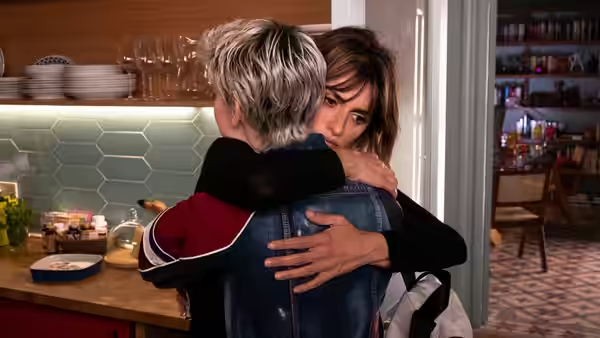
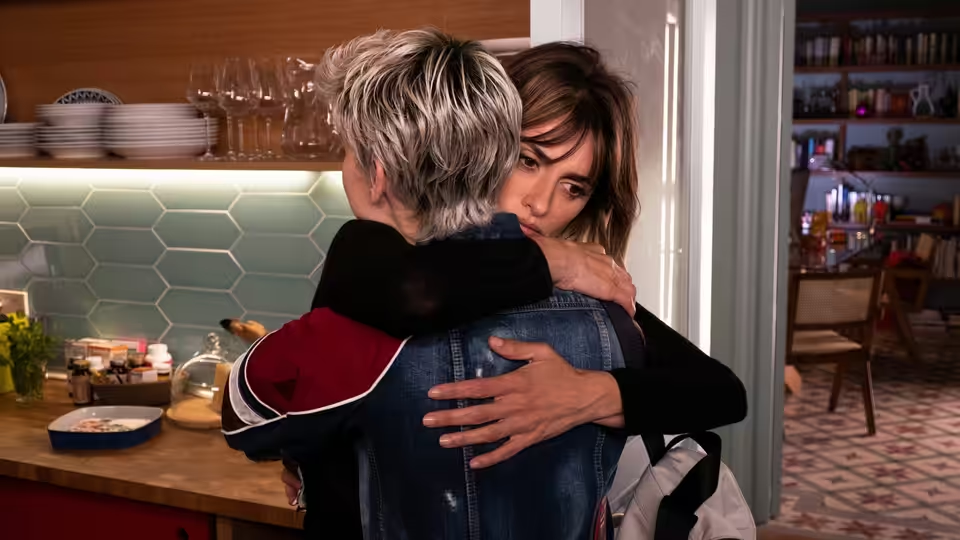
Janis (Penélope Cruz) embraces Ana (Milena Smit) in a kitchen
Film review

Parallel Mothers

2021 · Directed by Pedro Almodóvar · 2h 03m

In a sentencePenélope Cruz makes keeping quiet look exhausting

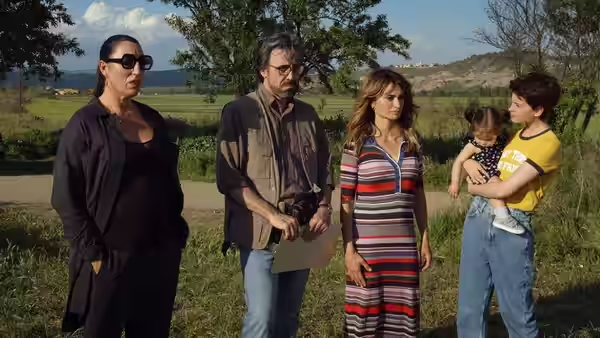
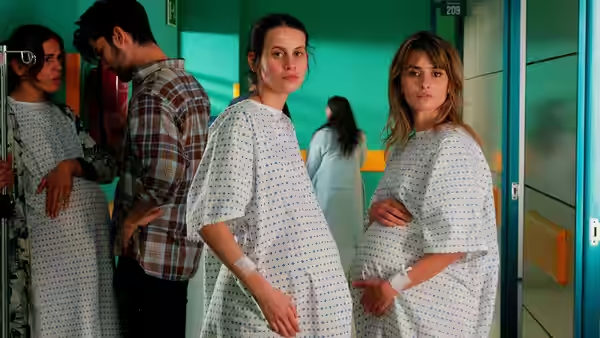
Motherhood connects the lives of Janis (Penélope Cruz) and Ana (Milena Smit), while family secrets complicate their relationship. Their story also involves Teresa (Aitana Sánchez-Gijón). Janis faces deception and its consequences as questions of care and responsibility become entangled with the search for personal truth. The families’ private lives unfold against the unresolved legacy of the Spanish Civil War, with Spain’s past continuing to shape the present. The women contend with loss, difficult loyalties and the things people choose not to tell one another.

Plays from YouTube when you press play; nothing loads from them until then.

Fi1m review

Pedro Almodóvar’s drama of motherhood and Spain’s past is warm, moving and occasionally untidy. The middle drifts, but Penélope Cruz makes Janis’s distress difficult to dismiss.

Parallel Mothers is a moving, occasionally untidy melodrama, and we recommend it for the women at its centre. Pedro Almodóvar brings motherhood and family secrecy into contact with the unresolved damage of the Spanish Civil War. That is a considerable amount for one drama to carry, and the two stories do not always sit comfortably together. What keeps the film persuasive is Penélope Cruz, who makes Janis worth attending to even when the plotting begins to feel more complicated than it needs to be.

The screenplay gives Janis plenty to endure, but Penélope Cruz never treats suffering as an automatic claim on our sympathy. We were moved by how quietly she plays devastation, particularly in the wordless exchanges between the leads. She lets us see the effort of containing distress without making every reaction a demand to be noticed. Milena Smit, as Ana, has the presence to make those exchanges feel shared. The attention passes between the women, and neither performance requires a speech to make the relationship matter.

Pedro Almodóvar’s screenplay has the confidence to use the contrivances of melodrama without apologising for them. A few disclosures are easy to anticipate, but knowing roughly where a story is going does not make the people in it less interesting. The warmth between the women helps us accept developments that might otherwise seem merely convenient, because their responses remain believable even when their circumstances strain belief. There is pleasure in watching a film take complicated feelings seriously without requiring everybody to behave sensibly.

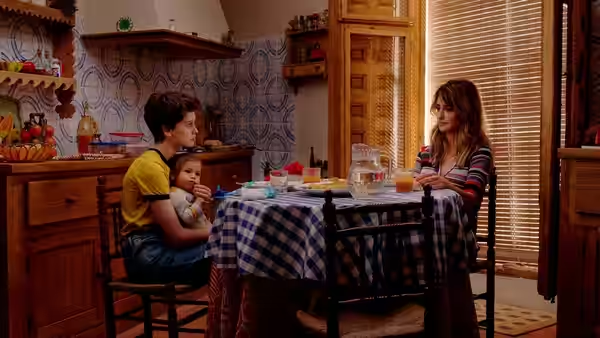
Antxón Gómez’s vivid décor gives the film much of its immediate appeal, with the surroundings contributing to the heightened mood. José Luis Alcaine’s cinematography makes that visual richness pleasurable without allowing it to overwhelm the performances. The women’s faces still hold our attention, which matters in a drama where so much is happening without words. The emphatic surroundings also make the actors’ restraint effective: nothing requires them to match the décor, and their quiet exchanges benefit from that freedom.

Teresa Font’s editing is less successful at maintaining the pull of the story through the middle section. Some passages take longer than their emotional weight warrants, and the film begins to seem as though it is waiting for its next disclosure. Alberto Iglesias’s score helps, giving the drama an insistence that suits the material, although music cannot entirely repair the loss of pace. At 123 minutes, there is room for these relationships to develop, but a little less time spent arranging their complications would have helped.

The Spanish Civil War strand gives the family drama a seriousness that extends beyond the immediate troubles of Janis and Ana. Pedro Almodóvar does not always make the connection feel natural, but his concern with how old harm continues to affect families belongs here. His sympathy for the women keeps the history from becoming merely a lesson delivered over their heads, even when the shifts between the stories feel awkward. Leave time afterwards for an argument about what people owe one another.
Critical consensus AI synthesised

83
Positive
23
Mixed
1
Negative
0

Most critics warmly receive Parallel Mothers, praising Almodóvar’s emotionally direct melodrama and its connection between motherhood and Spain’s unresolved Civil War history. Penélope Cruz attracts the clearest agreement: the reviews repeatedly credit her with grounding the story’s more extravagant turns through quiet intensity, empathy and emotional complexity. Praise also gathers around the women’s relationships, the vivid visual design and the film’s treatment of loss and remembrance, with many finding its political concerns inseparable from its personal stories.

The spread is chiefly one of enthusiasm rather than approval versus rejection, with reservations concentrated on cohesion, pacing and familiarity. Empire finds the middle less gripping, while The Hollywood Reporter notes predictable disclosures but still finds the drama satisfying. Eye for Film is less persuaded by the handling of history, finding it tonally weaker, though it praises Milena Smit and José Luis Alcaine’s cinematography; most critics regard the historical dimension as a strength.

Time Out
13 January 2022 · ★★★★★ · Dave Calhoun
100

Calhoun presents the film as a haunting, resonant exploration of Spain’s past and present. He singles out Penélope Cruz’s magnificent performance.

Read the full review →
Little White Lies
festival review · David Jenkins
95*

Jenkins regards the film as one of Almodóvar’s finest, praising its emotional depth and assured filmmaking. He especially singles out Penélope Cruz’s performance as extraordinary and emotionally powerful.

Read the full review →
Los Angeles Times
23 December 2021 · Justin Chang
90*

Chang gives the film a strongly admiring verdict, praising how Almodóvar intertwines motherhood with the legacy of the Spanish Civil War. He singles out Penélope Cruz’s radiant, complex performance as the story’s emotional center.

Read the full review →
The AV Club
21 December 2021 · A- · Leila Latif
90

Latif calls the film an outstanding melodrama and praises the trust between Almodóvar and Cruz. Cruz’s performance is singled out for its ability to convey Janis’s devastation with quiet intensity.

Read the full review →
The New Yorker
27 December 2021 · Richard Brody
90*

Brody finds the film a breathless, politically urgent melodrama whose personal stories make historical memory essential. He especially praises Penélope Cruz’s focused performance and Almodóvar’s vivid, documentary-like treatment of the mass-grave excavation.

Read the full review →
Variety
1 September 2021 · festival review · Owen Gleiberman
90*

Gleiberman finds the film moving and emotionally grounded, calling it Almodóvar’s best since All About My Mother. He praises its transporting final unification of motherhood’s life force with the history of Franco-era atrocities.

Read the full review →

Straight answers AI written, from our review

Is Parallel Mothers worth watching?
Parallel Mothers is worth watching for its moving performances and warm treatment of complicated loyalties; we score it 82 out of 100. Penélope Cruz makes Janis’s contained distress particularly affecting, though we find the middle slow and the connection between family secrets and Spain’s unresolved past occasionally awkward.
How long is Parallel Mothers, and what is it rated?
Parallel Mothers runs 2h 03m. It is a drama film.
Where can I watch Parallel Mothers in Iceland?
Parallel Mothers is not on any streaming or rental service in Iceland at the moment. It is available in 28 other countries; change your country at the top of the page to see where. Availability is checked daily.
How violent or frightening is Parallel Mothers, and is it suitable for children?
Parallel Mothers has a UK 15 certificate and is not suitable for children under 15. Its themes include loss, deception and the unresolved damage of the Spanish Civil War, with quietly played emotional distress central to its impact. The certificate sets the age threshold, but we cannot give a more specific warning about violence or frightening imagery.
How does Parallel Mothers compare to Secrets & Lies?
Parallel Mothers offers heightened melodrama and a historical strand, while Secrets & Lies finds humour and pain in difficult family conversations. We recommend both for performances that make revelations believable through affection and embarrassment. Secrets & Lies is the better choice for humour alongside family distress; Parallel Mothers suits an appetite for vivid décor and broader historical concerns, though its storytelling is occasionally untidy.
What should I watch after Parallel Mothers?
After Parallel Mothers, try Secrets & Lies (1996, Fi1m 88): Family revelations made believable by performances that leave room for embarrassment and affection. Then The Official Story (1985, Fi1m 81): A mother’s questions open onto a country’s refusal to face its past; and Ida (2013, Fi1m 85): A quieter search through family history and the damage people leave unspoken.

Cast

Awards

European Film Award for Best Actress, 2022

Nominated
European Film Award for Best Actress

Goya Award for Best Film, 2022

Nominated
Goya Award for Best Film

Premio Feroz for Best Drama, 2022

Nominated
Premio Feroz for Best Drama

Premio Feroz for Best Original Soundtrack, 2022

Won
Premio Feroz for Best Original Soundtrack

Premio Feroz for Best Supporting Actress, 2022

Won
Premio Feroz for Best Supporting Actress

Volpi Cup for Best Actress, 2021

Won
Volpi Cup for Best Actress

If you liked this, try…

  1. Secrets & Lies (1996, Fi1m 88)Family revelations made believable by performances that leave room for embarrassment and affection.

  2. The Official Story (1985, Fi1m 81)A mother’s questions open onto a country’s refusal to face its past.

  3. Like Father, Like Son (2013) · not reviewed yetAnother searching family drama about what makes someone a parent.

  4. Ida (2013, Fi1m 85)A quieter search through family history and the damage people leave unspoken.

  5. Petite Maman (2021, Fi1m 88)Motherhood across generations, told with fewer complications and just as much tenderness.