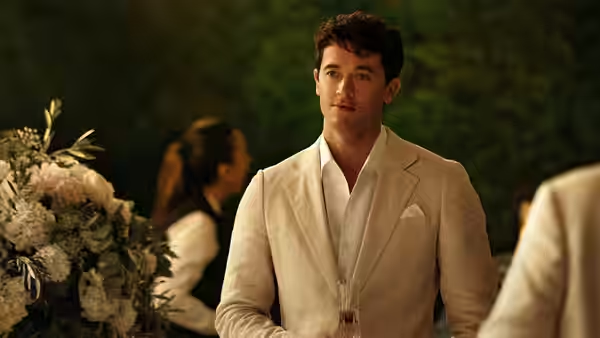
Emily Bader and Tom Blyth make agreeable holiday company in Brett Haley’s likeable but thin romance. The leads work harder than a script that gives their friendship too little substance across 116 minutes.
People We Meet on Vacation is a likeable but thin romantic comedy, sustained by its leads for longer than its writing deserves. Brett Haley’s adaptation of Emily Henry’s novel understands the comfort of watching two friends edge towards a relationship whose appeal is apparent from the start. A familiar outcome is perfectly acceptable if the waiting is interesting. The film manages that in patches, chiefly when the central pair make their holiday companionship feel easy and unforced.
Emily Bader and Tom Blyth give Poppy and Alex enough mutual ease to make their friendship plausible. We warmed to them in their holiday exchanges, because the actors seem to enjoy each other’s company rather than simply wait for the next romantic cue. Their attraction is readily believable, even when the writing gives us little else to go on. The problem arrives when we try to imagine these people away from the trips, with ordinary commitments and habits that might explain their choices.
The screenplay by Yulin Kuang, Amos Vernon and Nunzio Randazzo gives that ordinary life too little attention. The obstacles to romance feel inherited from other romantic comedies, and we never learn enough about this friendship to give them much weight. The supporting characters are especially poorly served, with too few concerns that matter independently of what happens between Poppy and Alex. A stronger sense of those other people might have made the central pair’s hesitation more understandable, but instead we spend too much time recognising the familiar shape of the story and waiting for it to move on.
Rob C. Givens’s glossy cinematography makes the holidays inviting, which is a legitimate pleasure in a film offering an undemanding escape. The places themselves make little impression beyond their usefulness as somewhere for the pair to be together. Travel could give a romance fresh situations and reveal habits that friends can otherwise conceal; here it provides too little of either. The scenery is agreeable, but it tells us less about Poppy and Alex than we need.
Evan Henke’s editing leaves too much of the film’s 116 minutes feeling repetitive. The holiday encounters need a firmer sense of change, rather than another return to the same question about the pair’s relationship. Keegan DeWitt’s music helps maintain the gentle romantic mood, though it cannot give those scenes the emotional weight the script has not earned. The comedy is similarly mild, with too few sharp exchanges to make the repetition enjoyable for its own sake.
This is for viewers already fond of friends-to-lovers stories, who are happy to let the performers cover some gaps in the writing. There are stretches where that bargain works, and the unthreatening mood has its uses. We would have liked a shorter film that gave these actors more individual people to play, with interests and obligations beyond the next shared trip. Choose it for the leads, provided a holiday romance with few surprises already sounds like enough.