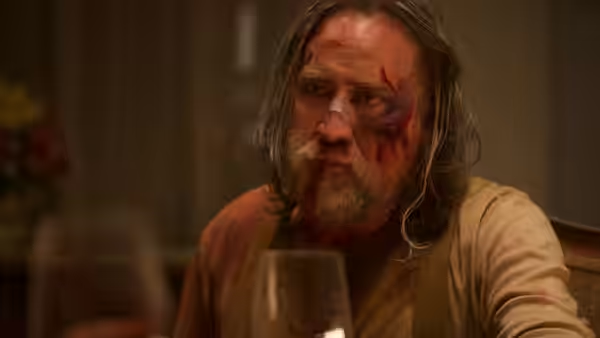
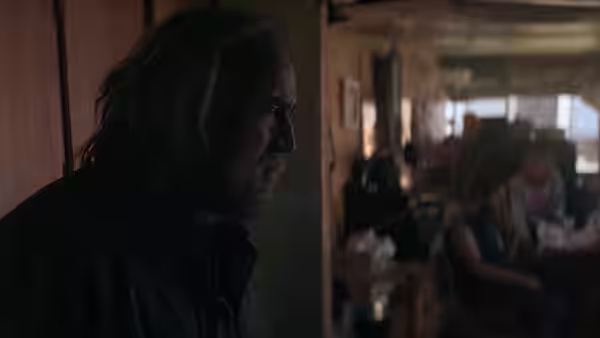
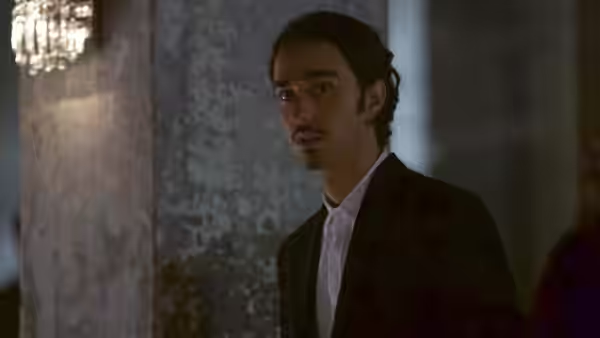
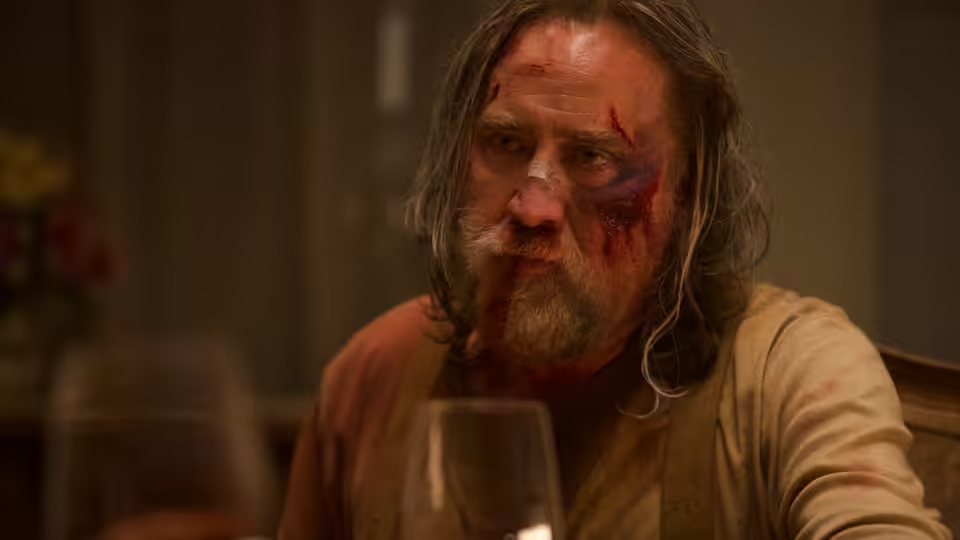
Rob Feld (Nicolas Cage), bruised and bloodied, sits at a restaurant table
Film review

Pig

2021 · Directed by Michael Sarnoski · 1h 32m · IFCO 15A

In a sentenceA revenge film in which the wronged man’s most frightening move is to cook you dinner and remember your name

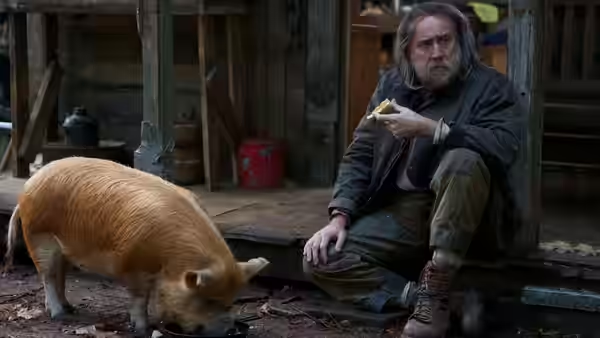
Rob Feld (Nicolas Cage) lives alone in a shack in the woods with a pig. In the mornings she noses about the forest floor for what he sells; in the evenings he cooks and listens to an old cassette. Once a week Amir (Alex Wolff), a young dealer, drives up the track to buy what she has found and sell it on to the city’s restaurants. Then two strangers break in at night, beat Rob and take the pig. With no car and no phone, he makes Amir drive him into the city to get her back, starting at a roadhouse where Mac (Gretchen Corbett) still knows his name and a basement under a hotel where Edgar (Darius Pierce) runs fights for restaurant workers.

Plays from YouTube when you press play; nothing loads from them until then.

Fi1m review

Michael Sarnoski’s first film sets up a revenge story about a stolen pig and declines to tell it. Nicolas Cage barely raises his voice and is as good as he has been in years, though the script keeps saying what his face already has.

Rob Feld (Nicolas Cage) lives in a shack in the woods with a pig who forages for him, and once a week a young man drives up the track to buy what she has dug up. That is his life until the night two strangers break in, beat him and take her. Anyone who has watched a Nicolas Cage trailer in the last ten years knows what should happen next. Michael Sarnoski’s first film, from a story he wrote with Vanessa Block, sets up that expectation in its first quarter of an hour and then spends the rest of its 92 minutes not meeting it. Rob does go to the city. He does not hurt anybody.

What he does instead is talk, in a voice that seldom gets above a murmur, to people who knew him before he went into the woods. It is the best work Cage has done in a long while, and it is good because he has stopped asking us to watch him act. He plays the whole film with dried blood on his face and a coat Jayme Hansen has torn at the shoulder, and he does almost nothing with his body. When he needs to hold a room he sits still and waits.

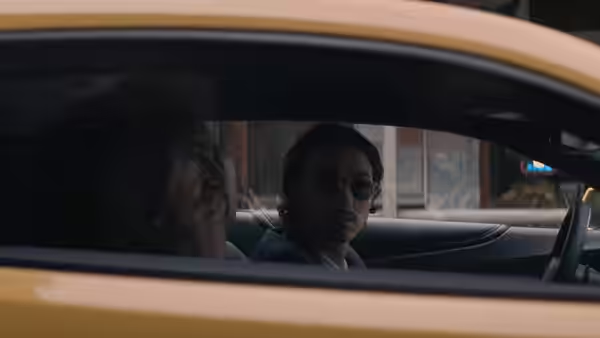
Amir (Alex Wolff) drives him in, all hair gel and tight jacket, playing classical music in the car to sound like a man who eats where he sells. Wolff is good at being slightly too loud. The two of them stop at a roadhouse where Mac (Gretchen Corbett) still knows Rob’s name, at a basement under a hotel where Edgar (Darius Pierce) runs bare-knuckle fights for kitchen staff, and at a restaurant with white tablecloths run by Finway (David Knell). The basement is where the film goes wrong. It is staged as if it were the real thing and we did not believe it for a second; it exists to get Rob hurt, and it is the one scene where Sarnoski is doing what the trailer promised.

The restaurant is where it goes right. Rob sits opposite Finway, whose menu describes the scallops as deconstructed, and asks him what he wanted to cook when he was young. Knell’s face does the rest: the smile going, the eyes filling, a man remembering that he once wanted to open a pub. It moved us more than we thought a scene about scallops could, and the reason is that nobody raises a voice. Rob is not threatening him. He is telling him the truth about his own life, and Sarnoski holds the two men in a plain shot and lets it sit.

Pat Scola shoots the forest in grey-green daylight with the camera at Rob’s shoulder, and shoots the city at night in orange streetlight and the dull steel of kitchens. Tyler B. Robinson’s production design gives Rob a stove, a table and a shelf of jars, and gives Finway a dining room about as warm as a dentist’s waiting room. Brett W. Bachman’s cut runs 92 minutes and nothing in it is padded. Alexis Grapsas and Philip Klein’s score is guitar and low strings and it has the manners to stay out of the talking scenes.

The script does not always have the same manners. Rob has a habit of explaining the theme, telling Amir that none of the city is real and that we do not get many things to care about, and the second time someone told us what matters we wished Sarnoski trusted his lead’s face as much as we did. Amir’s change of heart can be seen coming from the car park. Adam Arkin’s Darius arrives with a speech about the pig’s worth that sounds typed.

Most critics like it and so do we; the one dissenter calls it ordinary. Anyone who comes for the film the trailer sells will be restless by the half hour, and the 15 certificate is for one beating, early. See it without reading anything else about it. It will make you hungry and then it will make you sad, in that order.

Critical consensus AI synthesised

77
Positive
21
Mixed
4
Negative
1

Most critics like Pig, and nearly all of them make the same point first: it is not the revenge thriller its premise suggests. The praise clusters around Nicolas Cage, whose quiet, restrained performance is named as the film’s chief strength in review after review, with a restaurant confrontation with a former protégé singled out more than any other scene. Michael Sarnoski’s direction and the film’s patient treatment of grief draw steady approval, and several reviews note Alex Wolff’s rapport with Cage.

The reservations are about pace and tone. A few critics find the film too quiet or too morose to be distinctive, and one or two feel the philosophising outruns the story. The spread is narrow, and even the middling reviews call it moving. The one dissent comes from The New Yorker, which finds the storytelling blunt and the symbolism heavy, and credits Cage alone with lifting it. The Hollywood Reporter finds the screenplay uneven.

The AV Club
13 July 2021 · Mike D'Angelo
90*

The review finds Pig unexpectedly profound and magnificent, far richer than its revenge-thriller premise suggests. It especially praises Nicolas Cage’s raw, restrained performance and Michael Sarnoski’s confident storytelling and visual choices.

Read the full review →
Vulture
16 July 2021 · Bilge Ebiri
90*

Ebiri finds Pig a compassionate, expectation-defying fable rather than a conventional revenge thriller. He praises Cage’s haunted performance, especially in a restaurant confrontation that turns into a meditation on meaning and connection.

Read the full review →
RogerEbert.com
15 July 2021 · ★★★½/4 · Brian Tallerico
88

The review is positive about the film’s thoughtful approach to grief and its refusal to become a conventional revenge story. It singles out Nicolas Cage’s restrained performance as a particular strength.

Read the full review →
Empire
16 August 2021 · Joshua Rothkopf
85*

Rothkopf finds the film a fascinating, delicate drama and praises its quiet path toward redemption. He singles out Nicolas Cage’s unusually restrained, deeply felt performance.

Read the full review →
Los Angeles Times
15 July 2021 · Noel Murray
85*

Murray finds “Pig” a moving, melancholy character study rather than the action thriller its premise suggests. He praises Nicolas Cage’s riveting monologues and the film’s serious, beautiful treatment of loss.

Read the full review →
The i Paper
18 August 2021 · Christina Newland
85*

Newland finds the film deeply moving and praises its deft shift from revenge thriller to meditation on grief. She singles out Nicolas Cage’s restrained, heartbreaking performance and the screenplay’s economical storytelling.

Read the full review →

Straight answers AI written, from our review

Is Pig worth watching?
Pig is worth watching for anyone who wants a quiet character drama rather than the revenge thriller its set-up promises, and we scored it 82. Nicolas Cage barely raises his voice and is as good as he has been in years. Anyone hoping for the film the trailer sells will be restless by the half hour.
How long is Pig, and what is it rated?
Pig runs 1h 32m and is rated 15A by the IFCO in Ireland. It is a drama and thriller film.
Where can I watch Pig in Ireland?
Pig is streaming on Channel 4 in Ireland, and it is also available to rent from Apple TV from €3.99. It leaves Channel 4 on 4 October. Availability is checked daily; the links above go straight to each service.
How violent or frightening is Pig, and is it suitable for children?
Pig carries a 15 certificate in the UK and an R in the US, chiefly for one beating early on and a bare-knuckle fight staged in a basement. It is not frightening in the horror sense and the man at its centre hurts nobody. It is a slow, talky film about grief and cooking, so it is not for younger children on grounds of interest as much as content.
How does Pig compare to First Cow?
Pig and First Cow are both Oregon films about food, friendship and what the trade does to people, but First Cow is a patient frontier story and the finer film of the two. Kelly Reichardt lets a friendship carry the whole picture; Michael Sarnoski leans on Nicolas Cage and a script that sometimes states its theme aloud. Choose Pig for the performance and First Cow for the slower, richer film.
What should I watch after Pig?
After Pig, try First Cow (2019, Fi1m 85): Another Oregon film about food, friendship and what the trade does to people. Then Babette's Feast (1987, Fi1m 86): One meal, cooked with everything a person has, changes a room full of strangers; and Leave No Trace (2018, Fi1m 88): A man in the Pacific Northwest woods who cannot come back to the city.

Cast

If you liked this, try…

  1. First Cow (2019, Fi1m 85)Another Oregon film about food, friendship and what the trade does to people.

  2. Babette's Feast (1987, Fi1m 86)One meal, cooked with everything a person has, changes a room full of strangers.

  3. Leave No Trace (2018, Fi1m 88)A man in the Pacific Northwest woods who cannot come back to the city.

  4. Tampopo (1985, Fi1m 84)Japanese noodle western that takes cooking as seriously and far less sadly.

  5. Paris, Texas (1984, Fi1m 88)A silent man walks out of the wilderness to find what he lost.