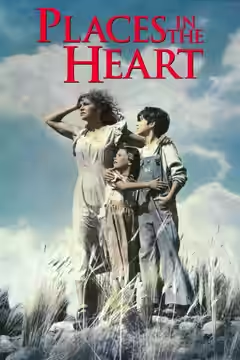
Robert Benton’s Depression drama about a Texas widow, a drifter and a blind lodger bringing in a cotton crop is plain, patient and beautifully shot by Néstor Almendros. A second plot keeps wandering off, but the final scene earns nearly everything.
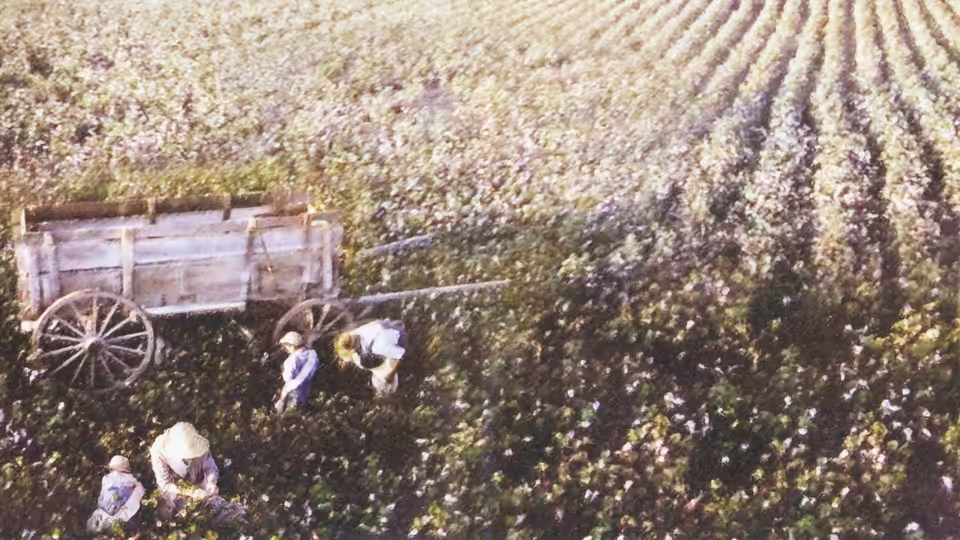
Places in the Heart is set in Waxahachie, Texas, in 1935: cotton country, the bank on the square and the church at the end of the street. It opens on a Sunday. Sheriff Royce Spalding (Ray Baker) is called away from his dinner to deal with a drunk boy by the railway, and within minutes he is dead, shot by accident by a black teenager, Wylie (De’voreaux White), who can barely hold the gun steady. What the town does to Wylie that afternoon is shown in daylight, from a distance, without music. We were horrified, and Benton means us to be, and he does not linger. The body is driven past the Spalding house and the film carries on.
It carries on with Edna Spalding (Sally Field), who has two children, a mortgage and no idea how much money is in the house. The banker, W.E. Simmons (Jay Patterson), would like her to sell. Instead she takes in Moze (Danny Glover), a drifter who asks for work and tells her the land will grow cotton, and she is landed with Mr. Will (John Malkovich), a blind man the banker wants out of his own home. The rest of the film is the three of them and the children trying to bring in a crop before the note falls due.
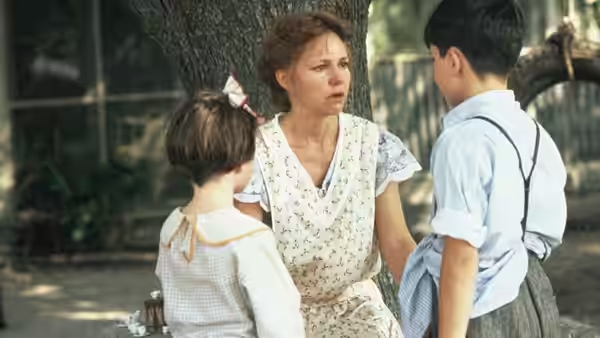
Field is doing something harder than it looks. Edna is not spirited or plucky, the words this sort of part usually attracts. She is frightened, polite and stubborn, and she learns as she goes: how to keep accounts, how to chop cotton, how to ask a black man to sit at her table and mean it. Glover plays Moze with the watchfulness of someone who knows exactly how this town works, and the scenes in which he teaches Edna the crop are the film’s spine. Malkovich plays blindness without a single reach or flinch, and gives Mr. Will a sourness that stops the household turning sweet.
Néstor Almendros shoots all of it in flat, even daylight, the fields the colour of dust and the sky washed nearly white, and he does not go golden when the cotton comes in. Gene Callahan’s town is wooden storefronts and a dirt square, and Ann Roth dresses everyone in clothes that have been washed too many times, so that a new dress, when one arrives, registers as an event. Carol Littleton’s cutting is unhurried until the weather turns, and there is a storm sequence in the middle of the film that she cuts for fear rather than spectacle, staying inside with the people. John Kander’s score stays quiet and the film leans on hymns instead.
The trouble, and most critics with a complaint have this one, is the other half of the film. Edna’s sister Margaret (Lindsay Crouse) is married to Wayne (Ed Harris), who is sleeping with the schoolteacher, Viola (Amy Madigan), whose husband Buddy (Terry O’Quinn) is Wayne’s friend. This strand is well acted, Crouse especially, and well written scene by scene. It has almost nothing to do with the farm. For long stretches it feels like a second film that has wandered in from the next town, and each cut back to it lets the air out of the cotton story.
Benton gets it back. The last scene of Places in the Heart is the reason the film is still talked about, and we will not describe it, except to say that it is quiet, it takes place in church, and we have not seen another film attempt it. It moved us more than we thought possible, partly because it gathers up the strand we had spent an hour resenting and shows us why it was there. Whether that excuses the divided attention beforehand is a fair question. We think it nearly does.
Benton is fond of these people, and fondness is a risk. There are moments, a birthday, a dance, where the film sits back and admires its own decency. But the opening has already shown us what this town is capable of, and the film does not forget it even when the characters would like to. At 111 minutes it is not long. Watch it on a Sunday, and do not plan anything for afterwards.