Film review

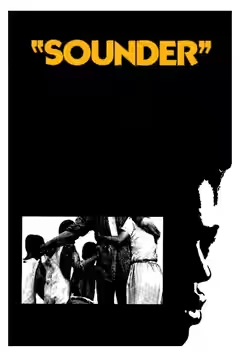
Sounder

1972 · Directed by Martin Ritt · 1h 45m · MPA G

In a sentenceThe dog gets the title and the woods; Cicely Tyson gets everything else

Drama

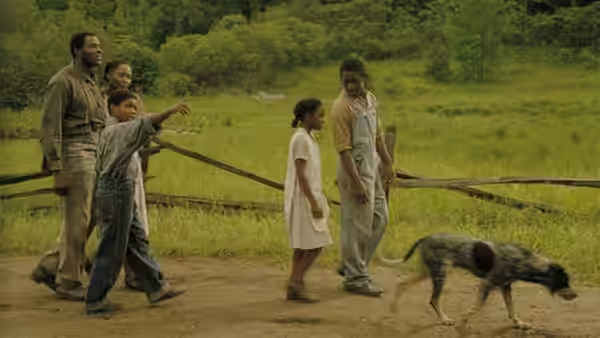
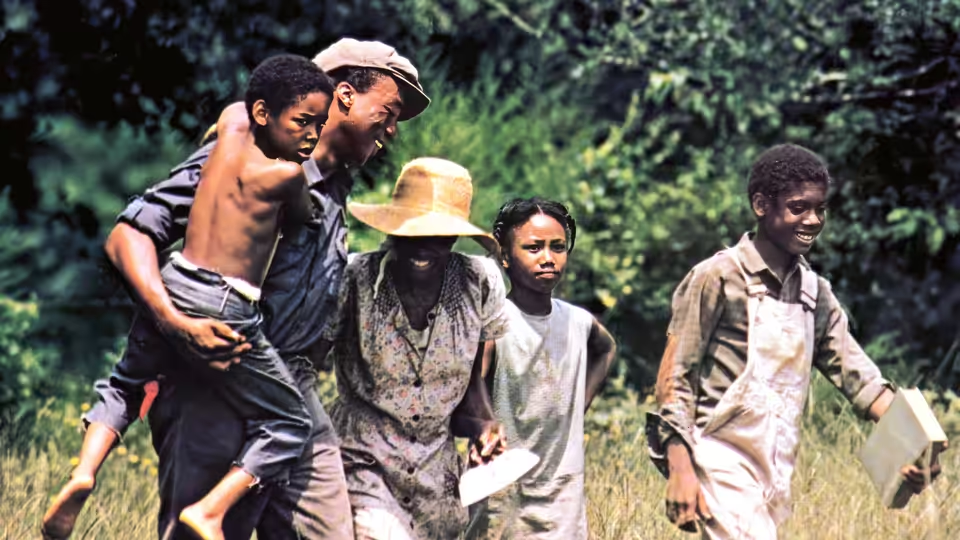
Louisiana, 1933. The Morgans are sharecroppers, and the crop is not enough. Nathan Lee Morgan (Paul Winfield) hunts at night with his eldest boy, David Lee (Kevin Hooks), and their coonhound, Sounder, and comes home empty-handed. The next morning there is meat on the table, and Rebecca (Cicely Tyson) does not ask where it came from. Sheriff Charlie Young (James Best) does. Nathan is taken from the cabin, and the family is left with the field, two small children, Earl (Eric Hooks) and Josie Mae (Yvonne Jarrell), and no word of where he has been sent. David decides to find out where his father has gone.

Fi1m review

Martin Ritt’s film about a Louisiana sharecropping family is plain, patient and unsentimental, and Cicely Tyson and Paul Winfield are as good as anyone has said. Only a stretch of schoolroom history in the middle stops trusting us.

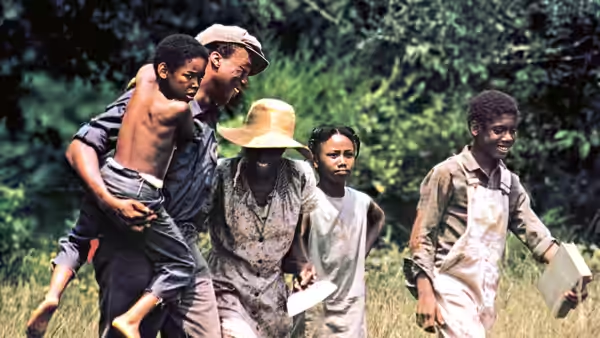
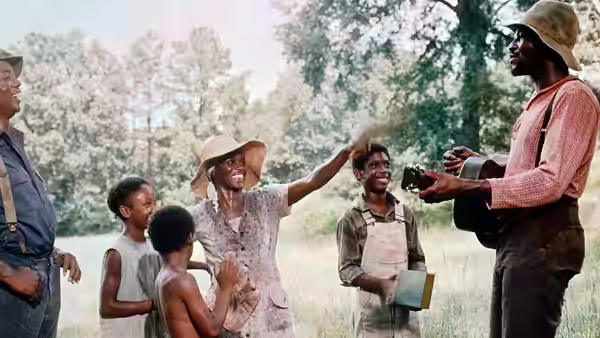
Louisiana, 1933, and a family that owns none of the land it works. Nathan Lee Morgan (Paul Winfield) takes his eldest boy, David Lee (Kevin Hooks), and the dog out after a raccoon at night, loses it, and comes home with nothing. In the morning there is meat frying, and nobody at the table asks how. Martin Ritt’s film, adapted by Lonne Elder III from William H. Armstrong’s novel, spends its opening on that household, a cabin, a field, a Sunday ball game with a neighbour called Ike (Taj Mahal) on guitar, before Sheriff Charlie Young (James Best) drives up with a wagon. From then on it is about what a wife and three children do when the father is taken for stealing meat. We would put it in front of almost anyone.

It is a U certificate and a children’s film in the sense that a child can follow every scene of it. It is not a children’s film in what it thinks about adults. Nobody here makes a speech about injustice. The sheriff is civil. The white woman Rebecca (Cicely Tyson) does laundry for, Mrs. Boatwright (Carmen Mathews), is kind in the way of someone who has never had to be brave. The system that takes Nathan works by rule and habit, and Ritt lets it, which does more damage than a villain would have.

John A. Alonzo, who shot Chinatown two years later, photographs the fields in hard white daylight and the cabin by whatever comes through the door, so that indoors the family’s faces are half in shadow and you lean in. Walter Scott Herndon’s cabin has a stove, a table and beds, and looks lived in rather than dressed. Sidney Levin cuts slowly and stays on people after they have finished speaking, which is where Tyson does her best work. Taj Mahal wrote the music as well as playing Ike: acoustic blues, guitar and banjo, much of it played by people on screen, so it never sounds like something poured over the top.

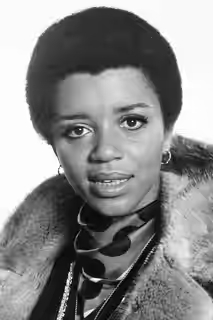
Tyson plays Rebecca as a woman who has decided in advance not to fall apart in front of her children, and the film is honest about what that costs her. Winfield is large and gentle and plays Nathan as a man who knows exactly what he did and would do it again. The scene that got us comes at the jail. Rebecca bakes a cake for David to take to his father, and the deputy breaks it into pieces on the counter, looking for whatever he imagines is hidden inside, then hands the boy the crumbs to carry through. We were angrier than we expected to be, and what made it worse was that nobody on screen raised a voice, not the deputy and not the boy. Then Nathan, through the bars, tells his son not to bring his mother to this place, and Hooks plays the whole exchange with his jaw.

The middle of the film, when David walks out to find the camp and is taken in by a schoolteacher, Camille Johnson (Janet MacLachlan), is where Elder’s screenplay adds to the book, and where it comes nearest to a lesson. She has shelves of books and reads to him out of them about black history, and MacLachlan is warm and unhurried, but these are the only scenes in which we could hear the film explaining its purpose. Two of the reviews we read find the whole film too soft and too uplifting. We think they are wrong about the whole and right about this stretch. And the dog, for a film named after him, is off screen for most of it. That is the point, but a small child may not think so.

Ritt made Hud before this and Norma Rae after it, and both of those films argue with you. This one does not. It is 105 minutes, it has no wasted scene, and it is patient in a way films of the period rarely allowed themselves to be with a poor family.

It reached British cinemas on 22 February 1973 and has not dated in any way that matters. Watch it with a child if you can find one; the hunt and the ball game will hold them, and the rest will wait for them. Tyson’s last scene we will not describe, except to say that we have thought about it for days.

Critical consensus AI synthesised

76
Positive
4
Mixed
2
Negative
0

Most critics admire Sounder, and the praise gathers in the same places. Martin Ritt’s direction is called restrained and sensitive, the adaptation of the novel scrupulous, and the picture of a Black sharecropping family in Depression-era Louisiana truthful rather than sentimental. Cicely Tyson’s mother is the performance singled out most often, with Paul Winfield’s father close behind. Several reviews note that the film speaks to children and adults alike, and that it shows hardship and joy side by side without cheapening either.

The reservations come from two quarters and say much the same thing. The New York Times finds the story noble but ordinary, short on excitement and on insight beneath its earnestness. Time Out, writing four decades on, thinks it conscientious but one-dimensional and too keen to uplift, especially beside more urgent films on similar subjects. The spread is wide: four warm reviews against two lukewarm ones, and nobody hostile. Even the doubters praise Tyson.

Film Comment
1 January 2019 · Sheila O’Malley
90*

The critic praises Martin Ritt's 1972 film for its documentary realism, authentic depictions of sharecropping life, and standout performances by Paul Winfield and Cicely Tyson. She highlights how the adaptation thoughtfully expands on the source novel by incorporating elements of Black history and balancing joy with hardship.

Read the full review →
RogerEbert.com
1 January 1972 · Roger Ebert
90*

Ebert calls it one of the most compassionate and truthful movies, succeeding on every level as a simple story of a black sharecropper family in 1930s Louisiana that communicates deeply to children and adults alike. He singles out the realistic, mature portrayal of family relationships and the father's advice to his son about pursuing opportunity.

Read the full review →
The New Yorker
23 September 1972 · Pauline Kael
90*

Kael hails it as transcending its inspirational genre to become the first movie about black experiences that can stir people of all colors, with masterful restraint by Martin Ritt and a scrupulous script. She singles out Cicely Tyson's performance as the strong, intelligent mother as a landmark.

Read the full review →
Variety
31 December 1971 · Variety Staff
85*

The review calls it an outstanding film that transcends space, race, age and time through its depiction of a poor black sharecropper family's struggles in the Depression era. It praises Martin Ritt's sensitive direction, the excellent adaptation, and the uniformly terrific cast.

Read the full review →
The New York Times
25 September 1972 · Roger Greenspun
50*

Greenspun finds it comfortable to praise the noble story of a black boy and his family in 1930s Louisiana but notes it lacks excitement and deeper insights, coming across as ordinary despite earnest direction by Martin Ritt. He praises the performances of the women, especially Cicely Tyson as the mother.

Read the full review →
Time Out
10 September 2012 · VG
50*

The film is a conscientiously made recreation of a black sharecropper's family life during the Depression, with a script by a noted black playwright. It points to themes of determination and black pride but feels one-dimensional and overly uplifting compared to more urgent Third World cinema on similar subjects.

Read the full review →

Cast

Awards

Academy Awards, 1973

Nominated
Best Actor
Nominated
Best Actress
Nominated
Best Picture
Nominated
Best Writing, Adapted Screenplay

If you liked this, try…

Nothing But a Man poster

Nothing But a Man

1964 · Ivan Dixon as a railroad worker trying to stay upright in Alabama; just as plain, angrier.

Killer of Sheep poster90

Killer of Sheep

1978 · Watts, a slaughterhouse, a marriage; Charles Burnett watches a family with the same patience.

Pather Panchali poster93

Pather Panchali

1955 · A poor Bengali family, a boy, a field, and Satyajit Ray refusing every easy tear.

The Learning Tree poster

The Learning Tree

1969 · Gordon Parks remembers a black boyhood in 1920s Kansas; gentler, and beautifully lit.

Bicycle Thieves poster92

Bicycle Thieves

1948 · A father, a son and a theft in Rome; the film Sounder’s jail scene is descended from.