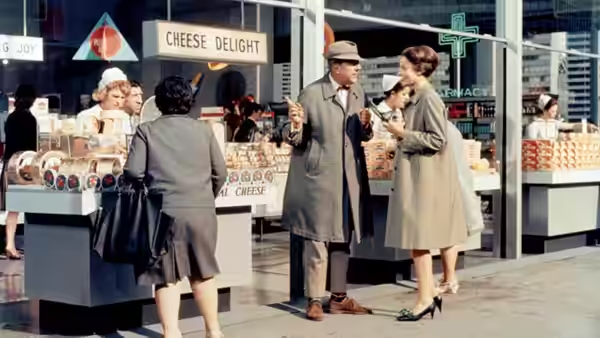
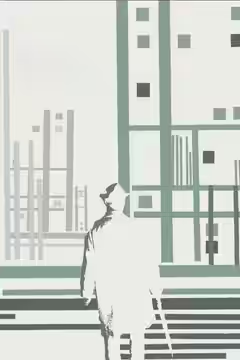
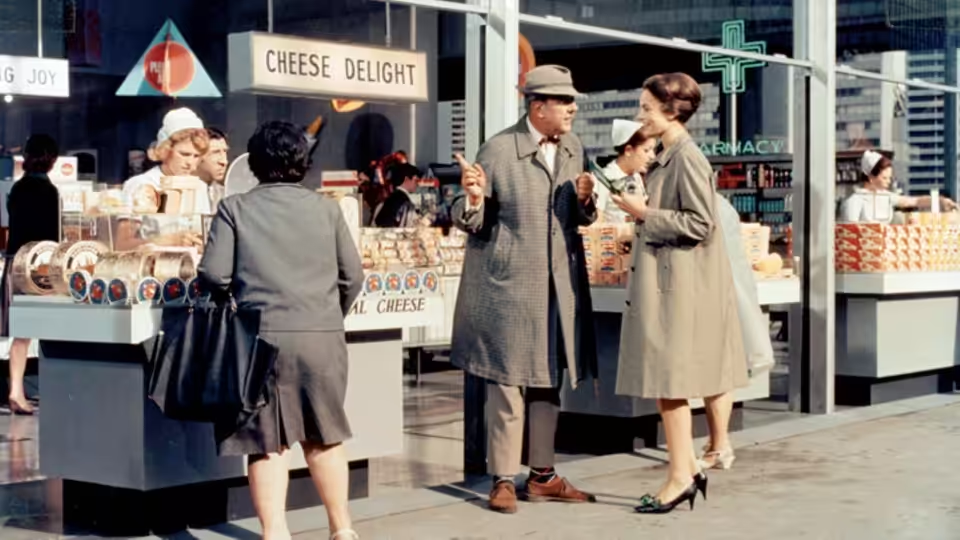
Monsieur Hulot (Jacques Tati) talks with a woman beside a cheese counter
Film review

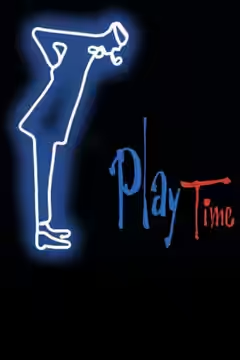
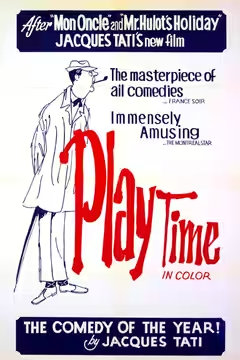
PlayTime

1967 · Directed by Jacques Tati · 1h 55m

In a sentenceThe glass gets more laughs than most leading men

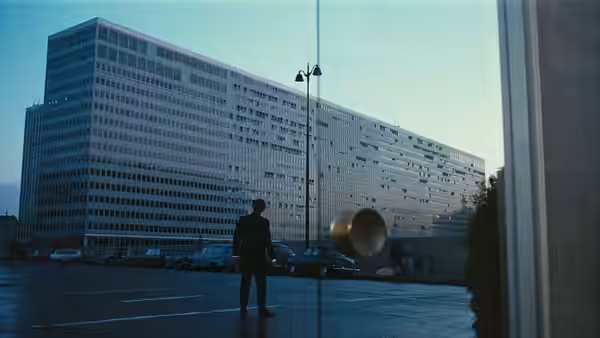
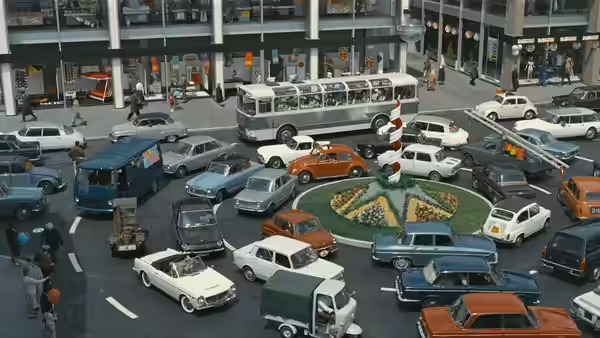
Monsieur Hulot (Jacques Tati) is one figure among the tourists, shoppers and workers occupying a setting of modern architecture, glass and reflections. A Young Tourist (Barbara Dennek), a Woman Selling Eyeglasses (France Rumilly) and a Shopper in Department Store (France Delahalle) are among the people sharing his surroundings. Attention moves between these people and the spaces around them, with several pieces of everyday business visible in the same frame. Monsieur Hulot provides someone to follow, but the activity elsewhere continues, and the view does not always make him its centre.

Plays from YouTube when you press play; nothing loads from them until then.

Fi1m review

Jacques Tati’s PlayTime is a funny, exacting comedy that rewards looking away from the obvious. The crowded images can feel chilly and overworked, but their small discoveries make the effort worthwhile.

Jacques Tati asks for more attention than most comedy directors, and PlayTime earns it. There are jokes spread across the image, with no guarantee that the person we happen to be watching is doing the funniest thing. That can make the film feel like work for a while, especially when we are waiting for a story to gather speed. Stay with it: this is a funny, generous film, even if its coolness occasionally keeps us at a distance.

His Monsieur Hulot does not monopolise our interest. Barbara Dennek’s Young Tourist belongs to a crowd whose smaller activities are worth watching independently of the leading man. This gives physical comedy more possibilities than the familiar contest between a central performer and an uncooperative object. We can watch the people at the edge, lose track of Monsieur Hulot and still be following the comedy, which takes a little getting used to if we expect every scene to announce its purpose.

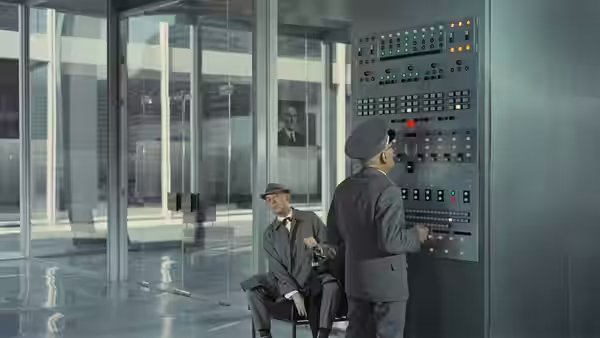
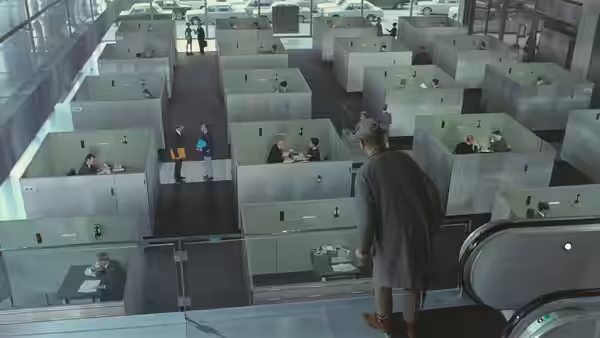
Jean Badal and Andréas Winding’s deep-focus cinematography makes that freedom possible. The crowded frames remain legible, so looking beyond the foreground brings rewards without dissolving into visual confusion. Eugène Roman’s production design gives glass and reflections enough prominence to become part of the comic business, making apparently orderly surroundings surprisingly difficult to read. We laughed at the way the glass confused our eye, then kept scanning for whatever else we might have missed.

The modern architecture supplies a useful target without requiring a succession of villains. Its ordered surfaces suggest a place where human behaviour ought to be equally tidy, an expectation the comedy is well equipped to test. The satire is gentle enough to leave us wanting a little more bite, but the director does not treat the people in these spaces as fools. A film which asks us to study strangers for so long would become unpleasant if it despised them.

Gérard Pollicand’s editing gives us time to search those images, and sometimes more time than the search needs. At 115 minutes, the film has stretches where we appreciate the arrangement but wait a little too long for the next laugh. Francis Lemarque’s music helps lighten the mood, though it cannot make us feel closer to people whom the wider views keep at a distance. The patience usually pays off, but there are passages we would happily see shortened.

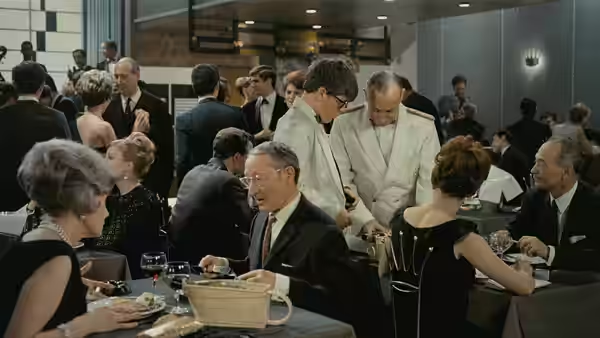
The restaurant sequence makes that attention especially rewarding, with bodies and gags arranged in layers across the frame. We will leave its incidents alone; their timing is a large part of their pleasure. Here the choreography feels sociable enough to make the earlier coolness less troublesome, and the density gives our eyes plenty to do without making the scene feel like homework. Jacques Tati lets the ensemble carry a physical comedy that could easily have settled for displaying his own skill.

Go in expecting a comedy that needs active watching. A small screen makes this harder work than it should be, because the people at the edges need room to register. We would choose it for an evening when the company is happy to watch closely, without talking over the pictures while waiting for the next line. Give it the largest screen available and put the phone out of reach.

Critical consensus AI synthesised

83
Positive
7
Mixed
2
Negative
0

Most critics respond warmly to PlayTime, with praise concentrated on Tati’s precise visual comedy and the number of gags unfolding across each frame. The sets, deep-focus staging and use of glass and reflections draw particular attention. The reviews find plenty to admire in its satire of modern architecture, too. Slant Magazine values the freedom to explore the image rather than follow a conventional story, singling out the restaurant sequence’s densely layered comedy.

The differences concern how engaging all that precision feels. The Guardian finds the satire occasionally genteel, while still praising the controlled, surreal staging. Eye for Film offers the clearest reservation, finding the film too cool and overextended to love outright, despite admiring the restaurant choreography. The available verdicts range from wholehearted enthusiasm to qualified admiration: the craft commands broad respect, but its wit and intricacy do not charm every critic equally.

Radio Times
★★★★★ · Calum Baker
100

The critic considers the film an ambitious, distinctive comedy whose artistry is extraordinary. They single out its unique visual style and the scale of its bespoke set for praise.

Read the full review →
Slant Magazine
18 August 2009 · ★★★★/4 · Eric Henderson
100

Henderson praises Playtime as an unusually immersive film that loosens viewers’ dependence on conventional storytelling. He singles out its densely layered gags and the freedom to discover details across the frame, especially in the restaurant sequence.

Read the full review →
Time Out
4 November 2014 · ★★★★★ · Dave Calhoun
100

Calhoun presents the film as a masterpiece that still holds up. He praises its visual wonders and subtle sight gags.

Read the full review →
Empire
1 January 2000 · David Parkinson
90*

The review finds the film increasingly poignant and majestic despite its melancholy. It praises the intricate, incisive comedy and the gags woven throughout every frame.

Read the full review →
The New Yorker
1 October 2006 · Richard Brody
90*

Brody regards the film as a masterwork whose satire of modern architecture and social engineering is both fierce and funny. He especially praises the remaster’s startling clarity and Tati’s exquisitely precise visual humor.

Read the full review →
The New York Times
28 June 1973 · Vincent Canby
75*

The headline presents the film as a funny and highly accomplished work. It singles out PlayTime as Tati’s most brilliant film.

Read the full review →

Straight answers AI written, from our review

Is PlayTime worth watching?
PlayTime is worth watching for its intricate physical comedy, provided we give its crowded images our full attention; we score it 88 out of 100. Glass, reflections and people at the edges supply unexpected laughs, though the pace sometimes drags and the characters can feel distant. We recommend a large screen and an evening without distractions.
How long is PlayTime, and what is it rated?
PlayTime runs 1h 55m. It is a comedy film.
Where can I watch PlayTime in New Zealand?
PlayTime is streaming on MUBI in New Zealand. Availability is checked daily; the links above go straight to each service.
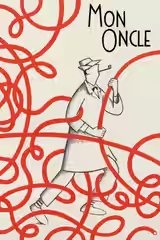
How does PlayTime compare to Mon Oncle?
PlayTime is cooler and more demanding than Mon Oncle, which makes it the better choice for close visual exploration rather than warm company. Both find comedy in people negotiating orderly surroundings, but PlayTime spreads its jokes across crowded public spaces while Mon Oncle finds repeated trouble in an automated house. We recommend Mon Oncle for warmth, PlayTime for patient discovery.
What should I watch after PlayTime?
After PlayTime, try Mon oncle (1958, Fi1m 82): More unruly human behaviour among surroundings that seem to demand obedience. Then The General (1926, Fi1m 91): Precise physical comedy that makes machinery worth watching as closely as faces; and Modern Times (1936, Fi1m 88): For another comedian finding trouble in the promise of perfect efficiency.

Cast

If you liked this, try…

  1. Mon oncle (1958, Fi1m 82)More unruly human behaviour among surroundings that seem to demand obedience.

  2. The General (1926, Fi1m 91)Precise physical comedy that makes machinery worth watching as closely as faces.

  3. Modern Times (1936, Fi1m 88)For another comedian finding trouble in the promise of perfect efficiency.

  4. Songs from the Second Floor (2000) · not on Fi1m yetSwedish comic tableaux with a much bleaker view of collective foolishness.

  5. The Taste of Tea (2004) · not on Fi1m yetA Japanese family’s everyday life allows room for gentle visual oddities.