Sofia Carson brings warmth to a poor, overlong romance, especially when she sings. Elizabeth Allen Rosenbaum’s film asks attraction to settle political disagreements it has barely examined, and the couple never becomes convincing enough to justify the fuss.
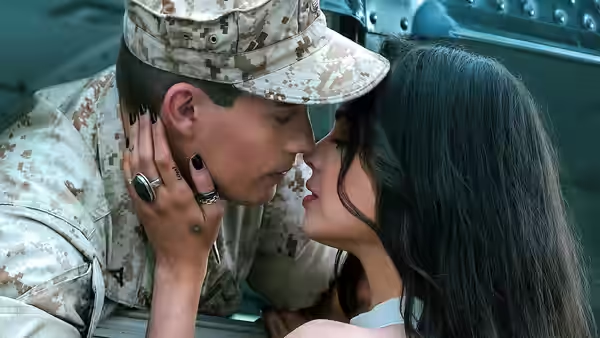
Purple Hearts wants us to believe that political opposites can fall in love without first agreeing on everything. That is a workable subject for a romance, and we do not need the couple to vote alike before we care about them. We do need to understand what each is willing to accept in the other. Elizabeth Allen Rosenbaum’s film rarely does that work, and the result is a poor, overextended romance with an appealing singer at its centre.
With Cassie Salazar and Luke Marrow, screenwriters Liz W. Garcia and Kyle Jarrow have disagreements that ought to affect how the couple treats one another. Instead, the writing keeps asking attraction to make those disagreements less important. The glimpses of casual racism are more convincing, because they give the political friction something specific and unpleasant to address. But Cassie’s principles become an inconvenience for the romance rather than something the screenplay remains curious about.
Sofia Carson supplies much of the reason to persist. Her musical performances have a directness that the dramatic writing lacks, and she makes Cassie’s feelings seem credible without requiring much explanation. We were moved by the singing, because her commitment gave the emotion a sincerity we had stopped expecting from the dialogue. It is frustrating that the film can find that so readily in a performance and struggle to give the relationship the same conviction.
Nicholas Galitzine has the harder task of making Luke a persuasive romantic partner while the script handles his differences with Cassie so lightly. We can see the attraction, but neither performance makes the couple’s awkward political accommodation convincing. The familiar pleasure of this kind of romance comes from watching two people discover something worth changing for. Here the writing is too eager to get past the disagreement, leaving the actors to supply affection where a more searching conversation is needed.
Matt Sakatani Roe’s blue-toned night photography is a pleasure, and Elizabeth Allen Rosenbaum seems more assured with the romantic atmosphere than with the arguments. These scenes give the relationship some welcome tenderness without making its difficulties any easier to believe. Kevin Bird’s production design contributes to the agreeable presentation, though it does little to make the couple’s opposing ways of life feel distinct. The visual work is rarely where the trouble lies, and the night scenes provide some relief from the strained writing.
Ishai Setton’s editing has to accommodate more melodrama than the central relationship can sustain, and at 122 minutes the film feels padded. The complications accumulate without making the people much more interesting, so the running time becomes difficult to justify. The music, credited to Tony Kanal and Blake Neely, supplies warmth that the dialogue struggles to earn. Yet even the pleasure of hearing Cassie sing cannot keep providing a reason to believe in Cassie and Luke.
Most critics have been unconvinced, and we share their objection to the way the film handles its couple’s beliefs. There is room in romantic drama for people who remain difficult, inconsistent or stubborn after they fall in love. Giving them a convincing relationship requires more patience than this busy screenplay has for them. If the singing is what draws you to Sofia Carson here, be prepared for a great deal of strained romance between the performances.