Luke Marrow kisses Cassie Salazar on a bus as soldiers in camouflage reach up to them
Film review

Purple Hearts

2022 · Directed by Elizabeth Allen Rosenbaum · 2h 02m

In a sentenceSofia Carson is much easier to believe when she starts singing

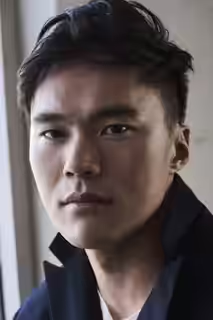
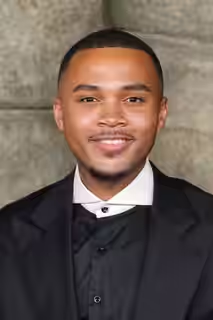
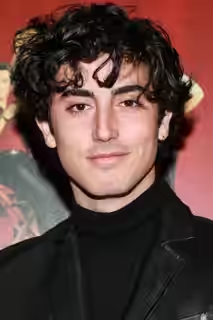
Cassie Salazar (Sofia Carson) and Luke Marrow (Nicholas Galitzine) are drawn into a romance despite opposing political beliefs. Cassie’s singing is part of a story in which personal attraction sits alongside disagreements about how people should live and treat one another. Frankie (Chosen Jacobs) and Nora (Kat Cunning) also feature. As Cassie and Luke try to find a way to be together, their differences raise questions about what each expects from a relationship, what either is prepared to overlook and how much room they can make for convictions they do not share.

Plays from YouTube when you press play; nothing loads from them until then.

Fi1m review

Sofia Carson brings warmth to a poor, overlong romance, especially when she sings. Elizabeth Allen Rosenbaum’s film asks attraction to settle political disagreements it has barely examined, and the couple never becomes convincing enough to justify the fuss.

Purple Hearts wants us to believe that political opposites can fall in love without first agreeing on everything. That is a workable subject for a romance, and we do not need the couple to vote alike before we care about them. We do need to understand what each is willing to accept in the other. Elizabeth Allen Rosenbaum’s film rarely does that work, and the result is a poor, overextended romance with an appealing singer at its centre.

With Cassie Salazar and Luke Marrow, screenwriters Liz W. Garcia and Kyle Jarrow have disagreements that ought to affect how the couple treats one another. Instead, the writing keeps asking attraction to make those disagreements less important. The glimpses of casual racism are more convincing, because they give the political friction something specific and unpleasant to address. But Cassie’s principles become an inconvenience for the romance rather than something the screenplay remains curious about.

Sofia Carson supplies much of the reason to persist. Her musical performances have a directness that the dramatic writing lacks, and she makes Cassie’s feelings seem credible without requiring much explanation. We were moved by the singing, because her commitment gave the emotion a sincerity we had stopped expecting from the dialogue. It is frustrating that the film can find that so readily in a performance and struggle to give the relationship the same conviction.

Nicholas Galitzine has the harder task of making Luke a persuasive romantic partner while the script handles his differences with Cassie so lightly. We can see the attraction, but neither performance makes the couple’s awkward political accommodation convincing. The familiar pleasure of this kind of romance comes from watching two people discover something worth changing for. Here the writing is too eager to get past the disagreement, leaving the actors to supply affection where a more searching conversation is needed.

Matt Sakatani Roe’s blue-toned night photography is a pleasure, and Elizabeth Allen Rosenbaum seems more assured with the romantic atmosphere than with the arguments. These scenes give the relationship some welcome tenderness without making its difficulties any easier to believe. Kevin Bird’s production design contributes to the agreeable presentation, though it does little to make the couple’s opposing ways of life feel distinct. The visual work is rarely where the trouble lies, and the night scenes provide some relief from the strained writing.

Ishai Setton’s editing has to accommodate more melodrama than the central relationship can sustain, and at 122 minutes the film feels padded. The complications accumulate without making the people much more interesting, so the running time becomes difficult to justify. The music, credited to Tony Kanal and Blake Neely, supplies warmth that the dialogue struggles to earn. Yet even the pleasure of hearing Cassie sing cannot keep providing a reason to believe in Cassie and Luke.

Most critics have been unconvinced, and we share their objection to the way the film handles its couple’s beliefs. There is room in romantic drama for people who remain difficult, inconsistent or stubborn after they fall in love. Giving them a convincing relationship requires more patience than this busy screenplay has for them. If the singing is what draws you to Sofia Carson here, be prepared for a great deal of strained romance between the performances.


Critical consensus AI synthesised

36
Positive
0
Mixed
1
Negative
4
IndieWire
29 July 2022 · C · David Ehrlich
57

Ehrlich finds the film wildly melodramatic and overstuffed, though its emotional core gives it an unexpected endearing quality. He praises Sofia Carson’s electric presence and the spark between the leads, while faulting the film’s clumsy soap-opera excesses.

Read the full review →
The AV Club
29 July 2022 · D- · Luke Y. Thompson
30

The AV Club pans the film as bloated, unoriginal, and lacking chemistry. It praises the director’s eye for blue-toned night scenes, while criticizing the facile politics and the leads’ unconvincing romance.

Read the full review →
The New York Times
29 July 2022 · Jeannette Catsoulis
30*

The review gives the romance a negative verdict, finding its politics and story unconvincing. It singles out the film’s implausible treatment of the couple’s opposing beliefs as a central flaw.

Read the full review →
Variety
29 July 2022 · Guy Lodge
30*

Lodge finds the romance watchable but maudlin, old-fashioned, and politically shallow. He praises Sofia Carson’s appealing presence and musical performances, while faulting the story for discarding her character’s more interesting principles.

Read the full review →
NME
30*

The review finds the film crushingly predictable and contrived, though not entirely hopeless. It praises a few well-observed moments addressing casual racism.

Read the full review →

Straight answers AI written, from our review

Is Purple Hearts worth watching?
Purple Hearts is hard to recommend as a romance, and we score it 39 out of 100, though Sofia Carson’s singing gives it some warmth. We find the central relationship unconvincing and the 122-minute running time padded; it offers more for viewers drawn to Carson’s musical performances than for those wanting a persuasive story about political opposites falling in love.
How long is Purple Hearts, and what is it rated?
Purple Hearts runs 2h 02m. It is a romance and drama film.
Where can I watch Purple Hearts in Ireland?
Purple Hearts is streaming on Netflix in Ireland. Availability is checked daily; the links above go straight to each service.
How violent or frightening is Purple Hearts, and is it suitable for children?
Purple Hearts has a UK 12 certificate, so it is not a choice for younger children; the age guidance points towards viewers aged 12 and over. We would flag casual racism and disagreements about political beliefs and relationships, but cannot offer a specific warning about violence or frightening scenes from the content established here.

Cast

If you liked this, try…

  1. Green Card (1990) · not on Fi1m yetA marriage of convenience gets the awkward domestic detail this romance needs.

  2. Beyond the Lights (2014) · not on Fi1m yetA singer’s public image complicates a romance with more patience for both people.

  3. The Big Sick (2017) · not on Fi1m yetRomance, family disagreement and illness, with jokes that make the difficult conversations count.

  4. Ali: Fear Eats the Soul (1974) · not on Fi1m yetA couple’s attraction faces prejudice the film refuses to tidy away.

  5. The Lunchbox (2013) · not on Fi1m yetAn exchange of meals and letters lets affection grow at a believable pace.

Purple Hearts (2022) review: good songs and a poor romance (Ireland) | Fi1m