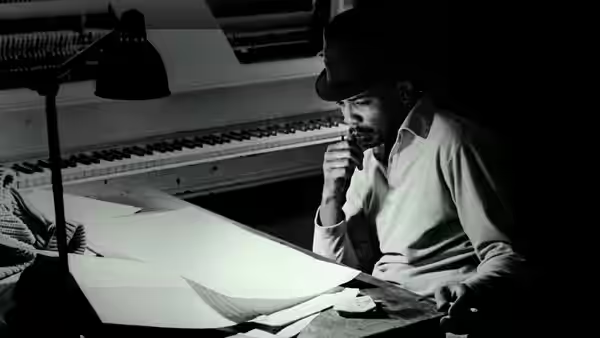
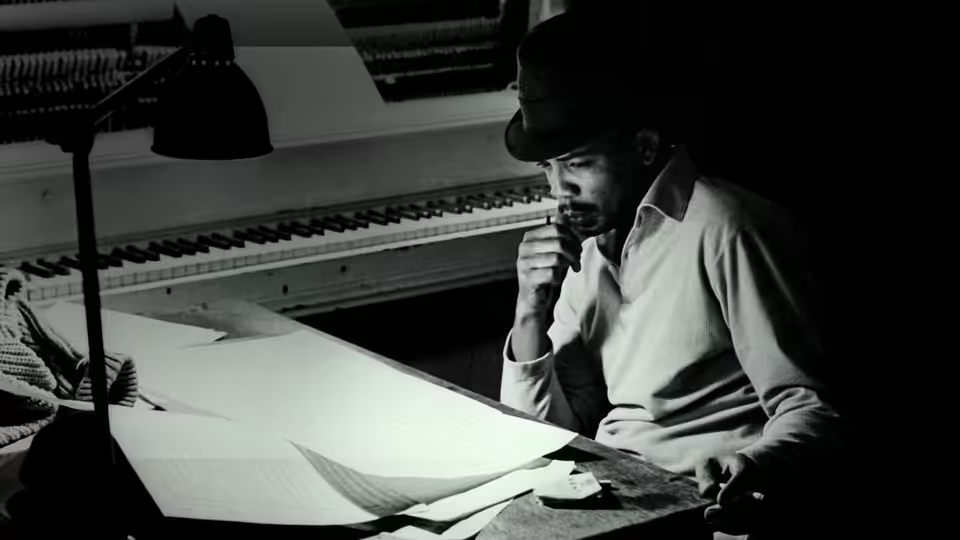
A man in a hat studies sheets of music at a desk beneath a lamp
Film review

Quincy

2018 · Directed by Rashida Jones, Alan Hicks · 2h 04m

In a sentenceQuincy Jones is good company, but the questions could do with worse manners

Quincy Jones appears as himself in this documentary about his life and music, directed by Alan Hicks and Rashida Jones. Rashida Jones also appears as herself, while Tom Hanks, Oprah Winfrey and John Legend appear as themselves. Archival footage and access to Quincy Jones’s inner circle bring his career into view, with personal recollections alongside accounts of his achievements. The film also makes space for his thoughts about mortality. Its subject remains at the centre, surrounded by people who know him and the music he makes.

Plays from YouTube when you press play; nothing loads from them until then.

Fi1m review

Quincy is an engaging introduction to Quincy Jones, with archive material that makes the history feel close. Alan Hicks and Rashida Jones are less persuasive when admiration needs to give way to a difficult question.

For those interested in its subject, Quincy is worth the time, provided we do not expect a searching account of the man or his music. Directors Alan Hicks and Rashida Jones assemble music history, personal recollections and tributes with obvious affection. Quincy Jones has the presence to hold our attention through much of its 124 minutes. The difficulty is that the film seems so pleased to have him there that it seldom risks making him uncomfortable.

The archival material gives the film much of its interest. Familiar career milestones become worth revisiting because the footage lets us look at the people involved, rather than simply accept another account of how important they were. There is pleasure in watching a musical life accumulate through these fragments, even when the route through it is conventional. The footage deserves the attention, without quite so much accompanying reassurance about the stature of the man at its centre.

Rashida Jones’s affection helps make the personal material approachable. The film has access to Quincy Jones’s inner circle, and there is a relaxed warmth to the encounters that a more formal survey might struggle to achieve. But closeness also seems to make it reluctant to interrupt an admiring account or examine a flaw for long. The people around him are often enjoyable company, even when their contributions tell us little we could not already gather.

Rory Marx Anderson’s cinematography is unobtrusive enough to keep attention on the people being filmed. That is a sensible choice when the central figure can hold the screen without much help. It also leaves the archive carrying much of the visual interest, while the surrounding footage settles into a comfortable familiarity. A more elaborate camera style would not necessarily improve matters: we wanted the directors to stay with something awkward for longer.

Editors Andrew McAllister and Will Znidaric have plenty of material to organise, and the film remains accessible as it moves through a crowded career. Its rhythm is less dependable. Episodes can feel collected rather than developed, with the next achievement arriving before the previous one has told us much about the person responsible. At 124 minutes, there is time for a fuller examination, but too much of it goes to confirming an impression already established.

We were moved when Quincy Jones reflects on mortality. The prospect of losing this engaging presence gives the film a seriousness that praise alone cannot produce. These passages also show what the gentler approach can achieve when it allows unease to remain. The frustration is that such candour does not receive the same attention as the achievements.

Music documentaries can be generous without treating every achievement as a reason to stop asking questions. Quincy has enough history and personable company to reward an existing interest, but it stops short of making a celebrated subject newly understandable. We do not need a hostile interview, or a catalogue of faults, to feel that someone has been examined properly. See it if the music already matters to you; expect the questions to remain polite.

Critical consensus AI synthesised

62
Positive
2
Mixed
4
Negative
1

The reviews lean towards qualified appreciation of Quincy, with praise clustering around its archival footage, musical history and access to Jones and his inner circle. The warmer responses find an affectionate, convincing portrait, with intimate material bringing fresh life to familiar career milestones. Even some sceptical notices acknowledge Jones’s charisma, though the film’s straightforward approach earns more approval as a tribute than as a searching examination of its subject.

The sharpest divide concerns whether that affection leaves enough space for scrutiny. The Los Angeles Times finds Rashida Jones’s treatment of her father loving and clear-eyed, while The Hollywood Reporter sees insufficient critical distance and The Guardian finds his flaws glossed over. Reservations also gather around scattered storytelling, conventional structure and pacing. The spread is wide: the strongest objections concern how little the film discovers, rather than simply how it arranges a crowded life.

IndieWire
9 September 2018 · B+ · Jude Dry
83

The review calls the documentary an inspiring and fitting tribute to Quincy Jones. It praises its intimate archival moments and the wealth of music history, while noting its straightforward style.

Read the full review →
Los Angeles Times
20 September 2018 · Noel Murray
75*

Murray finds the documentary loving and clear-eyed, though somewhat scattered. He praises Rashida Jones’s affectionate framing of her father’s life and flaws.

Read the full review →
Variety
10 September 2018 · Andrew Barker
65*

Barker finds the documentary a loving, convincing portrait, though its conventional structure and pacing keep it from fully encompassing Jones. He praises the archival footage for bringing fresh life to familiar career milestones.

Read the full review →
RogerEbert.com
64*

The page is blocked by a browser check, so the critic’s verdict cannot be determined. No specific praise or complaint is available from the text provided.

Read the full review →
The New York Times
20 September 2018
64*

The page could not be accessed, so its critical verdict cannot be established. The supplied text does not reveal what the critic praised or criticized.

Read the full review →
The Hollywood Reporter
9 September 2018 · festival review · Stephen Dalton
55*

The critic finds the documentary engaging and sweet, but too close to a gushing vanity project. He praises Jones’s charisma and the rich access to his inner circle, while faulting the film for its lack of critical distance and tighter structure.

Read the full review →

Straight answers AI written, from our review

Is Quincy worth watching?
Quincy is worth watching if its subject or his music already interests you; we score it 63 out of 100. The archive and relaxed access make it an engaging introduction, and we were moved by Jones’s reflections on mortality, but the directors’ admiration leaves too many difficult questions unasked.
How long is Quincy, and what is it rated?
Quincy runs 2h 04m. It is a documentary and music film.
Where can I watch Quincy in Chile?
Quincy is streaming on Netflix in Chile. Availability is checked daily; the links above go straight to each service.
How does Quincy compare to Buena Vista Social Club?
Quincy offers a more biographical account than Buena Vista Social Club, which we recommend over it for the pleasure of watching musicians play. Both find engaging company in their subjects, but their weaknesses differ: Quincy spends too long confirming Jones’s achievements, while the circling camera and restless cutting in Buena Vista Social Club can distract from the musicians.
What should I watch after Quincy?
After Quincy, try Buena Vista Social Club (1999, Fi1m 76): For the pleasure of musicians whose company matters as much as their playing. Then Anvil! The Story of Anvil (2008, Fi1m 80): For an affectionate music documentary prepared to show the awkward days too.

Cast

If you liked this, try…

  1. Thelonious Monk: Straight, No Chaser (1988) · not on Fi1m yetA musician’s habits and working methods receive the attention tributes often withhold.

  2. Buena Vista Social Club (1999, Fi1m 76)For the pleasure of musicians whose company matters as much as their playing.

  3. Jazz on a Summer's Day (1960) · not on Fi1m yetPerformance does most of the talking in this warmly observant concert film.

  4. The Gleaners and I (2000) · not on Fi1m yetA more curious, less ceremonial encounter with lives and work worth recording.

  5. Anvil! The Story of Anvil (2008, Fi1m 80)For an affectionate music documentary prepared to show the awkward days too.

Quincy (2018) review: good company, not enough difficult questions (Chile) | Fi1m