Film review

Ray

2004 · Directed by Taylor Hackford · 2h 32m · MPA PG-13

In a sentenceJamie Foxx is so good you stop noticing that the film around him is the usual one

DramaMusic

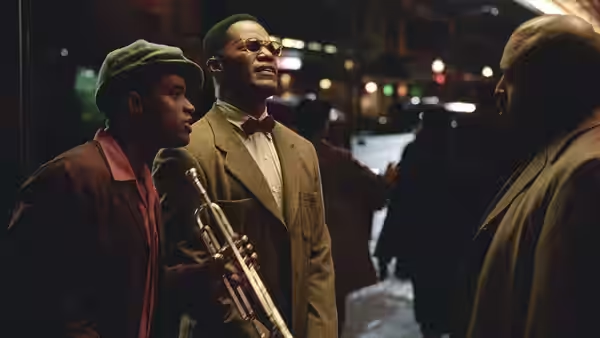
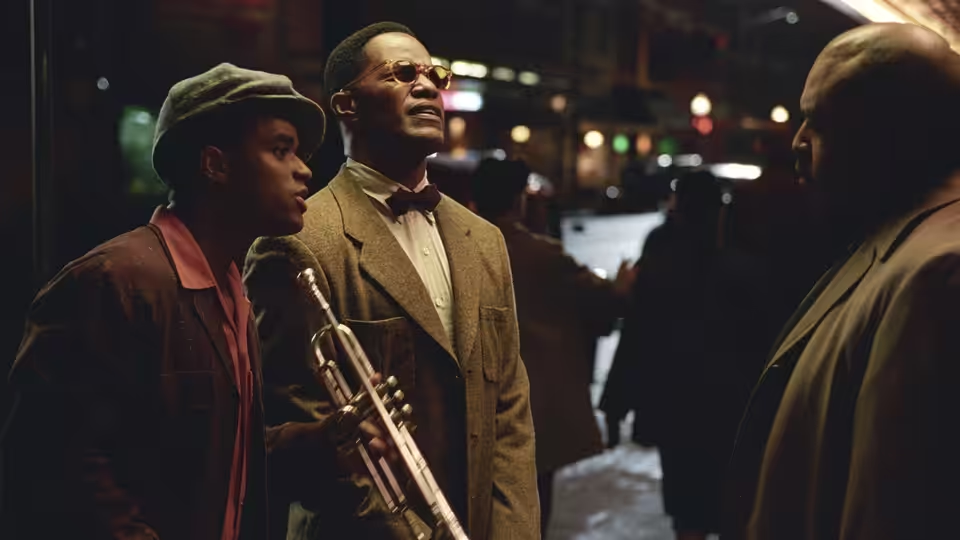
Florida, 1948. Ray Charles (Jamie Foxx), seventeen and blind since childhood, boards a bus north to Seattle with a suitcase and a pair of dark glasses, looking for work as a piano player. In the clubs he is taken on by the bandleader Gossie McGee (Terrence Howard) and befriends a young trumpeter called Quincy Jones (Larenz Tate). Between gigs the film returns to Greenville, Florida, where his mother Aretha Robinson (Sharon Warren) takes in washing to raise two small boys. Ray wants a record deal and a band of his own. In his way are men who see a blind musician as easy money, the beginnings of an addiction, and a memory of home he cannot put down.

Fi1m review

Taylor Hackford’s biopic tells Ray Charles’s story the way biopics usually tell them, one contract, one hit and one relapse at a time, for 152 minutes. Jamie Foxx and the songs make most of that not matter, and the rest we forgave.

Taylor Hackford’s film about Ray Charles begins with a blind teenager climbing onto a bus in Florida in 1948 and ends in the middle of the 1960s, and in between it does everything a musical biopic is expected to do. There is the poor childhood, the crooked first manager, the wife, the mistress, the needle, the road. Ray is good, and it is good almost entirely because of the man in the middle of it and the records he made. The film around him is competent and familiar, and at two and a half hours it is long.

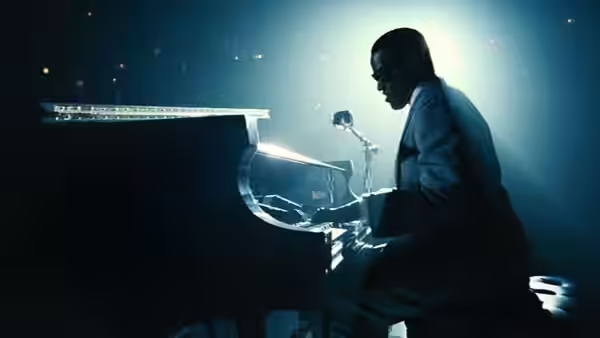
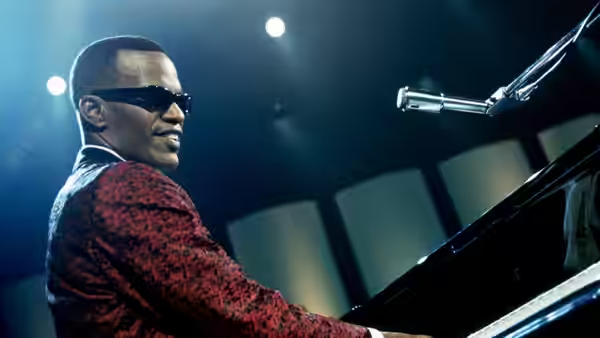
Jamie Foxx plays Charles with his eyes sealed shut for the whole 152 minutes, and the performance is all body: the rocking at the keyboard, the hand resting on the shoulder of whoever is walking him through a room, the grin that arrives a beat before the joke. The singing voice is Charles’s own, so Foxx’s job is the face and the frame, and he never once looks like a sighted man pretending. He also lets the man be unpleasant. This Charles counts his money in single notes, fires people without raising his voice and lies to his wife with the charm he uses on a crowd. Foxx does not ask us to like him, which is why we did.

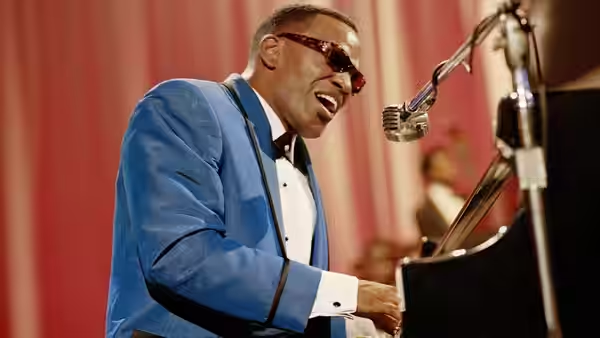
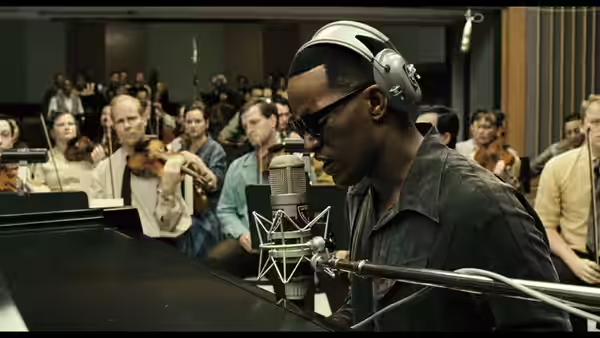
The music sequences are the reason to see it. Curtis Armstrong’s Ahmet Ertegun hums a tune across a desk and Foxx builds Mess Around out of it. A club owner needs twenty more minutes of set and Charles starts a riff on the electric piano that becomes What’d I Say, the band and then the crowd catching on one bar at a time. Regina King’s Margie Hendricks sings Hit the Road Jack at him across a stage, a duet that is really a row. We sat through these grinning, and once, during What’d I Say, we caught ourselves moving in the seat, which does not often happen to us at a biopic. Paul Hirsch cuts them long, staying with the band, so we watch the song being made.

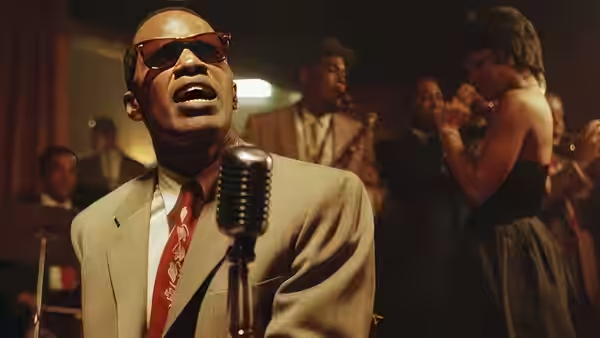
Paweł Edelman shoots the two halves of the story in two lights. The childhood in Greenville, Florida is bleached and overexposed, dust and sunflowers and a washtub in the yard. The clubs and hotel rooms of the touring years are amber and smoke. Stephen Altman’s sets get the smallness of it right, the tour bus, the motel, the recording booth with one good microphone. Sharen Davis puts Charles in sharkskin suits that get sharper as the money does, and the Raelettes in dresses a size too bright for the rooms they sing in. Craig Armstrong’s score mostly has the sense to stay out of the way of the records.

The trouble is the shape. James L. White’s screenplay runs on a loop: a deal, a hit, a woman, a fix, a fight, another deal. Each turn is dramatised as a highlight, so that fifteen years pass and nobody seems to get older except by their suits. The childhood is returned to so often, and with the same images each time, that by the fourth visit we could have called the cuts.

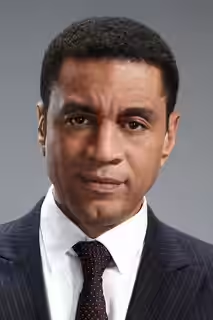
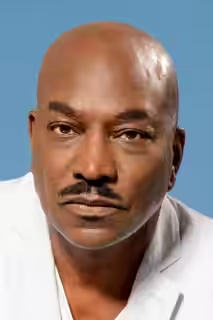
The women get the worst of it. Kerry Washington’s Della Bea Robinson is written as patience itself, and Washington can only play the writing; she has one good scene of anger and spends the rest waiting in doorways. King fares better because Margie is allowed to want something and to be wrong about it. Harry Lennix and Clifton Powell, as the two men who run the business and the road, are given more shades of loyalty than either wife or mistress gets.

Hackford made a documentary about Chuck Berry in 1987, and he knew then how to stand back and let a musician be difficult. Here he stands back for the songs and steps in for everything else, and the film is better when he is out of the way. It is worth your evening if the music is yours, and again for Foxx. Bring a long evening; the film needs one.
Critical consensus AI synthesised

72
Positive
16
Mixed
2
Negative
1

Most critics like Ray, and nearly all of them like it for the same reason. Jamie Foxx’s performance as Ray Charles is praised in almost every review, for the gait and the mannerisms and for going beyond impersonation into something that suggests the man’s appetites and drive. The music comes second: reviewers credit Taylor Hackford with putting the songs at the centre of the film and letting them carry it, and several note the period detail and production design with approval.

The reservations are about everything around the performance. The structure is called conventional, by-the-numbers and in places overlong; a few critics feel the film softens Charles’s flaws or never gets far inside his head. The spread is narrow, with most reviews landing in a warm middle band. The one outright dissent comes from Slant Magazine, which finds the film hokey and the central performance surface mimicry, an argument no other review makes.

RogerEbert.com
28 October 2004 · ★★★★/4 · Roger Ebert
100

The critic praises Jamie Foxx's exuberant, physically precise performance as Ray Charles and the film's focus on the music and the man's complexities. It highlights how the biopic captures Charles's artistic genius and personal struggles without oversimplifying.

Read the full review →
Radio Times
★★★★ · Barry Norman
80

Jamie Foxx delivers an outstanding impersonation of Ray Charles in this gripping musical drama that covers his life from childhood blindness and guilt through addiction and numerous affairs to success. Taylor Hackford’s excellent film features peerless music and benefits from Charles’ own involvement.

Read the full review →
The New York Times
29 October 2004 · A.O. Scott
80*

The review calls the film a satisfying biopic that succeeds in portraying Ray Charles through his music and Foxx's intelligent performance, despite some conventional biopic elements and occasional sentimentality. It singles out the way the story emphasizes the art itself over facile psychology.

Read the full review →
The Times
20 January 2005 · James Christopher
80*

The critic describes the film as gripping with magnificent period detail and hair-raising musical moments, praising Foxx's pitch-perfect portrayal of the complex, self-interested musician. It notes the conventional biopic structure but finds the performance compelling despite some soft-soaping of flaws.

Read the full review →
Los Angeles Times
29 October 2004 · Kenneth Turan
75*

The review describes the film as a proudly conventional but wholly entertaining biopic powered by irresistible music and Foxx's dominating, charismatic performance as the blind singer. It singles out how Hackford's conviction in the well-worn biopic conventions makes the story work despite being by-the-numbers.

Read the full review →
Screen Daily
14 September 2004
75*

A solid, diligent biopic with Hackford putting the music front and centre; it captures admirable and unsympathetic aspects of Charles but feels a little slick and methodical. Reservations melt away in the face of Jamie Foxx’s remarkable, scene-stealing performance that goes beyond impersonation.

Read the full review →

Cast

Awards

Academy Awards, 2005

Nominated
Best Costume Design
Nominated
Best Director
Nominated
Best Film Editing
Nominated
Best Picture
Won
Best Actor
Won
Best Sound

If you liked this, try…

Bird poster

Bird

1988 · Eastwood’s Charlie Parker film takes the messier route through addiction and genius, and trusts you more.

Coal Miner's Daughter poster81

Coal Miner's Daughter

1980 · Sissy Spacek sings Loretta Lynn herself; the marriage is the story, not the hits.

Love & Mercy poster

Love & Mercy

2014 · Brian Wilson in two eras and two actors, with the studio scenes the best of their kind.

Control poster80

Control

2007 · Ian Curtis in black and white; a music biopic that refuses every triumph the form expects.

Get on Up poster

Get on Up

2014 · Chadwick Boseman’s James Brown is at least as difficult as Foxx’s Charles, and the film knows it.