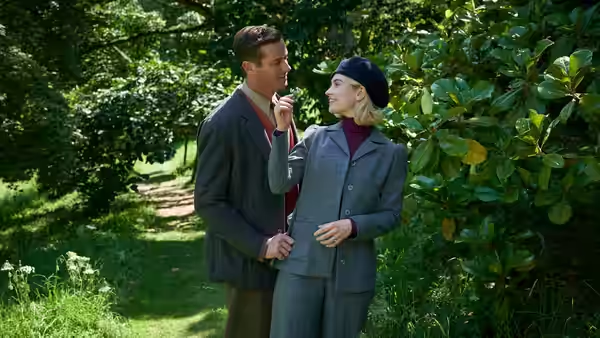
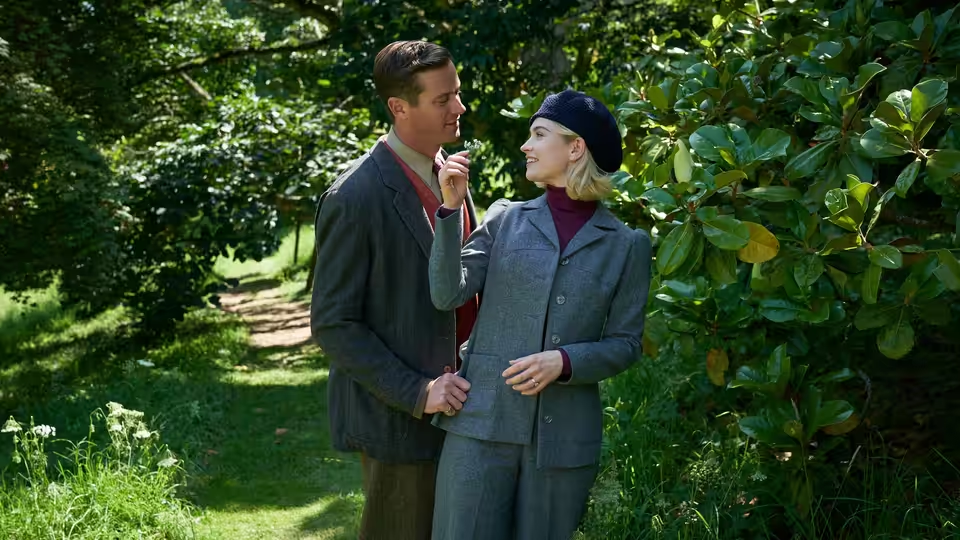
Mrs. de Winter (Lily James) and Maxim (Armie Hammer) talk in a leafy garden
Film review

Rebecca

2020 · Directed by Ben Wheatley · 2h 03m

In a sentenceKristin Scott Thomas makes a grand house unpleasant; everyone else struggles to make it interesting

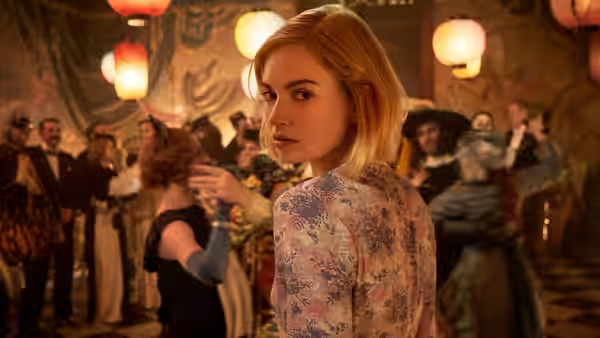
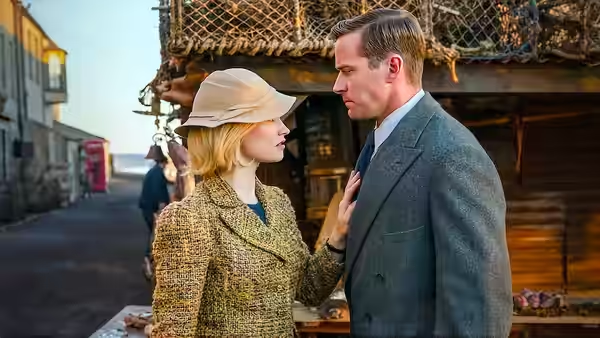
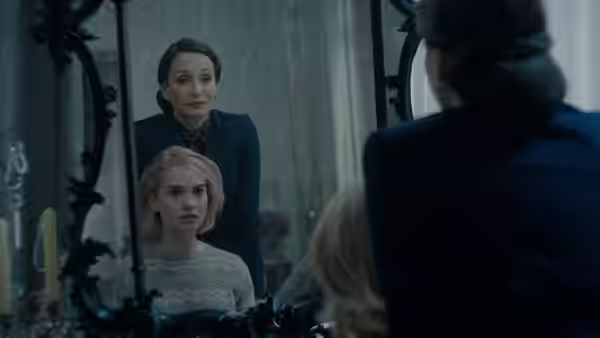
Mrs. de Winter (Lily James) tries to find her place beside Maxim de Winter (Armie Hammer) at Manderley. Her encounters with Mrs. Danvers (Kristin Scott Thomas) offer little reassurance, and the other woman’s manner is difficult to read. The house surrounds them with elaborate interiors, including the mirrored anteroom to Rebecca’s bedroom. Class shapes the relationships between the women, while Mrs. de Winter struggles with isolation. She wants security in her marriage, but her dealings with Mrs. Danvers make the household uncomfortable, and the romance becomes entangled with mystery.

Plays from YouTube when you press play; nothing loads from them until then.

Fi1m review

Ben Wheatley’s Rebecca offers carefully made rooms and one properly unsettling performance from Kristin Scott Thomas. The romance remains thin, though, and the late rush leaves too little suspense to justify the wait.

Ben Wheatley’s Rebecca is carefully made, intermittently unsettling and too often dull. This adaptation of Daphne du Maurier’s novel wants the romance to carry as much weight as the mystery, which is a reasonable ambition. The difficulty is that the central couple never becomes interesting enough to support that choice. Manderley gets plenty of attention, and the people inside it struggle to command as much of ours.

Lily James gives Mrs. de Winter a readable vulnerability, but the performance seldom develops beyond it. There is effort in the way she registers uncertainty, without enough variation to make that uncertainty gripping for this long. As Maxim de Winter, Armie Hammer is more convincing at being blunt than at suggesting anything troubling beneath his manner. Their scenes establish a romance without persuading us that either person needs this particular partner. We were bored by their exchanges, because the attraction never acquires the intensity that might make their unhappiness worth following.

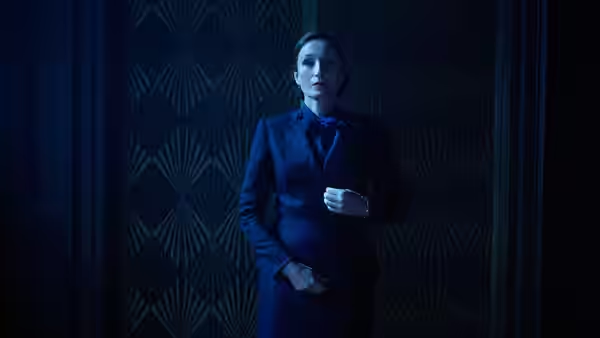
Kristin Scott Thomas is another matter. Her Mrs. Danvers makes politeness unpleasant without pushing the performance into caricature. The uncertainty about what she means gives her encounters some tension. She also suggests feeling beneath the cruelty, so the character has more to offer than a succession of intimidating looks. It is a performance that keeps the scenes involving Mrs. Danvers from settling into routine.

Sarah Greenwood’s production design gives Manderley rooms with distinct characters and enough detail to reward close attention. The mirrored anteroom to Rebecca’s bedroom is particularly effective: the decoration itself begins to feel disorientating. Laurie Rose’s cinematography makes good use of the contrast between light and deep shadow, giving the interiors some of the unease missing from the romance. These are substantial pleasures, even when the film encourages us to inspect the surroundings more closely than the faces.

Clint Mansell’s score works to supply the tension that the central performances leave wanting, but music cannot make their attraction more persuasive. Jonathan Amos’s editing gives the opening more room than it needs, then hurries when the story needs time to settle. The change in pace makes it harder to stay interested just when the mystery should be taking hold. At 123 minutes, the film is long enough to give both the romance and its complications their due, yet the balance feels wrong.

The screenplay by Joe Shrapnel, Jane Goldman and Anna Waterhouse leaves the relationships too simple for the complications placed around them. There are hints of a more uncomfortable film in the attention to class and the women’s differing perspectives, but these seldom make the encounters sufficiently tense. A Gothic romance needs to make attraction itself worrying. Here, too much depends on our accepting the couple’s attachment without the performances giving us much reason to believe in it.

The strongest reason to stay is Kristin Scott Thomas, though that is a narrow basis for choosing a film this long. Anyone chiefly interested in period interiors will find plenty to examine, and there is pleasure in the care taken over those rooms. We would look elsewhere for a romance with danger in it.

Critical consensus AI synthesised

47
Positive
2
Mixed
15
Negative
12

The consensus on Rebecca leans towards disappointment, though most critics find something to admire in its polished appearance and supporting cast. Praise centres on Kristin Scott Thomas’s Mrs Danvers, whose menace, cruelty and emotional shading give the adaptation much of its interest. Manderley’s interiors and the cinematography also draw favourable notices, even from reviews that find Ben Wheatley’s treatment too conventional or short of suspense.

The chief reservations concern the central romance, the leads’ casting and a final act that several critics find rushed or ineffective. Opinion ranges widely: Den of Geek praises the atmosphere and all three leads, while The New Yorker finds the casting and performances unable to give the central tensions emotional force. Some reviews welcome a more romantic approach; others miss the Gothic unease and sensuality. Comparisons with Hitchcock’s version are frequently unfavourable, with critics questioning how much this adaptation adds.

Empire
15 October 2020 · John Nugent
65*

The review finds plenty to like in Wheatley’s glossy, conventional adaptation, though Hitchcock’s version casts a long shadow. It singles out Kristin Scott Thomas’s deliciously vicious Mrs Danvers as the film’s standout.

Read the full review →
The New York Times
21 October 2020
65*

The review text is inaccessible, so its verdict and specific praise or complaint cannot be established. No rating is visible in the available page content.

Read the full review →
Screen Daily
15 October 2020 · Fionnuala Halligan
64*

The accessible page identifies this as Halligan’s review of the 2020 adaptation, but does not reveal her verdict. No specific element of praise or complaint is visible in the supplied text.

Read the full review →
IndieWire
15 October 2020 · C+ · David Ehrlich
63

Ehrlich finds the adaptation visually appealing but ultimately constrained by its source and unable to make its own identity. He praises Kristin Scott Thomas’s performance as Mrs. Danvers, while criticizing the romance and suspense for being weakened by side plots.

Read the full review →
Radio Times
★★★ · Emma Simmonds
60

Simmonds describes Wheatley’s take on the material as an intriguing marriage of director and story. She singles out Kristin Scott Thomas’s formidable performance as Mrs Danvers.

Read the full review →
Total Film
15 October 2020 · ★★★ · Kate Stables
60

Stables finds the remake a handsome, risk-taking romance that trades suspense for sweeping sadness. She praises Kristin Scott Thomas’s chilling performance but says the final-act changes fail to land.

Read the full review →

Straight answers AI written, from our review

Is Rebecca worth watching?
Rebecca is difficult to recommend beyond Kristin Scott Thomas’s unsettling performance and the carefully made interiors; we score it 49 out of 100. We find the central romance unpersuasive and the pacing uneven, so its pleasures are narrow: an uncomfortable household and rooms that often hold our attention better than the people.
How long is Rebecca, and what is it rated?
Rebecca runs 2h 03m. It is a romance and drama film.
Where can I watch Rebecca in New Zealand?
Rebecca is streaming on Netflix in New Zealand. Availability is checked daily; the links above go straight to each service.
How violent or frightening is Rebecca, and is it suitable for children?
Rebecca has a UK 12 certificate, so it is not a choice for younger children; its unsettling moments centre on Mrs. Danvers and the uncomfortable atmosphere at Manderley. We find it intermittently unnerving rather than consistently frightening, with politeness made threatening and interiors that feel disorientating. The certificate is the clearest guide for families considering it for older children.
How does Rebecca compare to The Handmaiden?
Rebecca is the weaker choice beside The Handmaiden if we want class, desire and a grand household to complicate a convincing romance. We recommend The Handmaiden for its clever, funny erotic thriller plotting and performances that give the relationship feeling. Rebecca offers carefully made interiors and an unsettling Kristin Scott Thomas, but its central couple never holds our interest.
Is Rebecca based on a true story or a book?
Rebecca is adapted from Daphne du Maurier’s novel, rather than presented as a true story. Ben Wheatley’s film gives the romance as much weight as the mystery, an approach we find reasonable but poorly sustained: the couple’s attraction is too thin to make their unhappiness compelling.
What should I watch after Rebecca?
After Rebecca, try The Handmaiden (2016, Fi1m 85): Class, desire and a grand household complicate an unusually persuasive romance. Then The Heiress (1949, Fi1m 90): For a romance whose smallest social cruelties have lasting consequences.

Cast

If you liked this, try…

  1. The Innocents (1961) · not reviewed yetA country house becomes frightening through patient observation and troubling performances.

  2. The Handmaiden (2016, Fi1m 85)Class, desire and a grand household complicate an unusually persuasive romance.

  3. The Heiress (1949, Fi1m 90)For a romance whose smallest social cruelties have lasting consequences.

  4. Les Diaboliques (1955) · not reviewed yetA marriage’s resentments feed a mystery that gives its dread time to develop.

  5. Crimson Peak (2015) · not reviewed yetAn imposing house and elaborate clothes accompany a less timid Gothic romance.