Jeremy Saulnier’s small-town thriller is best when nobody raises their voice, and Aaron Pierre never does. The first hour is as tight as anything Saulnier has made; the second sits down to explain the plot, and some of the tension goes with it.
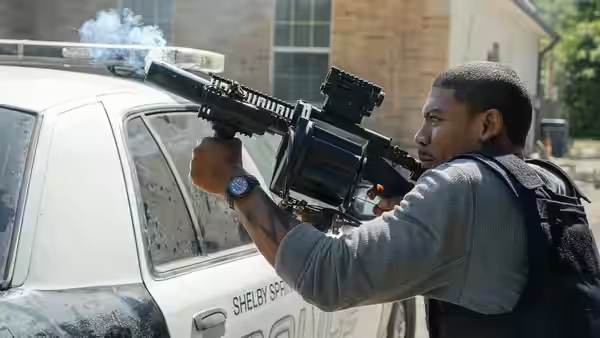
Jeremy Saulnier has built his new thriller on an old template. A stranger comes to a small town, the local police take something from him, he asks for it back, and they should have given it to him. Terry Richmond (Aaron Pierre) cycles into town with a bag of cash to post bail for his cousin Mike Simmons (C.J. LeBlanc). Two officers, Marston (David Denman) and Lann (Emory Cohen), knock him off his bike, find the money and keep it under a civil forfeiture law that lets them take cash without charging anybody. Terry wants it back, and he does not have long. It is a clean setup, and for about an hour Saulnier does almost nothing wrong with it.
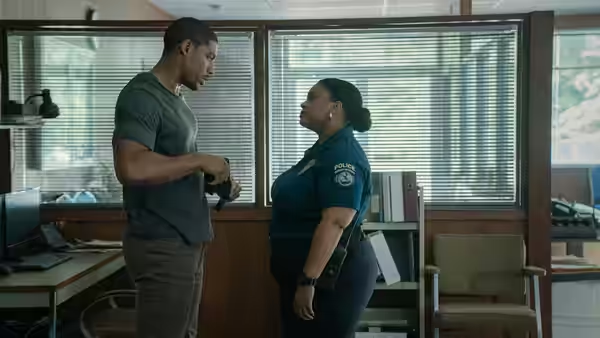
The film belongs to Pierre. He plays Terry as a man who decided, well before we meet him, that raising his voice is a thing that gets men like him killed, so he never does. He says “sir”. He asks for receipts. He stands at the front desk of the police station, hands where everyone can see them, and explains what he needs, and the officers behind the counter slowly realise that the large calm man in the lobby is not going to leave. When he finally moves it is fast and over in seconds, and nobody dies. Pierre makes the waiting the action, and it is the best thing in the film.
David Gallego shoots the town in flat, humid daylight, so it looks ordinary and slightly sick. The police station, from production designers Ryan Warren Smith and John P. Goldsmith, is a low brick building with fluorescent light and a counter at reception, and Saulnier stages his best set piece in it without leaving the lobby. Brooke Blair and Will Blair score it with a low electronic pulse that sits under scenes rather than on top of them. Saulnier cuts the film himself and he cuts it slow, holding on faces in the seconds before something happens.
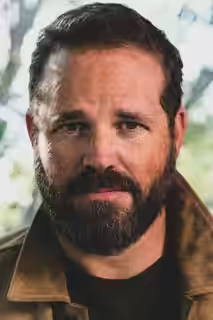
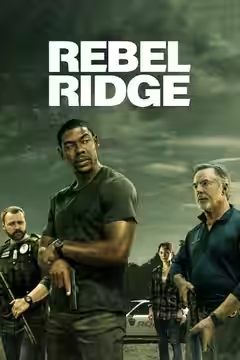
Don Johnson is Chief Sandy Burnne, and he plays him as a reasonable man, all drawl and patience, explaining to Terry why the law is on the department’s side and why a sensible man would take the deal. He is loathsome and he is never once loud, and Johnson plainly enjoys that. Denman’s Marston is the heavy, slow and sure of his own size. Cohen’s Lann is the jumpy one, and the film is smart about how the jumpy one is the dangerous one. AnnaSophia Robb plays Summer McBride, a clerk at the courthouse who has her own reasons to distrust the police and knows where the paperwork is kept, and her scenes with Pierre, reading statutes across a table, give the film its only warmth.
Here is what we felt. The roadside scene, in which the officers count Terry’s money in front of him and write him a receipt for taking it, made us angrier than any shoot-out could have, because everyone involved is so quiet and so certain they are allowed. And at the station, when Terry set his bag down, we sat forward on the sofa. We had been waiting forty minutes for him to move and Saulnier knew it.
Then the film sits down to explain itself. The second half is about where the town’s money goes, and it is laid out in dialogue, in offices and cars and living rooms, at length. Summer and Terry work through it like detectives in a procedural, and the film stops moving for long stretches while they do. It runs 131 minutes and there is a tighter 110 in it. The final confrontation is staged with care and Saulnier keeps the blood down, which we admire in principle and found a little airless in practice. We were never bored, but we were checking how much was left.
Blue Ruin had one idea, a man with a knife and no plan, and followed it to the end. Rebel Ridge has a bigger one, about a system that robs people legally and counts on them not knowing the forms, and it is worth the time it spends teaching us. It carries a 15 and earns it without much blood. Watch it for Pierre, and forgive the last hour for talking.