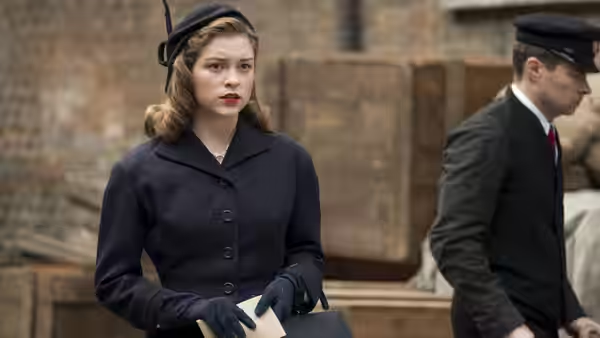
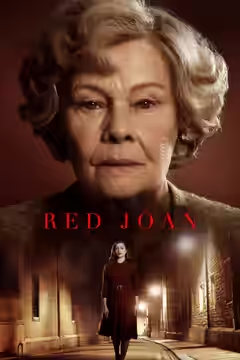
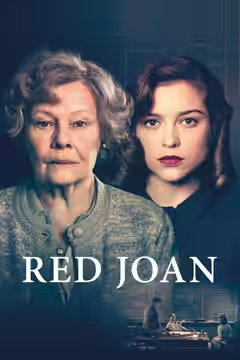
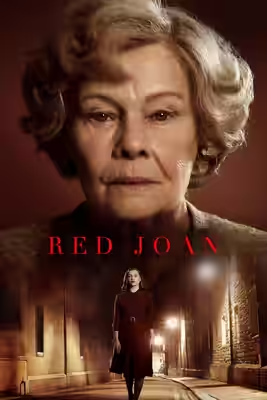
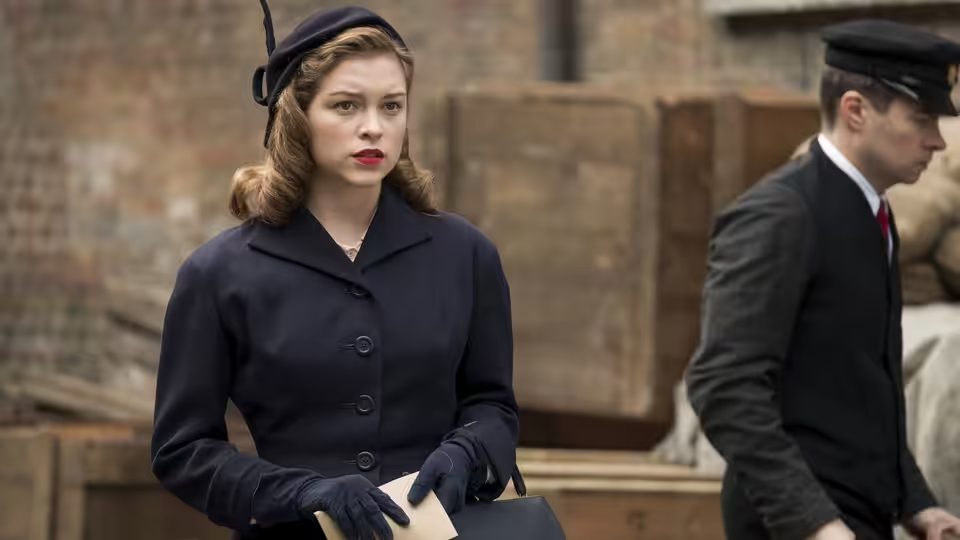
Young Joan (Sophie Cookson) holds papers beside a uniformed man on a city street
Film review

Red Joan

2018 · Directed by Trevor Nunn · 1h 41m

In a sentenceBetraying your country to Stalin has rarely looked so much like a Sunday-night costume serial

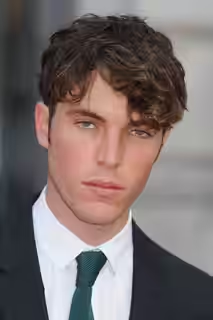
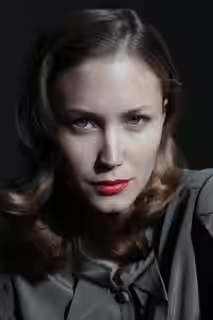
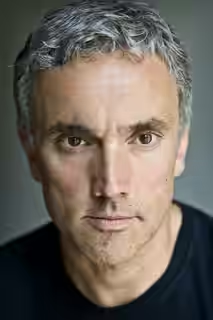
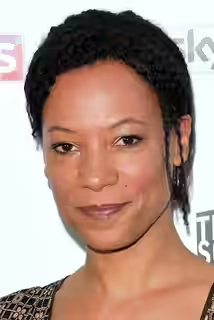
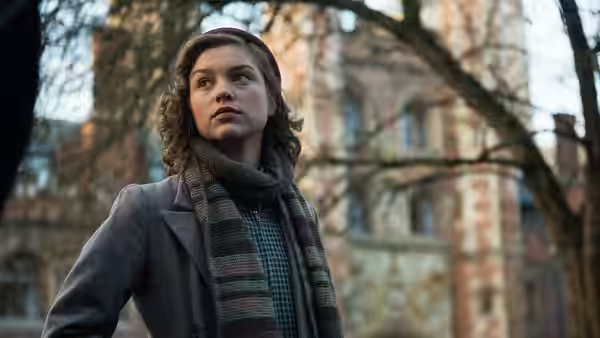
Joan Stanley (Judi Dench), a widow in her eighties living quietly in the English suburbs, opens her front door to officers from MI5 and is driven to an interview room. Across the table, Ms. Hart (Nina Sosanya) lays out the accusation: that decades ago Joan passed British atomic secrets to the Soviet Union. Her son Nick (Ben Miles), a barrister, sits beside her and learns who his mother was along with us. The film cuts back to Cambridge in 1938, where young Joan (Sophie Cookson), a physics student, is drawn into a circle of student communists by the glamorous Sonya Galich (Tereza Srbová) and her cousin Leo Galich (Tom Hughes). When war comes, Joan is recruited to a secret research project run by the decent, married Max (Stephen Campbell Moore).

Plays from YouTube when you press play; nothing loads from them until then.

Fi1m review

Sophie Cookson makes the young Joan worth following; Judi Dench is given a kitchen table and told to look worried. Trevor Nunn has a strange true case to tell and tells it as a cosy flashback drama, without nerve or tension.

Red Joan has a story most spy films would kill for. An elderly woman in a cardigan is arrested at home and turns out to have handed the Russians the bomb half a century earlier, and she is not sorry. Lindsay Shapero’s script, from Jennie Rooney’s novel, which was itself drawn from a real case, splits the telling between an MI5 interview room and the Cambridge of 1938, and Trevor Nunn directs it as a handsome, well-spoken, 101-minute drama in which nobody is ever in much danger. That is the problem in one sentence. A film about treason should make us sweat at least once, and this one never does.

Sophie Cookson is the reason to stay. Her Joan is clever, careful and a little flattered to be noticed, and Cookson plays the flattery honestly rather than as a weakness. The Cambridge scenes give her Sonya Galich (Tereza Srbová), who smokes and knows things, and Leo Galich (Tom Hughes), who makes speeches about Russia with his collar open. Hughes is doing what the part asks, but the part asks him to be irresistible and the writing gives him only slogans. We never believed Joan would risk her life for this man, and the film needs us to at least consider it.

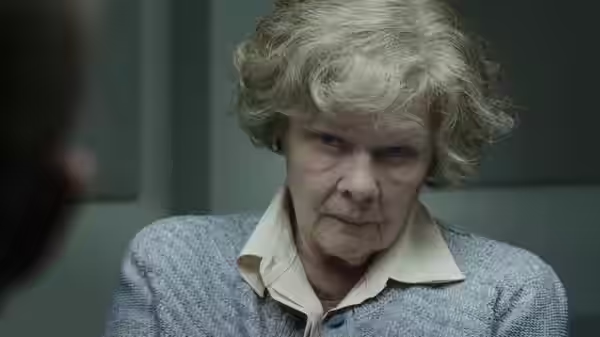
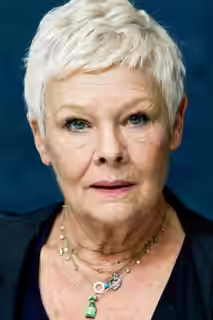
Judi Dench has far less to do than the poster suggests. She sits at a table, is asked a question by Ms. Hart (Nina Sosanya), says she does not remember, and is glared at by her son Nick (Ben Miles). Then the film goes back to the 1930s and answers the question for her. This happens a dozen times. Dench does what she can with it, and her face at the moment Nick stops defending her is a small, true thing. But we were bored by the hour mark, and the boredom turned to irritation each time Kristina Hetherington’s cut back to the present interrupted a scene that was finally getting somewhere.

The best stretch is the laboratory. Cristina Casali gives it blackboards, filing cabinets and brown linoleum, and Zac Nicholson lights it in a dim wartime grey that is a relief after the honeyed Cambridge afternoons. Stephen Campbell Moore plays Max, who runs the project, as a tired, courteous man who notices that Joan is more than a typist and is not sure what to do about it. The two of them working a problem at a blackboard have more charge than any of the political scenes, and Campbell Moore is the only actor here who seems to be hiding something.

The film’s second half gives Joan the reason the tagline promises, and we will not describe it. What we can say is that she is given the reason in a single scene, announces it in another, and the film treats the matter as settled. George Fenton’s strings swell at the appropriate moments to tell us she is right. Whether she is right is the most interesting question the material contains, and Red Joan is in too much of a hurry to be kind to its heroine to stop and argue it.

Nunn has spent most of his life in the theatre, and it shows in the way scenes are staged: people stand in rooms and state their positions, then someone leaves. The genre runs on what people conceal and for how long. Here nothing is concealed for more than a few minutes, because the structure keeps handing the answer to Dench to pass on to us.

Most critics have been a little harder on this than we are, and we do not think they are wrong, only that Cookson and the laboratory scenes earn it something. See it if you want an hour and a half of Cambridge in soft light and a good young actress carrying a film that should have been about her all along. Anyone who comes for the spying will be waiting a long time for someone to look over their shoulder.
Critical consensus AI synthesised

42
Positive
1
Mixed
3
Negative
11

Most critics come away unimpressed. The reviews describe a drab, stodgy and conventional espionage drama that does little with a promising true story, and the word “forgettable” recurs. Where praise appears, it lands almost entirely on the two leads: Judi Dench is credited with enlivening scenes the script gives her too little of, and Sophie Cookson is thought capable, with several critics finding her younger Joan the more convincing of the two.

The complaints cluster on motive. Critic after critic says the film fails to make Joan’s choice to spy persuasive, and the Evening Standard goes further, arguing that it misrepresents the real spy’s politics. The flashback structure divides opinion: IndieWire finds the past more compelling than the present, while The Guardian calls the flashbacks repetitive. The spread is narrow, with one clear dissenter: The Hollywood Reporter, reviewing from the festival, finds a taut and engaging old-fashioned thriller.

The Hollywood Reporter
8 September 2018 · festival review · Deborah Young
75*

The critic finds the film a taut, engaging old-fashioned spy thriller, though its central motivation stretches credibility. She particularly praises Judi Dench and Sophie Cookson, whose performances make Joan’s idealism persuasive.

Read the full review →
RogerEbert.com
64*

The page is blocked by a browser check, so the critic’s verdict cannot be verified. No praise or complaint can be identified from the available page text.

Read the full review →
Screen Daily
8 September 2018 · festival review · Wendy Ide
64*

The accessible page does not reveal the critic’s verdict. It identifies the film’s two lead performers but gives no readable praise or complaint.

Read the full review →
IndieWire
19 April 2019 · C+ · Kate Erbland
63

Erbland finds the film underwhelming, arguing that its fractured structure and dull older-Joan material weaken the story. She praises Sophie Cookson’s younger Joan and finds the flashback sequences more compelling and revealing.

Read the full review →
Evening Standard
18 April 2019 · ★★ · Charlotte O'Sullivan
40

O’Sullivan finds the drama stodgy and misleading, arguing that it distorts the real spy’s politics. She praises Judi Dench’s impish performance but says the film gives her too little to do.

Read the full review →
Little White Lies
23 April 2019 · 3/2/2 · Caitlin Quinlan
40

Quinlan finds the film safe, limp and forgettable despite its bold subject. She praises Judi Dench’s performance and the effort to clarify Joan’s political motives, but says the role is limited.

Read the full review →

Straight answers AI written, from our review

Is Red Joan worth watching?
Red Joan is only worth watching for Sophie Cookson, and we scored it 45. She makes the young Joan clever and careful, and the wartime laboratory scenes with Stephen Campbell Moore have a charge the rest of the film lacks. Anyone who comes for spying, danger or an argument about treason will find a cosy flashback drama in which nobody is ever in much peril.
How long is Red Joan, and what is it rated?
Red Joan runs 1h 41m. It is a thriller and history film.
Where can I watch Red Joan in Romania?
Red Joan is not on any streaming or rental service in Romania at the moment. It is available in 26 other countries; change your country at the top of the page to see where. Availability is checked daily.
How violent or frightening is Red Joan, and is it suitable for children?
Red Joan is a 12A and contains little that would frighten or disturb: it is a well-spoken period drama of interview rooms, Cambridge lawns and a wartime laboratory. There is no violence to speak of and nothing we would keep a teenager from. Younger children are more likely to be bored than upset by an hour and a half of people stating their positions in rooms.
How does Red Joan compare to Tinker Tailor Soldier Spy?
Red Joan shares its wet, grey Britain with Tinker Tailor Soldier Spy, and the earlier film is much the better of the two. Tomas Alfredson keeps you worrying about who is concealing what; Trevor Nunn hands the answer to Judi Dench every few minutes, so the tension drains away. Choose Red Joan only if you want soft-lit Cambridge and a good young actress rather than a thriller.
Is Red Joan based on a true story or a book?
Red Joan is adapted from Jennie Rooney's novel, which was itself drawn from a real case of a British woman accused of passing atomic secrets to the Soviet Union. Lindsay Shapero's script keeps the novel's split between an MI5 interview room and the Cambridge of 1938. You need not know the book or the case to follow it; the film explains everything, rather too quickly.
What should I watch after Red Joan?
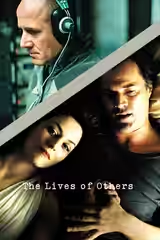
After Red Joan, try Tinker Tailor Soldier Spy (2011, Fi1m 84): The same wet, grey Britain, with the tension this film keeps misplacing. Then The Lives of Others (2006, Fi1m 84): A surveillance drama that actually asks what listening to someone costs you.

Cast

If you liked this, try…

  1. Tinker Tailor Soldier Spy (2011, Fi1m 84)The same wet, grey Britain, with the tension this film keeps misplacing.

  2. The Lives of Others (2006, Fi1m 84)A surveillance drama that actually asks what listening to someone costs you.

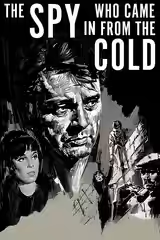
  3. The Spy Who Came in from the Cold (1965) · not reviewed yetRichard Burton, shabby and cold, in the Cold War film that set the standard.

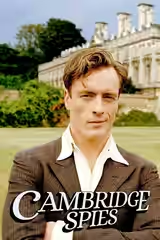
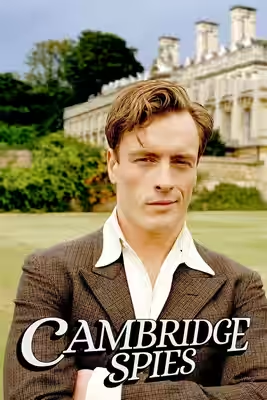
  4. Cambridge Spies (2003) · not reviewed yetThe real Cambridge recruits, over four hours, with the ideology taken seriously.

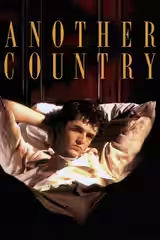
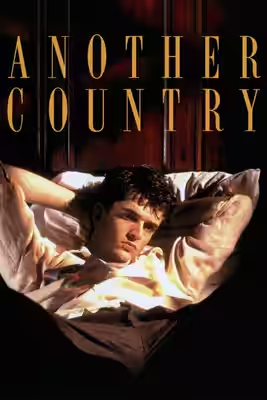
  5. Another Country (1984) · not reviewed yetHow a public-school boy decides to betray England, told with wit and sadness.

Free account

Know what to watch tonight

Two lists that know where things are streaming, collections you can share, your own score beside ours, and Discover that remembers what you have seen.

  • Want to see, sorted by what is streaming now
  • Seen, with your score out of ten
  • No adverts, ever
Red Joan (2018) review: a real spy story told without nerve (Romania) | Fi1m