Maika Monroe gives this Colleen Hoover adaptation more than it gives back. The scenes between a mother and the daughter she is not allowed to see are honest and quietly painful; the romance wrapped around them runs on coincidence and never quite convinces.
Colleen Hoover adapts her own novel, with Lauren Levine, and Vanessa Caswill directs a 114-minute weeper about a woman who has served her sentence and finds that the town has not finished serving hers. Kenna Rowan wants one thing, which is to be allowed to know her daughter. The film has two stories to tell about that: one about a mother kept from her child, and one about the man she falls for while she waits. The first is good. The second is where the trouble is.
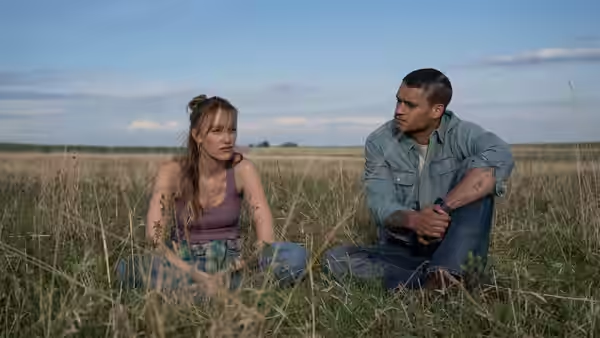
Maika Monroe is the reason the first story works. She plays Kenna without pleading, a woman who has decided that if she asks for nothing she cannot be refused, and she keeps her face so still that the smallest flicker reads on screen. We were moved, more than we expected to be, the first time Kenna sees Diem at a distance and does nothing at all; Monroe does not reach, does not cry, simply watches, and the restraint is what did it. Zoe Kosovic plays the girl as a child rather than a prop, which is rarer than it should be. Those scenes are the film’s spine and they are played straight.
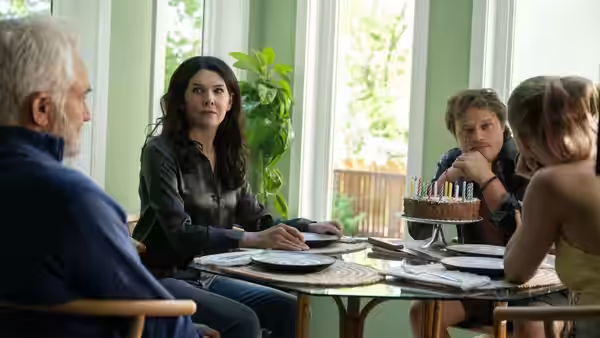
Bradley Whitford and Lauren Graham are the wall Kenna runs into. Whitford gives Patrick the harder edge, a man who has turned grief into a rule and will not look at the person who broke it. Graham has less to do for a long stretch and then, late on, is handed the best scene in the picture and plays it with no fuss at all. We will not say what it is. Lainey Wilson, as Kenna’s neighbour Amy, supplies the only easy warmth on screen, and the film could have used more of her.
The romance is another matter. Tyriq Withers is likeable and unhurried as Ledger, and he and Monroe are pleasant together, but the script asks us to accept that two people this bound up in the same dead boy can meet, talk and fall for each other without either working out who the other is. In a town this size it is a stretch, and the film keeps stretching it. Hoover and Levine write the pair a run of long conversations in cars, and the conversations say the same two or three things in slightly different orders. We found ourselves waiting for the next scene with the girl in it.
The craft is handsome and mostly in the way. Tim Ives shoots the town in warm late light, every porch and bar window gone amber, and it is lovely to look at and tells us nothing about where these people are or what it costs to live there. Francesca Massariol’s bar is the one set with any grain to it, worn wood and bad lamps, and Jayna Mansbridge dresses Kenna in the same two or three cheap layers, which is right. Michelle Harrison, editing, lets shots run on faces long past the point where the face has finished speaking, and by the third such hold we had stopped trusting them.
The old weepers made you earn your tears; they put the obstacle in the open and let you watch two people fail to climb it. This one hides the obstacle inside a coincidence and then spends an hour pretending nobody can see it. Against the Hoover films that came before it, including Regretting You, it is plainly the better made and the better acted, and most critics have said as much while declining to recommend it. We land in roughly the same place.
If you have read the book, you will get the film you wanted and Monroe is better than the material. If you have not, the mother-and-daughter half is worth a quiet Sunday, and the romance can be tolerated as the price of admission. The 12A is accurate: nothing here will shock anyone, which is both its comfort and its limit.