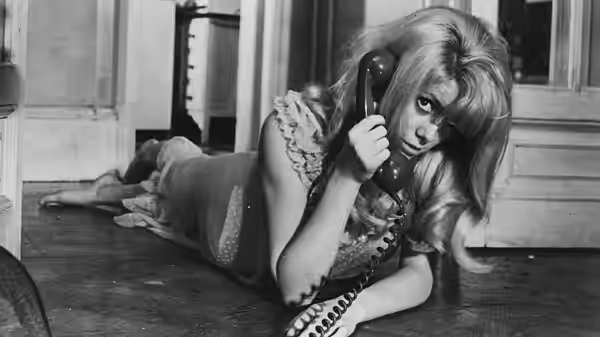
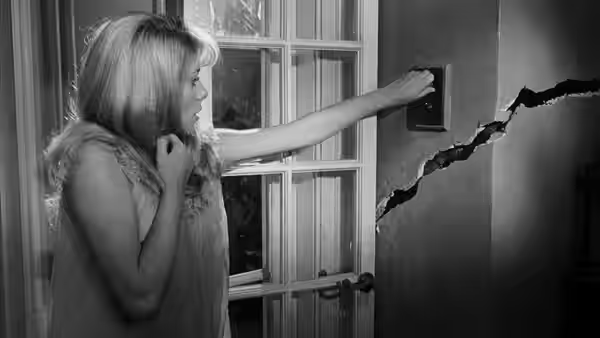
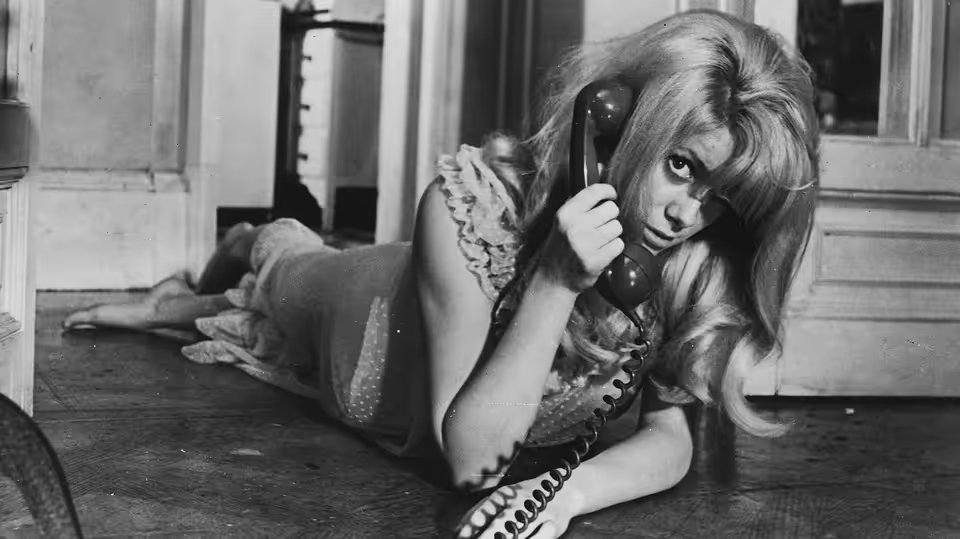
Carol Ledoux (Catherine Deneuve) lies on the floor, holding a telephone receiver
Film review

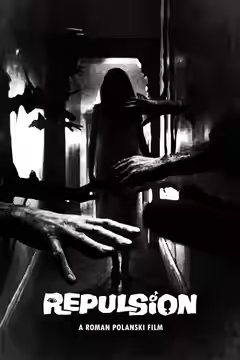
Repulsion

1965 · Directed by Roman Polanski · 1h 45m · Eirin R15+

In a sentenceA skinned rabbit on a plate, a dripping tap, and a woman the whole street thinks is fine

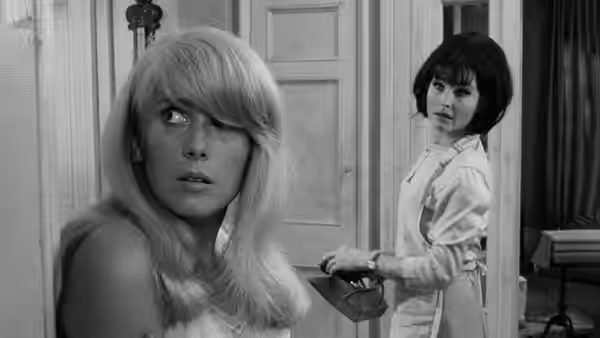
London, the mid-1960s. Carol Ledoux (Catherine Deneuve) is a manicurist at a beauty salon and shares a flat with her older sister Hélène (Yvonne Furneaux). Hélène’s lover Michael (Ian Hendry), a married man, has taken to staying the night, and Carol lies awake listening to them through the wall. By day she is pursued, politely and without success, by Colin (John Fraser), who wants to take her to dinner and cannot understand why she flinches when he kisses her. Then Hélène and Michael leave for a holiday in Italy and Carol is alone with the flat: the rent owed to the landlord (Patrick Wymark), Michael’s razor and vest still in the bathroom, a skinned rabbit left uncooked on a plate, and walls that have begun, quietly, to crack.

Plays from YouTube when you press play; nothing loads from them until then.

Fi1m review

Roman Polanski’s first English-language film shuts Catherine Deneuve in a London flat and watches her mind go. Decades of imitators have not dulled it; the rot, the cracks and the dripping tap still work on the nerves, and Deneuve barely says a word.

Roman Polanski arrived in London after Knife in the Water and, with the writer Gérard Brach, made a film about a young woman who does not want to be touched. Carol Ledoux (Catherine Deneuve) does nails in a salon, lives with her sister Hélène (Yvonne Furneaux) and lies awake at night listening to Hélène and her married lover Michael (Ian Hendry) through the bedroom wall. When the couple go abroad and leave her alone in the flat, the flat starts to come apart. Repulsion is 105 minutes long, most of them spent in three rooms and a corridor, and it is as frightening as anything Polanski has made. We would recommend it to anyone with the stomach for it, with the caveat that the stomach is the point.

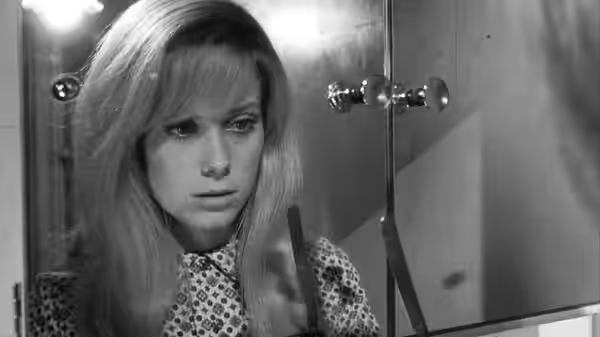
Deneuve is doing something rare here, which is almost nothing. Carol hardly speaks. She stares at a crack in the pavement while her colleague Brigitte (Helen Fraser) chatters about a boyfriend; she stares at Michael’s razor on the bathroom shelf; she stares at the wall. Polanski films her face the way another director would film a locked door, and Deneuve gives him only what is needed to make us look harder. When she does act, nicking a customer’s finger at the salon or picking up a man’s discarded vest and pressing it to her face, the film has trained us to jump.

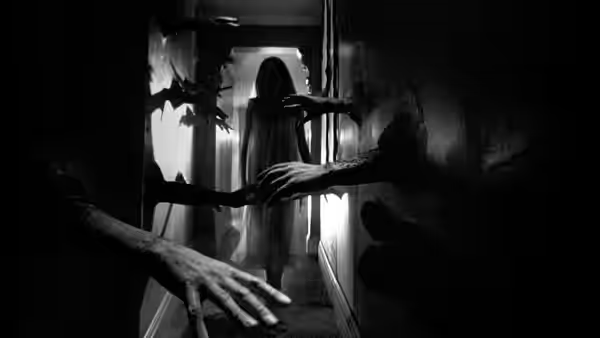
Gilbert Taylor shoots the flat in black and white on wide lenses, so that as the film goes on the corridor gets longer and the ceiling seems to come down. He lights the bathroom flat and bright, like a clinic, and the bedroom in bars of shadow. Nothing is done with fog or tilted cameras. The walls simply look wrong, and then they look worse. The sound does the rest: a tap that will not stop dripping, a clock, flies, and from the garden next door a convent bell and the shrieks of nuns playing ball, which is one of the strangest and most effective noises we know of in a horror film. Chico Hamilton’s score is drums and a little jazz, used sparingly and never to tell us when to be scared.

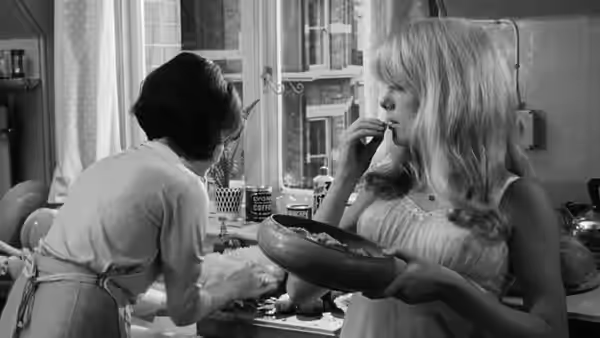
We were horrified, and not by anything with blood in it. It was the rabbit. Hélène leaves it skinned on a plate for a dinner that never happens, and Polanski keeps cutting back to it over the days that follow, on the sideboard, in the handbag, the flies thickening each time. It stands for everything Carol cannot bring herself to deal with, and it made us want to leave the cinema. Later the walls do things we will not describe, and Alastair McIntyre’s editing is what makes them land: he cuts into a hallucination without a warning note and cuts out of it the same way, so that for a second we are as unsure as she is which flat we are in.

The men are the weak part, and partly on purpose. Colin (John Fraser) is a decent drip whose decency runs out the moment a door is shut on him; Michael leaves his razor in a bathroom shared by two women and thinks nothing of it; the landlord (Patrick Wymark) comes for the rent and stays for something else. Every one of them treats Carol as a problem to be solved by being nearer to her. The film sees this clearly, and it also draws them thinly, so that Hendry in particular is left playing a moustache. There is a stretch in the middle, twenty minutes or so of Carol drifting from room to room, where we felt the film marking time before it dared to go further.

Polanski would return to flats and the people going mad in them, most famously in Rosemary’s Baby three years later, and this is the barest of those films: no coven, no conspiracy, one woman and some plaster. The only sentence of explanation comes in the final shot, and we would have cut it. The film has spent 105 minutes not needing a cause.

It carries an 18 certificate for a reason that has less to do with what is shown than with how long you are made to sit with it. Watch it alone if you can, in a flat, at night. You will notice your own taps.

Critical consensus AI synthesised

87
Positive
7
Mixed
1
Negative
0

The reviews are almost uniformly admiring, and they admire the same things. Most critics call it a deeply disturbing psychological thriller, and the praise settles on how completely Polanski builds a warped world from inside Carol’s head, so that her collapse looks reasonable to her and terrifying to us. The sound design comes up again and again, as does the violence of the imagery, both cited as the reason the film gets under the skin rather than merely startling. Several also single out Deneuve’s subtle, watchful performance and the film’s precise small details over its shocks.

The spread is narrow. Only one review holds back, and even that is not a complaint about craft: Eye for Film finds it hard to sit through and reads it chiefly as a study of how women are neglected and mistreated, with Carole’s reactions making sense from where she stands. Nobody argues the film does not work; the only question is how much of it a viewer can bear.

Radio Times
★★★★★ · Tom Hutchinson
100

Hutchinson presents the film as a deeply disturbing, hallucinatory psychological thriller. He singles out Polanski’s violent imagery and terrifying sound design for praise.

Read the full review →
Slant Magazine
14 April 2006 · ★★★★/4 · Ed Gonzalez
100

Gonzalez finds the film a tense, disturbing triumph that makes fear and desire feel inseparable. He especially praises its meticulous interplay of sound and visuals in evoking Carole’s fractured psyche.

Read the full review →
Empire
13 March 2007 · Kim Newman
90*

Newman praises the film as a disturbing, highly effective portrait of psychosis. He singles out its precise details, especially Ian Hendry’s conflicted reaction to discovering a corpse.

Read the full review →
The Guardian
3 January 2013 · Peter Bradshaw
90*

Bradshaw calls the film a brilliant, deeply disturbing psychological thriller. He especially praises how convincingly it creates a warped world from Carol’s point of view.

Read the full review →
Time Out
· GA
90*

The critic calls the film a stunning, exceptionally realised work. They single out its portrait of the protagonist’s mental and emotional disintegration.

Read the full review →
Variety
31 December 1964 · Variety Staff
85*

Variety praises the film as a classy, genuinely horrific psychological drama. It singles out Catherine Deneuve’s subtle performance and Polanski’s especially effective use of sound.

Read the full review →

Straight answers AI written, from our review

Is Repulsion worth watching?
Repulsion is worth watching for anyone with the stomach for a slow, close study of a woman coming apart in a London flat, and we scored it 88. Catherine Deneuve barely speaks, Gilbert Taylor's black-and-white photography makes the rooms look wrong before anything happens, and the dread builds for 105 minutes. It sags for a stretch in the middle, and the final shot explains more than it should.
How long is Repulsion, and what is it rated?
Repulsion runs 1h 45m and is rated R15+ by the Eirin in Japan. It is a drama and thriller film.
Where can I watch Repulsion in Japan?
Repulsion is available to rent from Apple TV from ¥440. Availability is checked daily; the links above go straight to each service.
How violent or frightening is Repulsion, and is it suitable for children?
Repulsion carries an 18 certificate and is a horror film that frightens through duration rather than gore: a dripping tap, a rotting skinned rabbit, cracking walls and hallucinations that arrive without warning. There is little blood, but the unease is sustained and the film sits inside sexual fear and unwanted male attention throughout. It is not for children, and we would keep it from younger teenagers too.
What should I watch after Repulsion?
After Repulsion, try Rosemary's Baby (1968, Fi1m 92): Polanski’s next flat, with a bigger cast, a plot and the same dread of neighbours. Then Persona (1966, Fi1m 89): Bergman puts two women in a house by the sea and lets their faces do the work.

Cast

Awards

Berlin International Film Festival, 1965

Won
Silver Bear Grand Jury Prize

If you liked this, try…

  1. Rosemary's Baby (1968, Fi1m 92)Polanski’s next flat, with a bigger cast, a plot and the same dread of neighbours.

  2. Persona (1966, Fi1m 89)Bergman puts two women in a house by the sea and lets their faces do the work.

  3. The Innocents (1961) · not on Fi1m yetDeborah Kerr alone with the children and the house; the sound design is a cousin.

  4. Possession (1981) · not on Fi1m yetIsabelle Adjani in a Berlin flat, going where Carol only hints she might.

  5. Saint Maud (2019) · not on Fi1m yetA young woman, a seaside flat and a mind that will not be argued with.

Repulsion (1965) review: Deneuve alone, and still frightening (Japan) | Fi1m