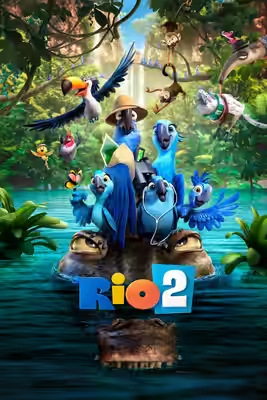
Carlos Saldanha’s sequel sends its macaws up the Amazon with seven plots, a dozen songs and four screenwriters, and only Jemaine Clement’s vengeful cockatoo finds anything to do. Lovely to look at, tiring to follow; fine for the children, a long sit for anyone else.
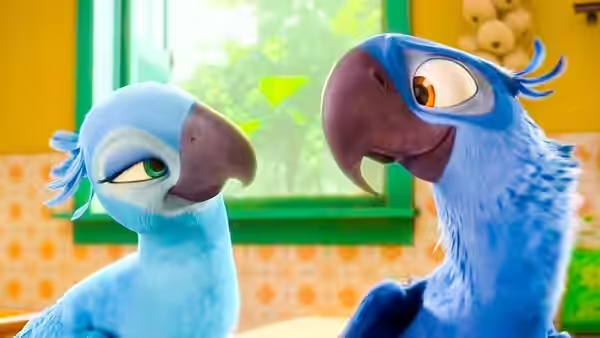
Carlos Saldanha’s first Rio, from 2011, had one idea and held it: a pampered pet bird who cannot fly is dropped into a city that never stops moving. The sequel takes Blu (Jesse Eisenberg) and Jewel (Anne Hathaway), now parents of three, out of the city and into the Amazon, where Jewel’s father Eduardo (Andy Garcia) runs a hidden flock of blue macaws and nobody has heard of a pancake. That is a fair idea too. The trouble is that four credited screenwriters, Jenny Bicks, Yoni Brenner, Don Rhymer and Carlos Kotkin, have each brought a plot, and Saldanha has kept all of them.
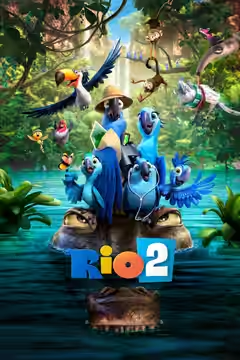
So, alongside the in-laws, there is a logging gang cutting into the forest, a Carnival talent audition that Pedro (will.i.am), Nico (Jamie Foxx) and Rafael (George López) have come to the jungle to judge, a smooth old flame called Roberto (Bruno Mars), Linda (Leslie Mann) and Tulio (Rodrigo Santoro) lost on a riverboat, and Nigel (Jemaine Clement), the cockatoo from the first film, now unable to fly and tracking Blu for revenge with a poisonous frog in tow. Any two of these would fill 101 minutes. The film does all of them, and the editors Randy Trager and Harry Hitner cut between them so briskly that no scene is allowed to finish what it started.
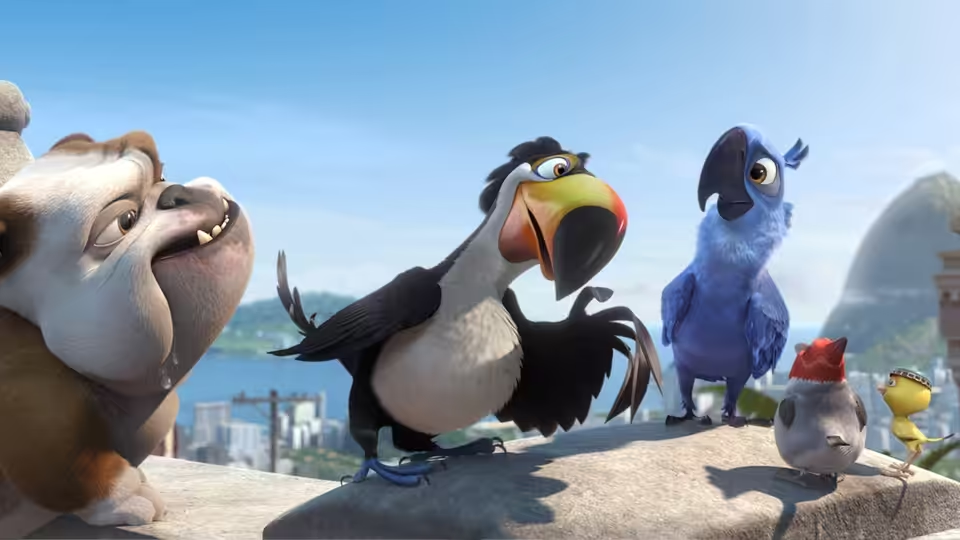
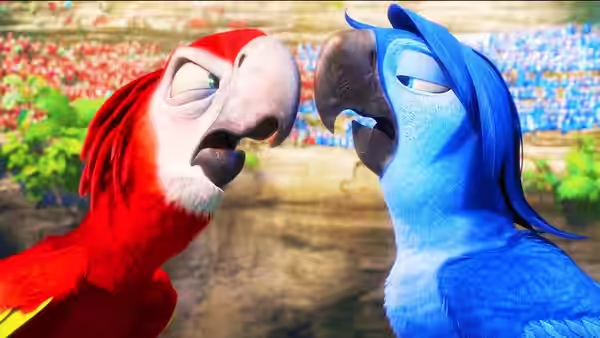
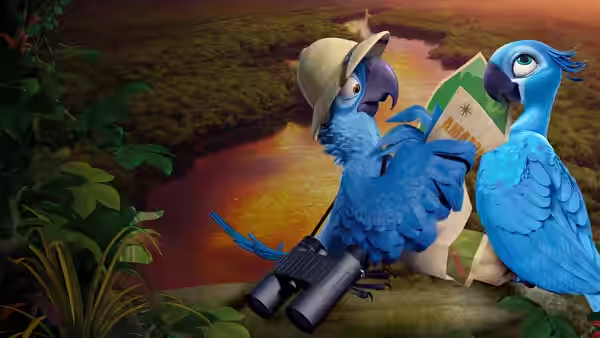
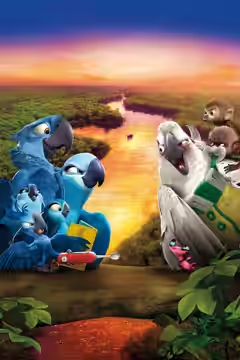
The look is where the money went, and it shows. Renato Falcão lights the flight north as a series of flat painted layers, like a pop-up book opening page by page over the coast, the plains and the river, and it is the loveliest stretch in the film. Once in the forest the palette goes to deep greens and wet blues, and the macaws are drawn feather by feather. When Eduardo’s flock takes off together in formation we did sit up. It is one of the few moments where the screen is doing one thing at a time.
Clement is the reason an adult will keep watching. His Nigel is a ham actor reduced to being carried about by an anteater, and he plays the humiliation with full relish, rolling every vowel. His rendition of “I Will Survive”, staged as a Carnival audition, made us laugh out loud, and then laugh again at the frog, Gabi, who adores him and cannot touch him because she would kill him. It is the only strand in the film with a joke built into its premise rather than bolted on afterwards.
The leads fare less well. Eisenberg’s Blu is still a fretting, over-prepared townie, which was funny once, and the script’s single idea for him is that his father-in-law thinks he is soft. Garcia barks that line in a dozen forms. Hathaway’s Jewel is handed the dullest material of all, torn between husband and home in scenes the film keeps interrupting. The children barely register. John Powell’s score, bright with Brazilian percussion, holds the pieces together, but the songs arrive roughly every ten minutes and several of them stop the picture dead. The loggers are villains without a face worth remembering.
We were tired by the hour mark, and then faintly ashamed of being tired at a film made for six-year-olds. The first Rio found its shape in a small story. This one has Saldanha’s plain affection for Brazil in every frame, and the Carnival audition, with its capoeira dancers and tone-deaf hopefuls, is the one place he lets that affection run loose. Everywhere else it is being managed.
Children under eight will be fine; the colour and the noise never let up and the U certificate is secure. Parents will be reaching for their phones somewhere around the logging subplot. Watch for Clement, and for the flight to the Amazon, and then decide whether the rest is worth sitting through.