Stephen Poliakoff writes and Peter Hall directs a slow, quietly angry film about a woman released from a hospital after most of her life. It drifts in the middle and softens at the end, but Peggy Ashcroft and Geraldine James make it worth your evening.
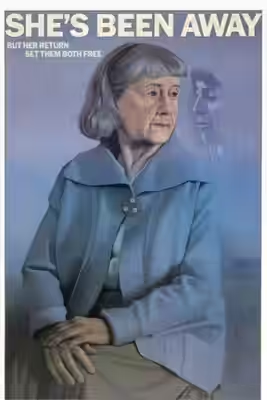
Stephen Poliakoff’s script begins with a woman being told that the hospital she has lived in for most of her life is shutting, and that she is free. Peter Hall films the news as a small administrative event, which is how Lillian Huckle (Peggy Ashcroft) receives it. She’s Been Away is a quiet film, often a slow one, and it has a slack stretch in the middle that we felt. It is also one of the best things we have seen Ashcroft do, and that is reason enough to sit through the slow parts.
The opening half hour in the hospital is the film at its most confident. Philip Bonham-Carter shoots the wards and corridors in flat, even light, with the camera kept still and at a distance, so that the patients look like furniture that has been there for decades. Hugh Lloyd’s George and Rosalie Crutchley’s Gladys are the friends Lillian leaves behind, and Hall gives them time: a game of cards, a goodbye on a staircase, nobody raising a voice. Ashcroft plays Lillian as a woman who has learned that the safest thing to do with any feeling is to put it down and walk away from it. For a long while she barely speaks.
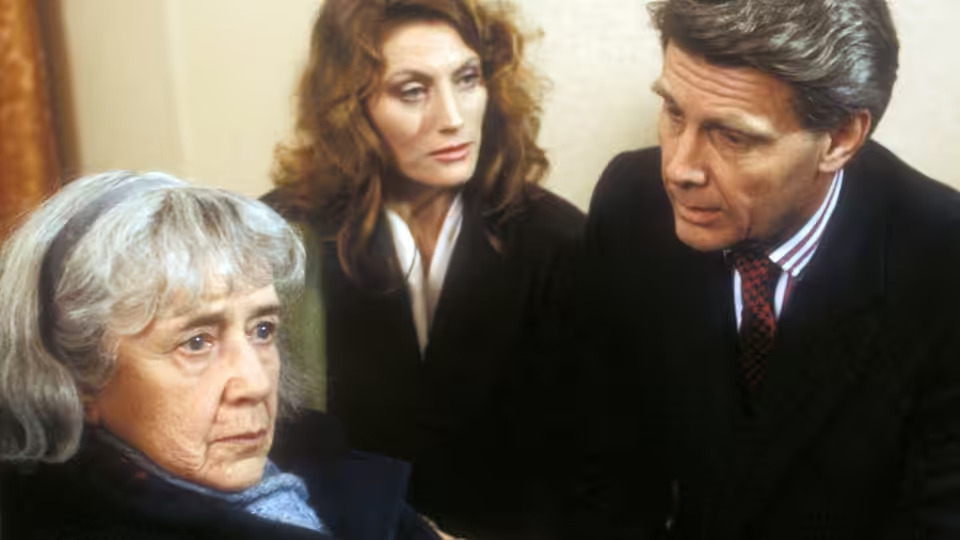
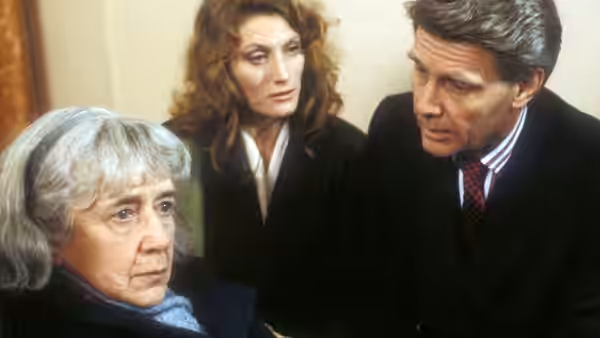
Then she is driven to the Ambroses. Gary Williamson’s design makes their London house large, pale and full of glass, a place where everything has been chosen and nothing is loved. James Fox’s Hugh is decent, embarrassed and mostly elsewhere; he wants to have done the right thing without having to be in the house while it is done. Geraldine James’s Harriet is the film’s second subject and its engine. Pregnant, clever, with nothing to do all day but be married, she is the one person in the house who notices that Lillian is a person, and James plays her curiosity as something close to hunger. Their scenes together, two women on opposite sides of a kitchen, are where the film breathes.
The flashbacks are the film’s weakest device. Rebecca Pidgeon is good as Young Lillian, bright and stubborn in a household that wants a quieter daughter, and the family’s reasons for sending her away are shown plainly enough. But Ardan Fisher cuts to the past at the moments we least want to leave the present, and Stephen Edwards’s score, sparing and mostly piano in the modern scenes, turns thick and sorrowful whenever the old house appears, telling us what to feel about things Ashcroft’s face has already told us. The past is a footnote here and the film treats it as a chapter.
Here is the scene that got us. Hugh and Harriet give a dinner party, and Lillian sits among the guests while they talk across her about property and schools and other people’s divorces. Ashcroft listens, and we watched her listen, and when she finally says something it is short, true and lands on the table like a dropped glass. We laughed, and then we were ashamed of laughing, because the joke is that a woman everyone has agreed is mad is the only one present who says what she sees. It moved us more than we expected a dinner-party scene to.
The middle sags. Hall is a theatre director and frames his rooms like stages, people arranged across the width of the picture and left there, and once Lillian has settled in there are twenty minutes where the film has nothing to do but wait for Harriet to crack. Rachel Kempson’s Matilda, the older relative who remembers more than she lets on, is given one good scene and then forgotten. The second half takes a turn we will not describe; we will say only that the film relaxes into it a little too happily, and that the last reel is warmer and less convincing than everything before it.
Poliakoff would go on to spend a career on the question of what families bury and who pays for the burying, and this is an early, plainer version of that interest, without the later films’ tricks. It runs 103 minutes and carries a PG, and it is best watched at home, in the evening, with the phone in another room. Give it the first half hour. Ashcroft will keep you for the rest.